
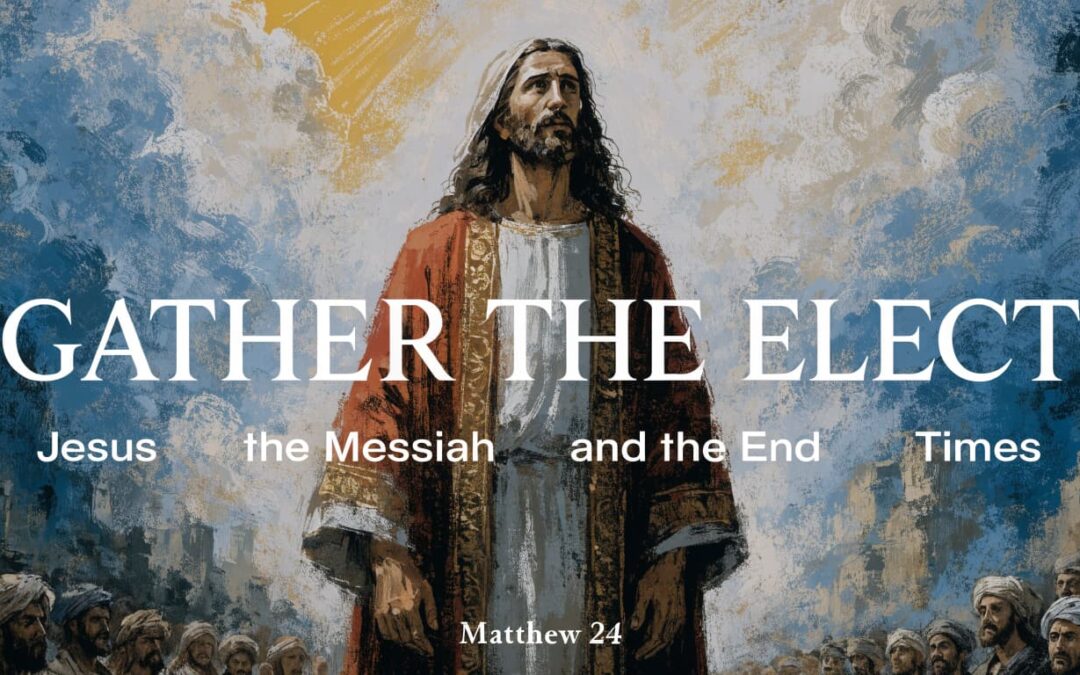
The Gathering of His People: Hope After Jesus’ Appearing
Gather the Elect: Matthew 24:29–31 holds two truths together: Jesus warns of tribulation, then promises that He will gather His people. Mark 13:24–27 gives a parallel account, with the same wide-reaching picture of the elect gathered from the four winds.
We'll stay close to what Jesus says while looking at the Old Testament echoes and the different ways Christians understand this gathering. The promise gives us hope, even though it doesn't settle every question about the timeline. Let's begin with the order Jesus describes in Matthew 24:29–31.
The Gathering of His People Comes After Jesus’ Appearing
Jesus places the gathering of His people after a hard series of warnings. That order matters. In the Olivet Discourse, hope does not come from pretending the trouble is absent; it comes from knowing that Jesus sees what His disciples face and promises to gather His own.

How the promise fits the warnings in the Olivet Discourse
In Matthew 24 in the NKJV, Jesus warns His disciples about false messiahs, deception, persecution, and tribulation. Mark's parallel account also warns of opposition and calls His followers to watch (Mark 13 in the NKJV). These warnings are not a footnote to the promise. They are the setting in which Jesus gives it.
Matthew records the sequence plainly: after the tribulation, signs appear in the heavens; the Son of Man comes with power and great glory; then He sends His angels to gather the elect with a trumpet. Mark gives the same basic order, placing the gathering after the tribulation and the appearance of the Son of Man. We should let that sequence speak for itself, without turning it into a detailed schedule the passages do not provide.
That is a steadying promise for disciples who may face fear, pressure, or confusion. Jesus does not tell them to treat every alarming claim as truth. He warns them about deception, calls them to watchfulness, and assures them that His people will not be beyond His reach. Christians differ on how this gathering relates to other passages about the end times, but the words here give us real hope: Jesus will gather His people.
For a closer look at the order Matthew records, see our discussion of Jesus' return after the tribulation.
What the angels, trumpet, and four winds communicate
Jesus says He will send the angels. They act under His authority, carrying out His command to gather the elect. The focus is not on speculation about angelic ranks or methods. The point is that Jesus directs the gathering, and His messengers do His bidding.
The great trumpet announces a momentous act of God. In Scripture, a trumpet can call people to attention or signal a decisive event. Here, Jesus connects its sound with the gathering. We should take that detail seriously without claiming it proves, by itself, a particular modern end-times timeline.
Then there are the four winds. The phrase conveys every direction, a picture of a gathering that reaches far beyond one place or community. Matthew says the elect are gathered from one end of heaven to the other. Mark adds that they are gathered from the farthest part of earth to the farthest part of heaven. The wording is sweeping, but neither account gives a travel map or explains every detail of how the gathering unfolds.
The details work together: Jesus commands, the angels gather, the trumpet announces, and no direction is out of reach. We can hold to that promise while remaining careful about what the text leaves unstated.
What Jesus Means by Gathering the Elect
When Jesus says He will gather the elect, He describes people chosen by God and kept within His reach. The verses make that promise clear, even though Christians differ about exactly who the elect are and how the gathering unfolds. We should hold tightly to what Jesus says, while being careful not to treat later conclusions as details the passage states directly.
The promise of a complete gathering from every direction
In Matthew 24:31, Jesus says He will send His angels to gather the elect from the four winds, from one end of heaven to the other. Mark's parallel adds that they will be gathered from the farthest part of earth to the farthest part of heaven (Mark 13:27). The language reaches in every direction. No distance, location, or hardship can place God's people beyond Jesus' reach.
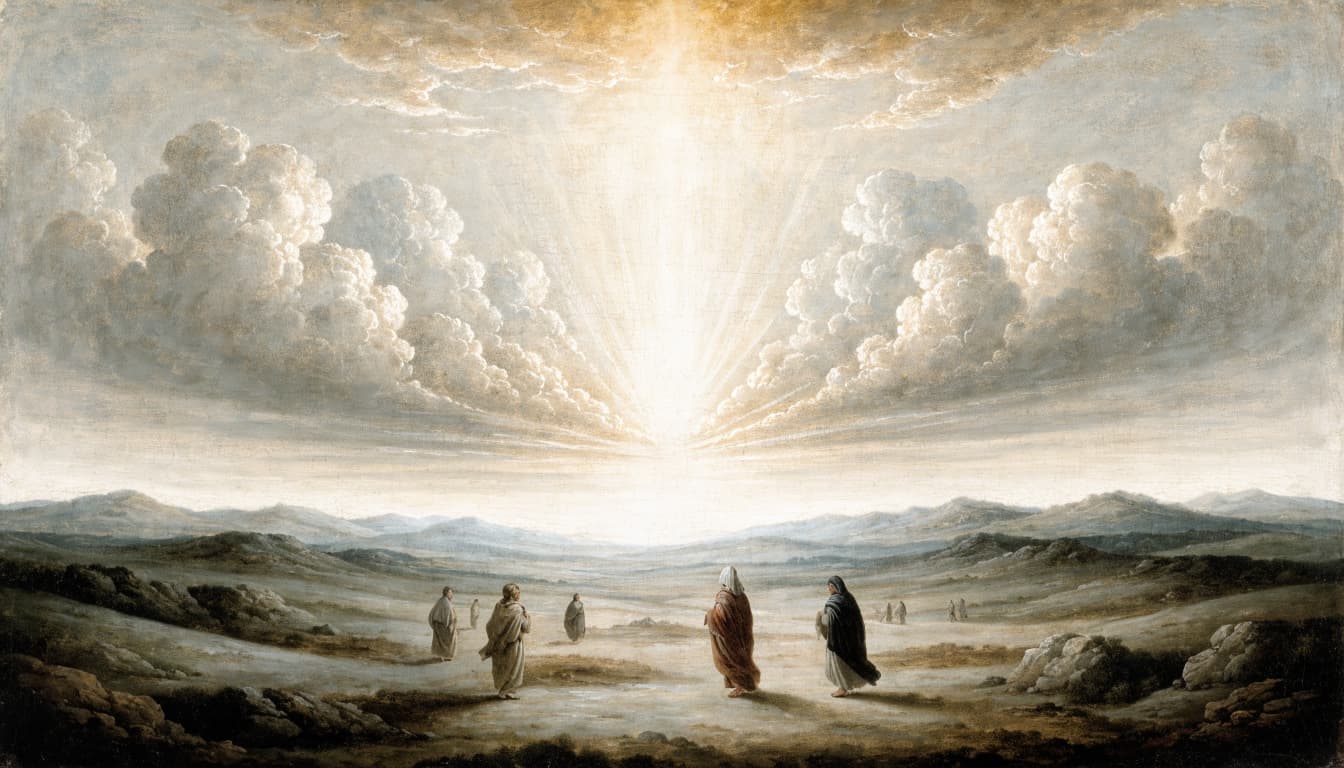
That matters when believers face pressure or feel scattered. Jesus does not promise here to explain every step or answer every question about how the gathering happens. He promises that He will send His angels and bring His people together. The certainty rests in His authority, not in our ability to map every detail.
The words also echo Israel's hope of restoration. In Deuteronomy 30:4, Moses speaks of God gathering Israelites who have been scattered even to the ends of heaven. That connection helps us hear the weight of Jesus' language. It does not, by itself, settle every question about the identity of the elect.
Why Christians differ about who the elect are
Jesus speaks to Jewish disciples whose Scriptures included promises of Israel's restoration. That setting matters. The gathering language also recalls Daniel's vision of the Son of Man, where He receives authority and a Kingdom. These Old Testament promises shape how we read the passage, but they do not force every Christian to reach the same conclusion about the elect's ethnic identity.
Some Christians understand the elect here primarily as Israel, and see the gathering in light of God's promises to restore His people. Others understand the elect as the church, gathered to Christ at His return. Still others use the term for the whole redeemed people of God, including Jewish and Gentile believers. Each reading tries to account for the passage's language and wider Biblical context.
What does Jesus state directly? He identifies the elect as those His angels will gather at His command. He does not explicitly say in these verses whether they are ethnic Israel, the church, or all God's redeemed people. That distinction helps us discuss the different views without confusing an interpretation with the words on the page.
We can explore the passage alongside Matthew 24's signs of Christ's return, while keeping the central assurance in view: Jesus knows those chosen by God, and no corner of creation lies beyond His reach.
Old Testament Promises Behind the Gathering
Jesus' words draw on prophetic images His disciples would have known: the Son of Man coming with the clouds, God's Kingdom, and scattered people gathered home. These echoes give the promise depth, but they don't answer every question about timing or the identity of the elect. We need to hear what the passages connect clearly, then leave room where interpretation differs.
Daniel’s Son of Man and the Kingdom
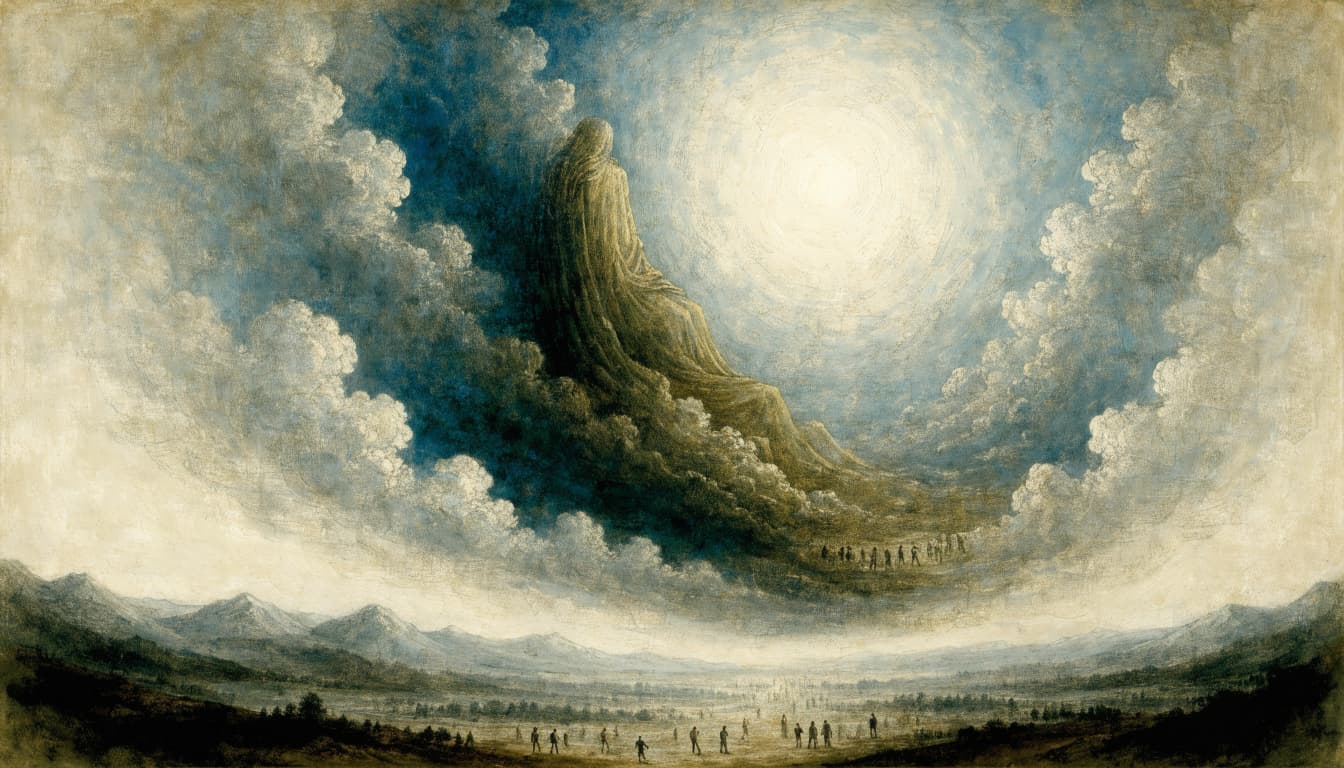
When Jesus speaks of the Son of Man coming with the clouds, He recalls Daniel's vision of the Son of Man. Daniel sees one like a Son of Man approach the Ancient of Days and receive dominion, glory, and a Kingdom that will not pass away. Jesus' language places His promise within that vision of divine authority and lasting rule.
But what does "coming with the clouds" emphasize? Christians have understood the connection in different ways. Some read Daniel's scene as the Son of Man's heavenly vindication and enthronement, His receiving authority from God. Others emphasize a public return, when people see Him coming in glory. Still others understand Jesus' words as a prophetic picture that joins His heavenly authority with His future appearing.
The Daniel connection is strong; one specific timeline is not settled by the phrase alone. We can affirm that Jesus speaks with the authority of the promised King without claiming that Daniel 7, by itself, resolves every debate about how His appearing unfolds. For more on the connection, see Daniel 7's vision of the Son of Man and His Kingdom.
Deuteronomy’s promise to gather the scattered
The "four winds" language also recalls God's promise in Deuteronomy 30:4. Moses speaks of Israelites scattered to the ends of heaven, then promises that God will gather them and bring them back. When Jesus says His angels will gather the elect from the four winds, that restoration language gives the image a clear Old Testament background.
This echo supports an Israel-restoration reading of Jesus' words. His disciples knew the promises to Israel, and the language of scattered people gathered from far away would have carried that hope. Still, an echo is not a complete definition. Deuteronomy 30:4 does not, by itself, settle whether Jesus means ethnic Israel, the church, or all God's redeemed people by "the elect."
The cosmic signs around the gathering raise a similar question about how prophetic language works. Darkened heavenly lights and shaken powers may be read as literal events, symbolic language for divine judgment, or imagery that carries both meanings. Scripture uses cosmic upheaval to describe moments when God acts decisively, but interpreters differ over how that imagery applies here.
So we should keep the strong connections in view without forcing them to answer what they don't say. Daniel points us to the Son of Man receiving the Kingdom; Deuteronomy recalls God gathering scattered Israel. Together, these promises help us hear the hope in Jesus' words, while leaving the debated details open.
How the Gathering Relates to the Rapture and Christ’s Return
Christians often connect Jesus' gathering of the elect with Paul's teaching about believers being caught up to meet the Lord. The passages share striking details, but they don't describe the events in exactly the same way. We should compare them carefully and avoid asking either passage to settle more than it says.
Why some connect Matthew 24 with the rapture
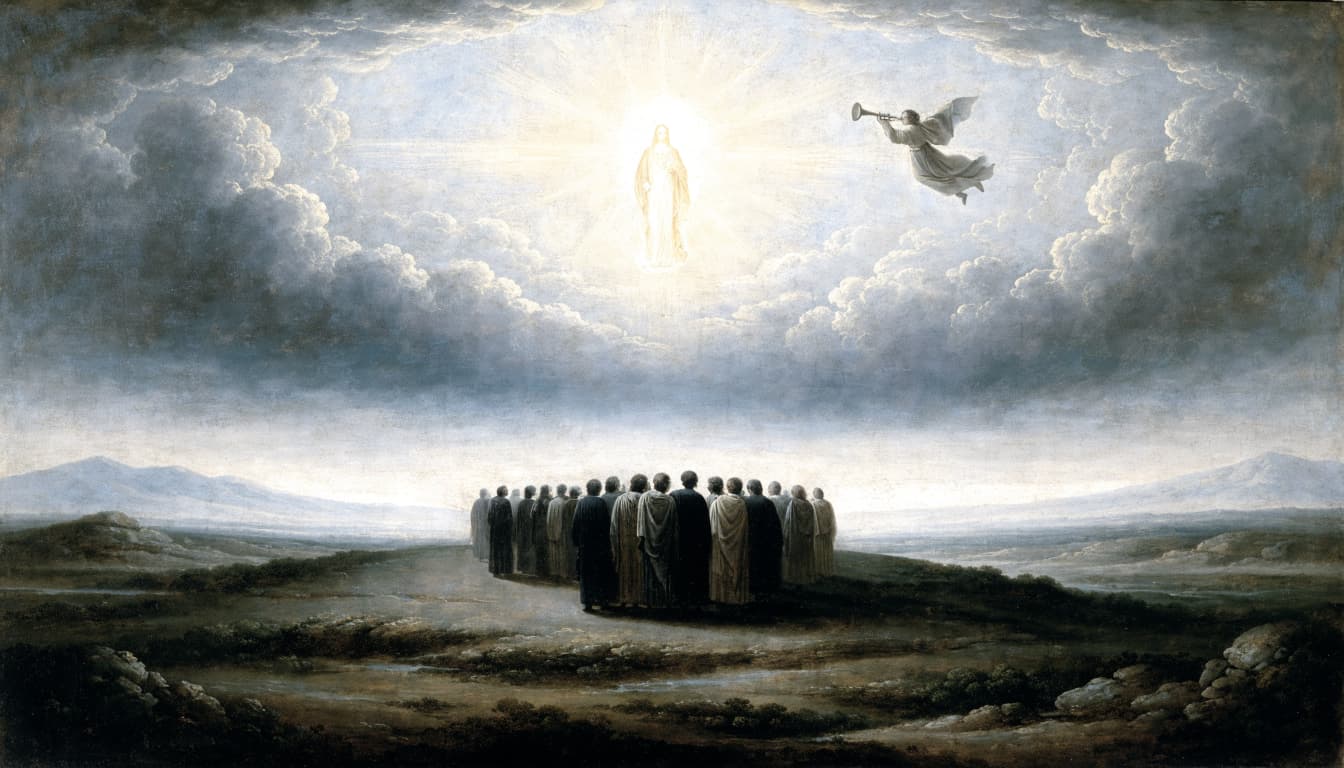
In Matthew 24:31, Jesus says He will send His angels with a great trumpet to gather the elect after the tribulation. Paul describes a related scene in 1 Thessalonians 4:16–17: the Lord descends, a trumpet sounds, the dead in Christ rise, and living believers are caught up to meet Him.
The overlap is easy to see. Both passages speak of the Lord's coming, a trumpet, and His people being gathered. Many Christians therefore understand Matthew's gathering as the rapture Paul describes, or as another account of believers meeting Christ at His visible return. For a discussion of how interpreters compare the passages, see this overview of 1 Thessalonians 4 and the rapture.
Other Christians see important differences. Matthew names angels and the elect, and places the gathering after the tribulation described in the discourse. Paul speaks explicitly of the dead in Christ rising and believers being caught up to meet the Lord in the air. Matthew 24:29–31 doesn't use the word rapture, or explain resurrection, translation, or a meeting in the air. Those details matter when we compare the passages.
How pretribulational and posttribulational readings differ
A posttribulational reading sees Matthew's sequence as consistent with believers being gathered at Jesus' return after tribulation: first the tribulation, then His visible coming, then the gathering. Christians who hold this view often connect the gathering in Matthew with the rapture in 1 Thessalonians, while recognizing that the passages emphasize different details.
Pretribulational interpreters commonly understand the church's rapture as an earlier event, distinct from the gathering Jesus describes in Matthew 24. Some also understand "the elect" here as Israel or believers who come to faith during the tribulation, rather than the church. These interpretations aim to account for Matthew's setting and sequence, but the passage doesn't explicitly identify the elect in those terms.
We can state what Matthew does clearly: the gathering Jesus describes follows the tribulation in this passage. Whether it is the same event as the church's rapture, or a distinct gathering, is part of the wider debate. Matthew 24:29–31 alone doesn't resolve that chronology, so we should distinguish the passage's direct claims from the larger framework we bring to it.
Whatever view we hold, the promise remains: Jesus will appear, and He will gather His people. We can read that assurance alongside the Biblical promise of Jesus' second coming without treating every debated detail as settled.
Jerusalem’s Destruction, Prophetic Imagery, and Future Hope
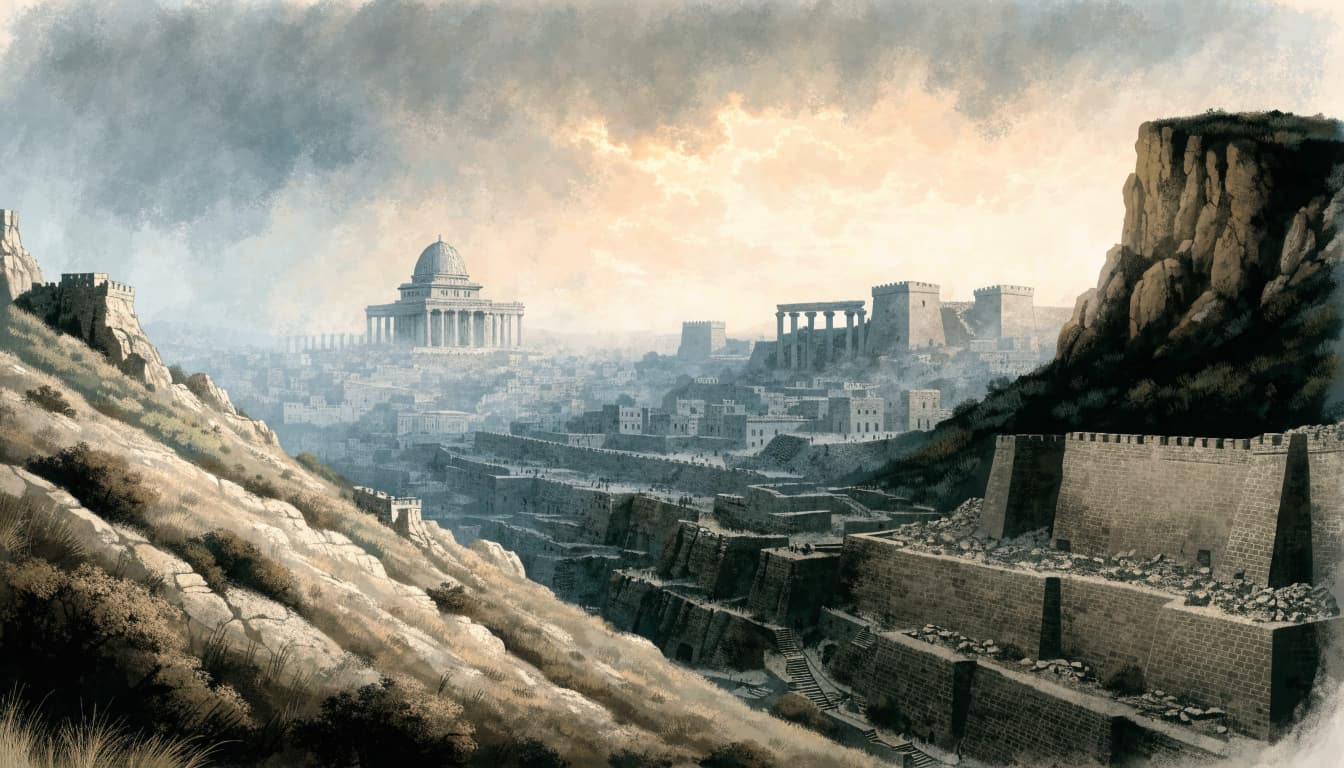
Jesus spoke about the Temple's destruction in a real historical setting, and Rome destroyed Jerusalem and the Second Temple in AD 70. The question is how that crisis relates to the cosmic signs, the Son of Man's coming, and the gathering of the elect. Christians read those parts differently, but the debate doesn't erase Jesus' promise.
What first-century readings emphasize
Preterist readings connect some or all of Jesus' words in Matthew 24:29–31 with Jerusalem's crisis and the Temple's fall. The word preterist refers to an interpretation that sees certain prophecies as fulfilled in the past. Some readers apply most of the discourse to the first century; others focus on particular signs and warnings.
In these readings, the darkened sun, falling stars, and shaken heavens are prophetic images of divine judgment, not necessarily a forecast of literal astronomical events. They also understand Daniel's Son of Man coming on the clouds as language of vindication or enthronement, rather than a visible descent to earth. That interpretation draws on Daniel 7:13–14, where the Son of Man approaches the Ancient of Days and receives dominion and a Kingdom.
This view takes the Temple's historical destruction seriously, but Christians differ on how much of Jesus' prophecy it explains. For a closer look at the first-century setting, see the Olivet Discourse and Jerusalem's fall in AD 70. A discussion of Matthew 24's focus on Jerusalem's destruction also presents a primarily historical reading.
Why some readers see both a historical and future horizon
Other Christians see AD 70 as a real judgment that also points beyond itself. Jerusalem's fall gives the warnings a concrete first-century fulfillment, while the language of Christ's appearing and the gathering of His people reaches toward a final consummation. The two horizons can belong together without making every detail a separate event on a simple timeline.
Jesus' prophetic language can hold more than one layer of meaning. A historical judgment may echo a future act of God, and an image of divine vindication may also speak to the hope of Christ's return. Yet the text doesn't draw a bright line telling us exactly where the first horizon ends and the final one begins. We should be careful about claiming more precision than the passage provides.
We can recognize the weight of Jerusalem's destruction and still look forward to Jesus' appearing. The interpretations differ, but the promise remains central: He will gather His people. We don't have to settle every question about AD 70 to trust His words or hold fast to the hope they give.
How This Promise Gives Believers Hope and Calls for Watchfulness
Jesus' promise gives us something firm to hold when persecution, upheaval, or uncertainty presses in. He will appear, send His angels, and gather His elect. We can trust those clear words without pretending every debated detail has been settled.
Hold firmly to what Jesus says and stay humble about what is debated
In Matthew 24:29–31, Jesus describes His appearing and the gathering of His elect. That is the promise we can affirm with confidence. His people will not be forgotten or left beyond His reach, even when the world around them feels shaken.
Christians differ over who the elect are in this passage and how the gathering relates to the church, Israel, and the timing of Christ's return. We can explain our convictions, but we should label an interpretation as an interpretation. The passage names Jesus, His angels, and the gathering; it does not spell out every part of a timeline.
That distinction makes room for conviction without turning disagreement into a test of faith. We can hold firmly to what Jesus said, pray for wisdom, and listen carefully when other believers read the debated details differently. Our hope rests in Christ's promise, not in having every end-times question answered.
Let future hope shape faithful living now
Jesus' promise is meant to strengthen disciples in the present. If you face pressure for your faith, remember that hardship does not mean Jesus has lost sight of you. He knows His people, and His word gives us reason to keep trusting Him when circumstances are painful or confusing.
So what does watchfulness look like? It isn't fearfully scanning every headline for a secret timetable. Jesus calls His followers to readiness, and we live that out through steady faith, love for others, prayer, and obedience. As Pentecostal believers, we also trust the Holy Spirit to strengthen us for faithful witness and service while we wait.
We should resist date-setting and sensational predictions. They can distract us from the work Jesus has given us today, and they claim certainty the passage does not provide. Jesus tells His disciples to watch, not to calculate what He has not revealed. His teaching on biblical prophecy keeps endurance and faithful living in view, while this commentary on watchfulness in Mark 13 considers Jesus' call to stay alert.
Hope and watchfulness belong together. We look forward to Jesus' return, and we remain faithful in the life He has placed before us. When trials come, we can pray, serve, love, and keep trusting Him. We do not know the day or hour, but we know the One who promised to gather His people.
Conclusion
After His appearing, Jesus promises to send His angels to gather the elect from every direction. The echoes of Daniel's vision and God's promise to gather His scattered people deepen that hope, even as Christians differ about how the gathering relates to Israel, the rapture, and Jerusalem's fall in AD 70.
We don't have to settle every debated timeline to trust what Jesus says. Our hope rests in His promise: He will gather His people. As we await Jesus' promised return, we can stay watchful and faithful.
The Hope of Christ’s Return
The Gathering of His People: Hope After Jesus Appearing
Jesus promised His disciples that He would come again and take them to be with Him (John 14:3). That promise reaches beyond the first believers to all who trust in Him. Bible prophecy presents His appearing not merely as an event to anticipate, but as the moment when the Lord gathers His people into His presence.
Paul urges believers to encourage one another with the assurance that, at the Lord’s coming, those who have died in Christ and those who remain will be united with Him (1 Thessalonians 4:16–18). For a church facing grief, waiting, and uncertainty, this is enduring hope: our future rests not in our ability to discern every detail of prophecy, but in the faithfulness of Jesus, who will not forget His own.

The Gathering of His People After Christ Appears
Jesus promised His disciples, “I will come again, and receive you unto myself” (John 14:3). That promise gives the gathering of His people its center: not a timetable to decode, but the returning Savior Himself. In Matthew 24:30–31, Jesus describes the Son of Man coming with power and great glory and sending His angels to gather His elect. Paul likewise writes that believers will be gathered to Christ at His coming (2 Thessalonians 2:1).
These passages direct our hope toward what Jesus has said He will do. 1 Thessalonians 4:16–17 speaks of those who belong to Christ being with Him, while 1 John 3:2 reminds us that when He appears, we shall see Him as He is. Read together, these promises call believers to watchfulness, faithfulness, and encouragement as we await the Lord who gathers His own.
“And if I go and prepare a place for you, I will come again, and receive you unto myself; that where I am, there ye may be also.” — John 14:3 (KJV)
Jesus’ own words anchor the hope of His return: He promises to receive His people so they may be with Him.
Hope Grounded in What God Has Promised
The promise that Christ will gather His people offers comfort because it rests on His word, not on our ability to predict when He will appear. Paul tells believers to “comfort one another with these words” after describing the Lord’s coming and His people being with Him (1 Thessalonians 4:13–18). Scripture gives us reason to grieve with hope, to remain steadfast, and to look toward Jesus.
Bible Prophecy Ministries is devoted to helping readers consider what Scripture says about prophecy—what has happened, what is promised, and how it all revolves around Jesus. Through articles that connect related passages and keep Christ at the center, the ministry seeks to encourage careful reading rather than speculation. The gathering of His people belongs within that mission: it is a promise to receive with humility, an encouragement to share, and a reminder that God is faithful to what He has spoken.
Frequently Asked Questions About the Gathering
Explore what Scripture says about Jesus’ appearing and the hope of being gathered to Him.
What does Scripture say about the gathering of Jesus’ people?
Jesus promises to receive His followers to Himself in John 14:2–3. Paul describes believers meeting the Lord and being with Him forever in 1 Thessalonians 4:16–17.
Who will be gathered to Jesus?
In 1 Thessalonians 4:16–17, Paul speaks of those who have died in Christ and those who belong to Him and are alive at His coming. Both share the promise of being with the Lord.
What does this promise mean for believers who have died?
Paul says the dead in Christ will rise first, assuring grieving believers that death does not separate them from the hope of Christ’s return (1 Thessalonians 4:13–16).
Why is the gathering a source of hope?
Its deepest comfort is not a timeline but a person: Jesus. Paul’s assurance is that His people will be with Him forever (1 Thessalonians 4:17–18).
Does Scripture give an exact date for Jesus’ appearing?
Jesus says that no one knows the day or hour (Matthew 24:36). Rather than setting dates, believers can remain watchful and faithful.
How should believers respond to this promise now?
Paul tells believers to encourage one another with these words (1 Thessalonians 4:18). Studying the passages in context can nurture hope and keep attention on Christ.
Hold Fast to the Hope of His Appearing
Read John 14:2–3 and 1 Thessalonians 4:13–18 for yourself. Reflect on the promise of being with Jesus, then explore more Bible prophecy articles centered on Him.