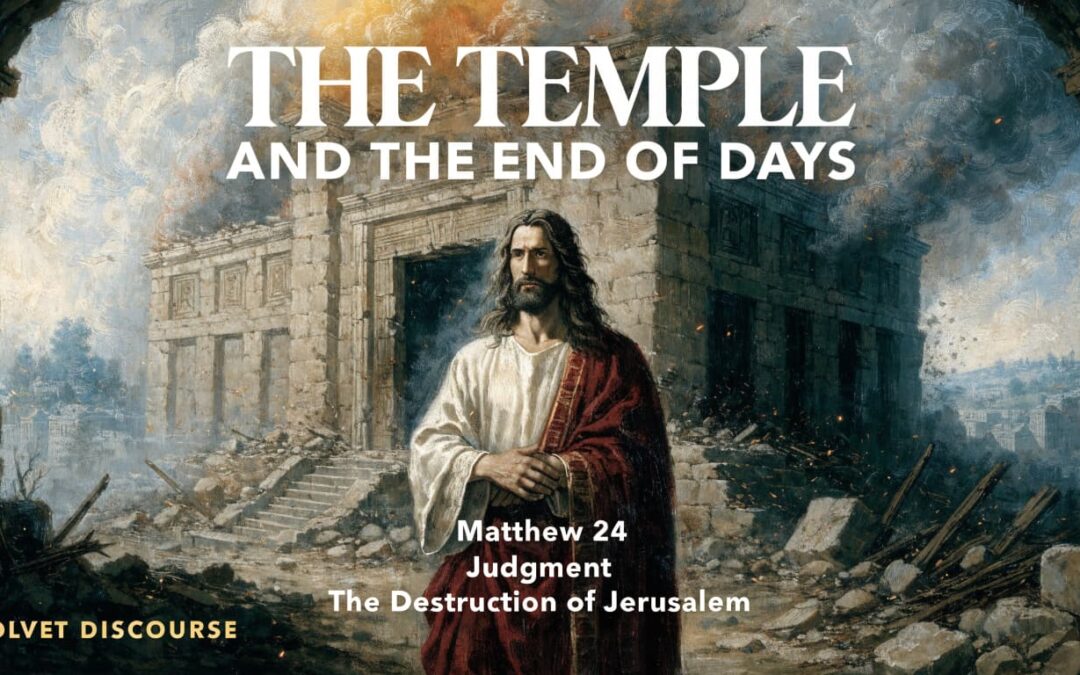
Matthew 24: The Temple’s Fall and the Mount of Olives
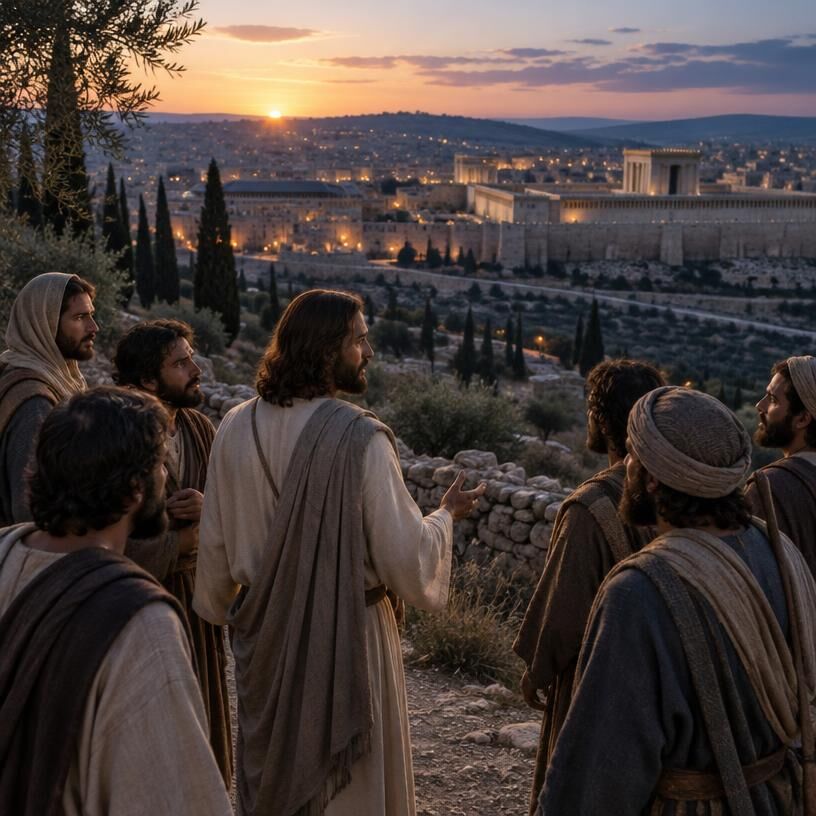
The disciples admired the Temple's impressive buildings, but Jesus told them that not one stone would be left upon another. As they left Jerusalem and went to the Mount of Olives, their questions opened into His teaching about judgment, His coming, and the end of the age.
What did Jesus mean, and how does the Temple's destruction in the first century fit with the signs He described? We'll look at the setting, consider the main ways Christians interpret Matthew 24, and ask what His words mean for faithful Christian life today.
Let's begin with why the move from the Temple to the Mount of Olives matters, and how the disciples' questions shape the discourse. We'll also look at Matthew 24 and the Olivet Discourse.
From the Temple to the Mount of Olives: Why the Setting Matters
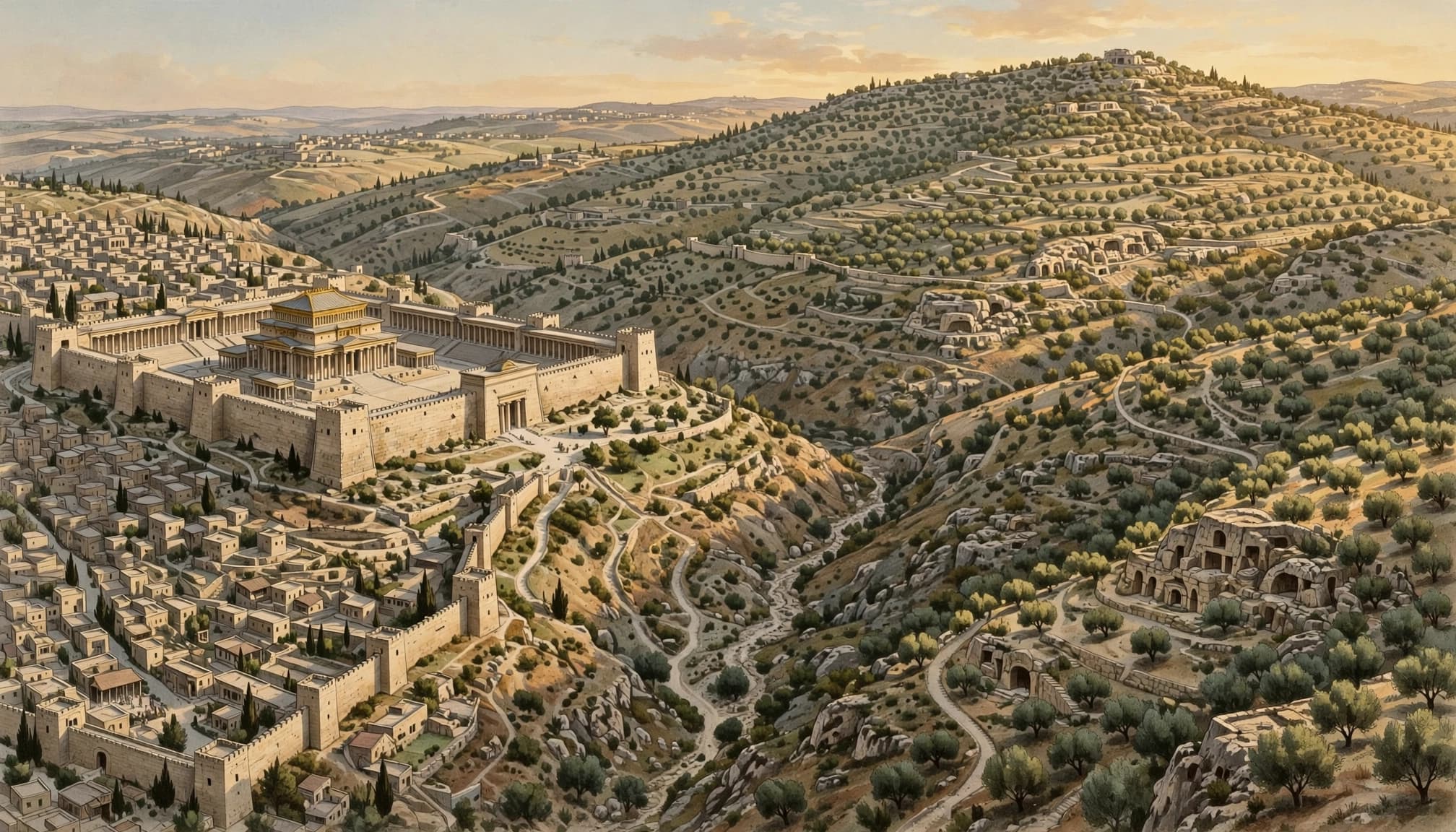
Matthew opens this teaching with a change of place, and that movement matters. Jesus leaves the Temple precincts after predicting its destruction. Soon after, He sits on the Mount of Olives, where His disciples ask what will happen and when. The setting connects their questions to the warning they have just heard.
The Temple prediction sets the conversation in motion
The disciples point out the Temple buildings, impressed by what they see. Jesus answers with a startling prediction: not one stone will remain upon another. You can read the full opening passage, Matthew 24:1-3 in the NKJV.
The Temple was central to Jerusalem's religious life. So when Jesus spoke of its destruction, the disciples had reason to ask what He meant and when it would happen. The prediction was not an abstract teaching about the distant future. It concerned a place they could see, a place they knew, and a loss that would reshape their world.
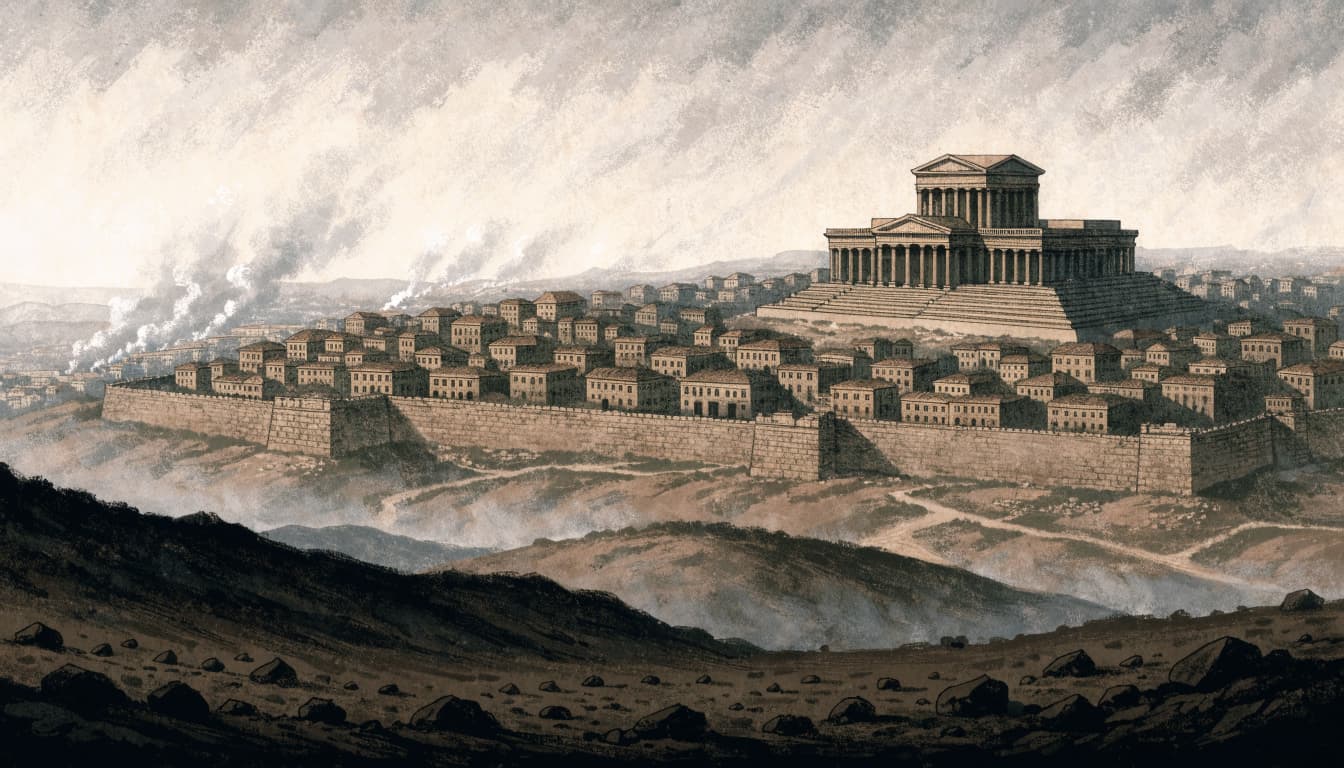
The Temple's destruction came during the Roman siege of Jerusalem in AD 70. That historical event gives the opening words real weight, though it does not settle how every later prophecy in the discourse should be understood. We need to keep the immediate setting in view without assuming it answers every interpretive question.
On the Mount of Olives, the questions widen
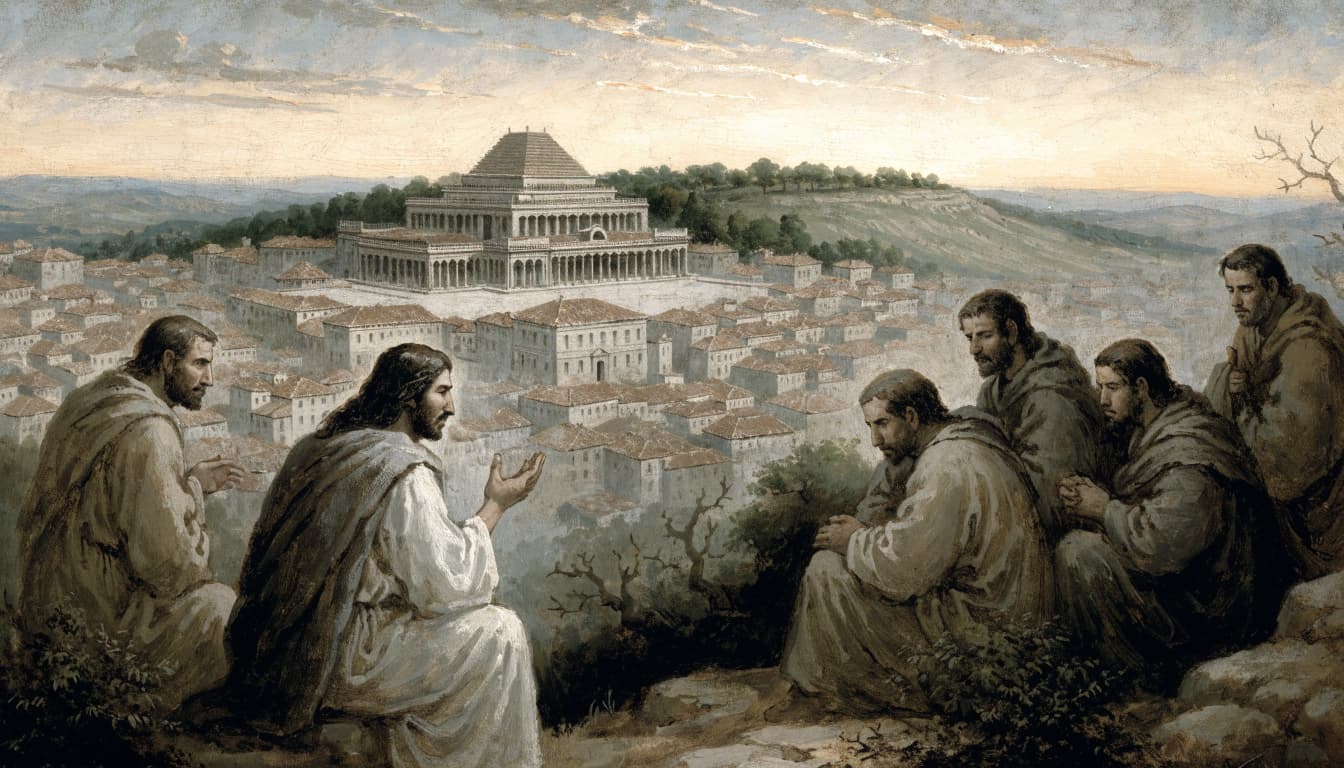
After leaving the Temple, Jesus sits on the Mount of Olives. From there, the disciples ask Him privately about "these things," His coming, and the end of the age. The move from the Temple to the hillside creates a natural link between Jesus' warning and their questions. They want to understand what His words mean, and what signs to watch for.
That connection matters when we read the disciples' questions. They may have understood the Temple's destruction, Jesus' coming, and the end of the age as parts of one sequence. Matthew presents them together, but we should be careful not to assume the disciples already understood how each event related to the others. Their questions show what they wanted to know, not necessarily what they had already worked out.
Matthew 24-25 is commonly called the Olivet Discourse, named for the place where Jesus teaches. The label helps identify the passage, but it doesn't decide how we should interpret every prophecy in it. Christians read some of these sayings differently, especially when they consider the Temple's fall alongside Jesus' future coming. We can begin with what the text makes clear: Jesus has just spoken about the Temple, and His disciples ask Him about that warning and what lies ahead.
For that reason, we should read the discourse with both the Jerusalem setting and the disciples' questions in mind. A guide to reading Biblical prophecy in context can help us keep those details together instead of rushing to a timeline before we hear the conversation.
What Matthew 24 Says About the Temple’s Destruction
Jesus' prediction about the Temple is the clearest starting point for understanding Matthew 24. The disciples saw an impressive complex; Jesus saw a place that would soon lie in ruins. What He said came to pass, but that historical fulfillment doesn't answer every question about the signs and His final return.
Jesus’ words in Matthew 24:1-2
After Jesus left the Temple, His disciples pointed out its buildings. He answered that not one stone would be left upon another. Read Matthew 24:1-2 in the NKJV.
That was a direct prediction of the Temple's destruction. The buildings were central to Jerusalem's religious life, so Jesus' words would have sounded shocking. He wasn't speaking in vague terms about change or decline. He said the Temple would be torn down.
The Roman siege and the Temple’s fall
Roman forces destroyed the Second Temple during the siege of Jerusalem in AD 70, under the command of Titus. The Encyclopaedia Britannica account of the siege describes the Roman capture of the city and the destruction of the Temple. We can connect that event to Jesus' prediction without assigning a precise day or treating every detail of Matthew 24 as settled.
Luke's account gives a more explicit picture of Jerusalem under attack. Jesus speaks of the city surrounded by armies, a sign that its desolation is near. You can read Luke 21:20-24 in the NKJV. Many readers connect these words with the Roman siege and the captivity that followed.
The event also appears in other Biblical discussions of Jerusalem's fall. For example, Daniel's prophecy and the events of AD 70 considers how interpreters connect the destruction of the city and sanctuary with Daniel's words.
What the destruction does, and does not, establish
Jesus clearly predicted the Temple's destruction, and AD 70 provides a historical fulfillment of that warning. But Matthew 24 also includes questions about signs, the end of the age, and the coming of the Son of Man. Christians differ on how those passages relate to Jerusalem's fall. Some understand much of the discourse as focused on first-century events; others see the Temple's destruction alongside signs that still point to Christ's future return.
We shouldn't force every part of the chapter into one timeline simply because the Temple fell. Nor should we ignore the historical setting Jesus gave His words. The Temple's ruin confirms the seriousness of His warning, while the harder questions call us to keep reading and handle Scripture carefully.
How to Read the Signs and Warnings in Matthew 24
Matthew 24 moves through warnings, hardship, witness, and the coming of the Son of Man. Read the full chapter in the NKJV, and notice how often Jesus calls His disciples to stay watchful rather than guess at dates. We can follow the passage's main themes without forcing every sign into a timetable.
Jesus warns against deception and panic
Jesus begins by warning His disciples not to be deceived. False messiahs will claim authority in His name, and wars, rumors of wars, famines, and earthquakes will follow. But He says these events are not, by themselves, proof that the end has arrived (Matthew 24:4-8).
That warning still matters. A confident voice, a dramatic prediction, or a headline about conflict can stir fear, but Jesus tells His followers not to run after every claim. He gives them a way to respond: stay alert, test what they hear, and refuse to confuse upheaval with a date on God's calendar.
Persecution calls for endurance and witness
Jesus also speaks plainly about persecution. His followers will face hatred, betrayal, and false prophets; some will grow cold in their love. Yet He says the one who endures to the end will be saved (Matthew 24:9-13). Endurance here is faithful obedience through pressure, not an attempt to calculate how close we are to the final day.
Then comes a mission that reaches beyond the immediate crisis: the Gospel of the Kingdom will be preached in all the world as a witness to all nations (Matthew 24:14). The Holy Spirit empowers believers to testify, even when opposition rises. We should hear this as both a promise and a call to faithful witness, not as permission to turn every world event into a countdown.
The abomination of desolation points back to Daniel
Jesus next names the "abomination of desolation" and points His listeners to Daniel the prophet (Matthew 24:15-22). The phrase recalls Daniel's visions of desecration and judgment, and Christians differ on how its timing relates to Jerusalem's fall and events still to come. Daniel's prophecy about the weeks and desolation offers a closer look at that connection.
Jesus' immediate instruction is practical: when danger comes, those in Judea should flee. He also warns against claims that the Messiah has appeared in a hidden place. The warning against deception remains clear, even where readers disagree about how each prophetic detail is fulfilled.
The coming of the Son of Man is not a date to set
Jesus describes cosmic signs and the coming of the Son of Man in glory (Matthew 24:29-31). Christians differ on how these images relate to Jerusalem's destruction in AD 70 and Christ's future return. We should acknowledge that disagreement without softening the passage's central point: Jesus will come with power, and His people must be ready.
The fig tree teaches His disciples to recognize what is near, but Jesus also says no one knows the day or hour (Matthew 24:32-36). That leaves no room for confident date-setting. We read the signs with care, hold fast to His words, and keep serving while we wait.
How Matthew 24 Fits With Mark 13 and Luke 21
Matthew 24 belongs beside Mark 13 and Luke 21, but the three accounts aren't interchangeable. Each records Jesus' warning about the Temple and the disciples' questions, then develops the teaching with its own details and emphasis. Reading them together helps us see the shared message without blending the Gospel writers' distinct accounts.
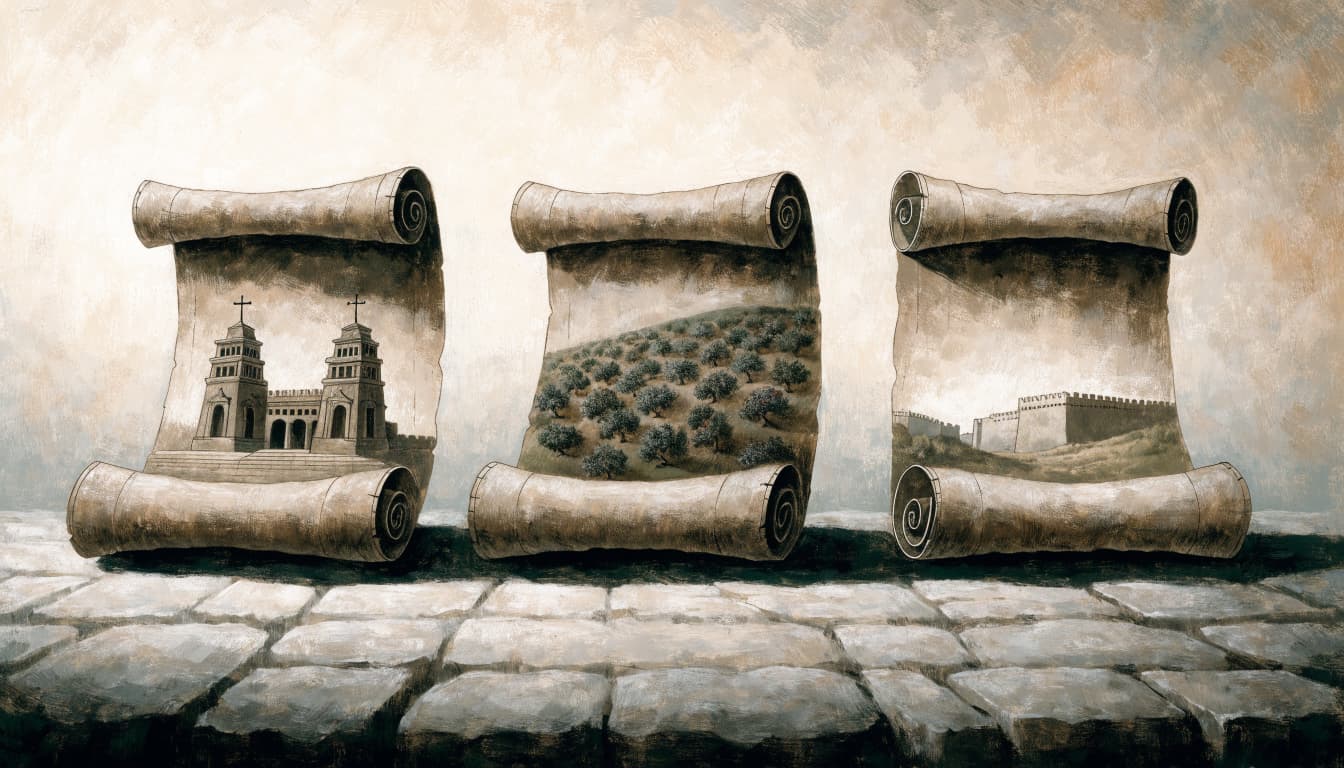
The three accounts begin with the same shock
In Matthew 24:1-3 in the NKJV, Jesus predicts the Temple's destruction, then sits on the Mount of Olives. His disciples ask privately about the timing, His coming, and the end of the age. Mark records a similar scene in Mark 13:1-4 in the NKJV, naming Peter, James, John, and Andrew as the disciples who ask Him.
Luke opens with the same Temple prediction and a question about timing and signs in Luke 21:5-7 in the NKJV. He doesn't name the Mount of Olives or identify the questioners. That difference matters. We should let Luke's account speak in Luke's terms instead of importing every detail from Matthew and Mark.
Shared warnings, distinct details
All three accounts warn about deception, upheaval, persecution, and the need to endure. Matthew gives more space to the proclamation of the Kingdom among the nations and to Jesus' teaching on watchfulness. Mark emphasizes the disciples' witness under pressure, including the Holy Spirit's help. Luke stresses endurance and describes Jerusalem surrounded by armies, followed by captivity and the times of the Gentiles (Luke 21:20-24 in the NKJV).
Those details fit together, but they aren't identical. Luke's description of armies surrounding Jerusalem gives readers an explicit picture of the city's crisis. Matthew and Mark instead use the phrase "abomination of desolation" and connect it with Daniel. We can compare these passages while still respecting how each Gospel presents Jesus' words. For a broader overview of their relationship, see this explanation of the Olivet Discourse.
Why the differences help us read Matthew
Matthew's account is the fullest of the three and continues into chapters 24 and 25, where Jesus teaches about readiness, faithfulness, and judgment. Mark ends with a short, direct call to watch. Luke closes by urging His followers to stay alert and pray. The shared call is clear: Jesus' disciples must remain faithful, not panic or chase every claim about the end.
The differences also warn us against forcing one interpretation onto every detail. Christians disagree about how the Temple's fall in AD 70 relates to the coming of the Son of Man and the end of the age. Reading the accounts in their original Biblical context helps us keep both the shared teaching and each Gospel's distinct emphasis in view. We can compare Scripture carefully, trust Jesus' warning, and hold fast to what He made plain: no one knows the day or hour, so His people must be ready.
Three Main Views of the Olivet Discourse
Christians agree that Jesus warned His disciples about Jerusalem, deception, suffering, and His coming. The disagreement is about how those events fit together. When we read Matthew 24 in the NKJV, three broad approaches help explain why sincere believers reach different conclusions.
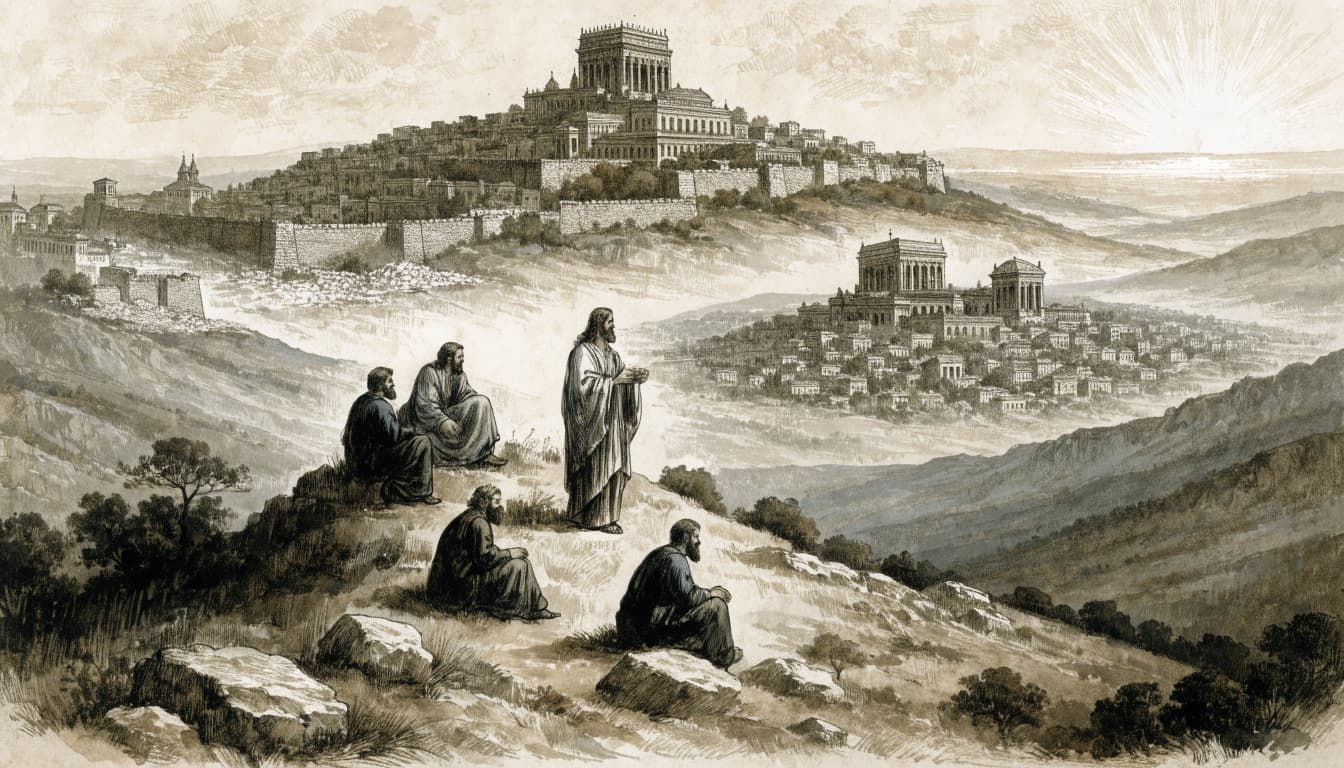
The preterist view focuses on the first century
A preterist, or largely historical, reading sees much of the discourse as referring to the Jewish revolt and Jerusalem's destruction in AD 70. It connects Jesus' warning about the Temple with the crisis that came within the disciples' generation. Some interpreters also understand the cosmic language as prophetic imagery for judgment on Jerusalem, rather than a description of the world's final end.
This view takes the Temple setting and Jesus' warning seriously. It also gives weight to the phrase "this generation." The question it raises is how to understand the Son of Man's coming and the end-of-the-age language if much of the passage was fulfilled in the first century. Christians who hold this view answer that question in different ways.
The futurist view looks ahead to Christ’s return
A futurist reading understands the discourse as pointing mainly to events that will happen before Jesus' future return. Many futurists recognize that the Temple's destruction in AD 70 fulfilled Jesus' prediction, while seeing later signs, including the abomination of desolation, as awaiting a further fulfillment.
This approach keeps the final coming of Christ in clear view and reads the signs as events that precede it. But it must also account for the disciples' immediate question about the Temple and Jesus' words about "this generation." Futurists differ on how to connect those first-century details with events still to come.
A combined view sees near and future fulfillment
A partial-preterist, or "near and far," approach connects parts of the discourse with Jerusalem's fall while also seeing the final coming of Christ as future. In this reading, AD 70 is a real fulfillment of Jesus' warning, and it may also foreshadow a final judgment. The approach holds the historical setting and future hope together, though Christians still differ about where one emphasis ends and the other begins.
These labels can help us follow the discussion, but they don't settle every detail. Pentecostals don't all share one interpretation, either. Some are futurist; others favor a historical or combined reading. Our Spirit-filled perspective can keep mission, witness, and readiness in focus without turning one interpretation into the only Pentecostal position. Jesus calls His followers to proclaim the Kingdom and remain watchful, even as Christians debate the timing and fulfillment of particular signs.
We can examine each view by asking what it explains well and what questions it leaves open. These principles for studying Biblical prophecy can help us weigh the setting, the language, and the wider teaching of Scripture without claiming more certainty than the passage gives us.
What Jesus’ Teaching Means for Christian Readiness Today
Jesus' teaching in Matthew 24 isn't an invitation to panic or build a countdown chart. He warns about deception, suffering, and upheaval, then tells His followers to remain faithful. The details of prophecy matter, but so does the way we live while we wait.
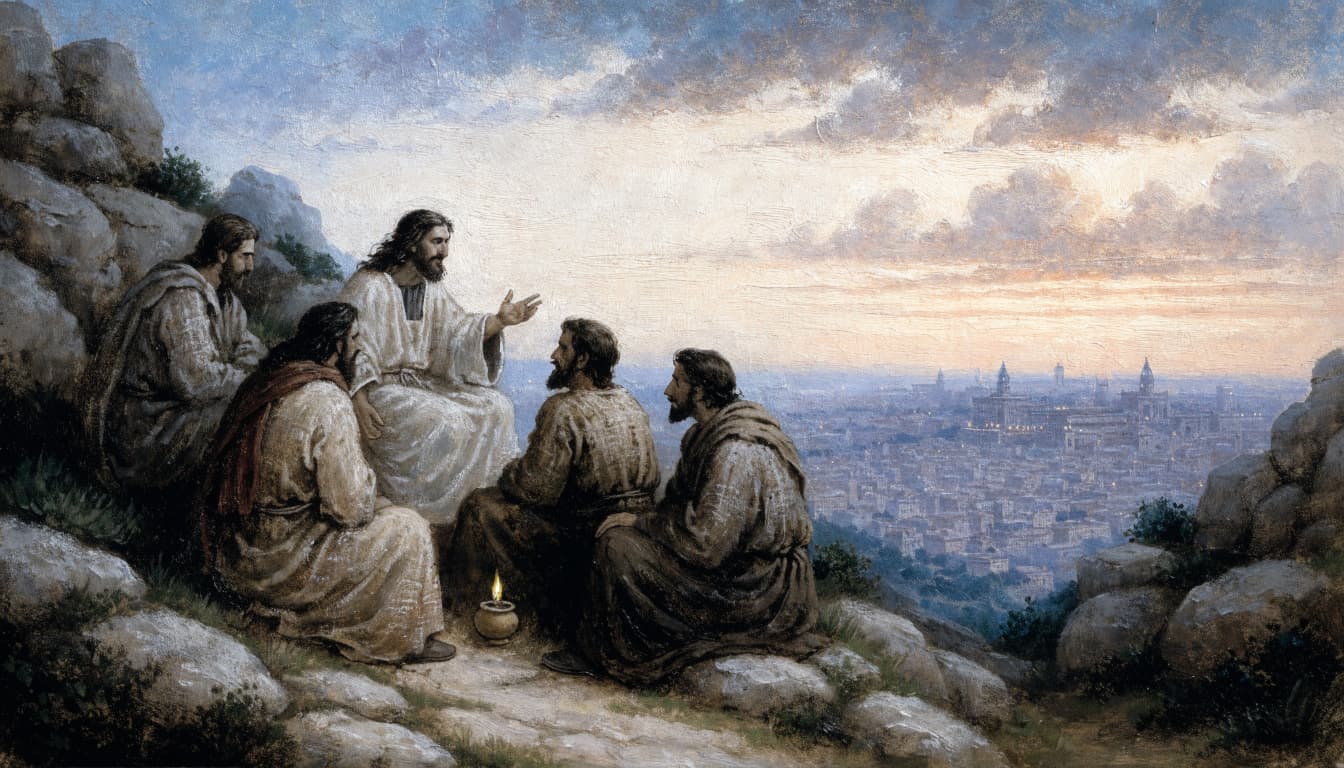
Readiness means staying faithful, not setting dates
Jesus tells His disciples to watch because they don't know when their Lord will come (Matthew 24:42). That instruction leaves no room for confident date-setting. When someone claims to know the day, or turns every crisis into proof that the end has arrived, we should return to Jesus' words and test the claim carefully.
Readiness is a daily posture. We keep following Christ, resist deception, and carry on with the work He has given us. Matthew's next chapter makes that call concrete through parables about servants who remain faithful and people who are prepared for the bridegroom. Jesus wants alert disciples, not frightened ones.
Discernment, endurance, and witness belong together
Jesus warns that false messiahs and false prophets will mislead people. Discernment matters, especially when a teaching stirs fear or promises secret knowledge. We can measure claims against Scripture, pray for wisdom, and refuse to pass along predictions simply because they sound urgent.
He also prepares His followers for opposition and hardship. In Matthew 24:13, Jesus speaks of enduring to the end. For Spirit-filled Christians, endurance doesn't mean withdrawing from the world until prophecy is fulfilled. The Holy Spirit empowers us to remain faithful and bear witness, even under pressure. Jesus says the Gospel of the Kingdom will be proclaimed among the nations (Matthew 24:14). That mission continues while we wait.
Pentecostals hold different views about how particular prophetic details fit together. We can acknowledge those differences without letting them distract us from Jesus' clear commands: stay watchful, endure, and testify to the Gospel.
Prayer keeps watchfulness grounded
Watchfulness can become fear if we focus only on danger. Jesus' teaching points us toward prayerful faithfulness instead. Luke's account closes with a call to watch and pray, a reminder that readiness is lived before God, not performed for an audience.
So we pray for discernment, ask the Holy Spirit to strengthen our witness, and keep serving our neighbors. We can study the signs without letting speculation take over our faith. Jesus, the faithful and true King remains our hope, and His call to readiness is a call to follow Him today.
Conclusion
The Temple's destruction in AD 70 gives historical weight to Jesus' warning. But Matthew 24 also shows how the disciples' questions opened into a larger conversation about His coming and the end of the age. Their move from the Temple to the Mount of Olives reminds us to read His words in their setting and take His call to readiness seriously.
We can hold fast to Jesus, study Scripture carefully, and keep bearing witness through the Holy Spirit. The future belongs to Him, so we can remain watchful without giving in to fear. Learn more about the fall of Jerusalem and the Temple in AD 70.
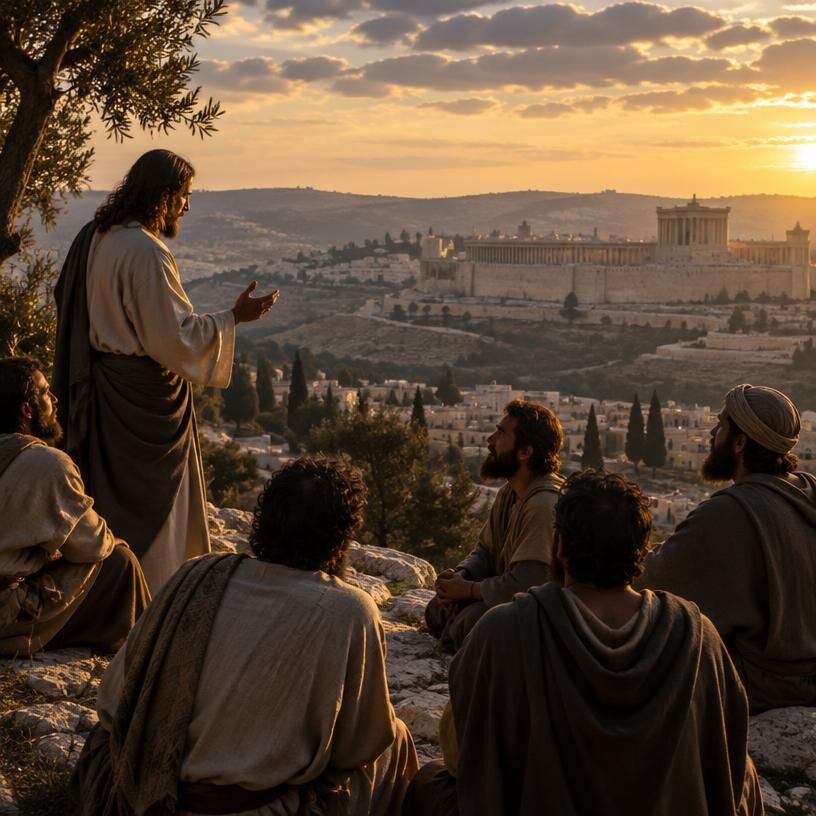
A Prophecy Spoken Across from the Temple
As Jesus left the temple, He told His disciples that its magnificent stones would be thrown down. Later, seated on the Mount of Olives, He answered their questions about when these things would happen and what signs would accompany His coming and the end of the age. Matthew 24 begins with a real place and a startling prediction, then draws readers into a wider conversation about judgment, watchfulness, and hope in Christ. This article follows that setting and Jesus’ words carefully, distinguishing the temple’s fall from the questions His disciples asked about what comes next.
Why the Disciples Asked About the Temple
As Jesus left the temple in Jerusalem, His disciples drew His attention to its impressive buildings. The temple stood at the center of Jewish worship, making His response startling: not one stone would be left upon another (Matthew 24:1–2). Later, seated on the Mount of Olives, the disciples asked when this destruction would happen and what sign would mark His coming and the end of the age. Their questions grew out of a specific prediction about a place they knew and a larger hope for God's Kingdom. Bible Prophecy Ministries examines this passage in its historical setting while keeping its mission in view: tracing what Scripture says has happened, what is yet to come, and how prophecy points to Jesus.
Signs to Recognize, Warnings to Remember
- Deceivers will claim to speak for Christ; do not be misled.
- Wars and rumors of wars are not, by themselves, proof that the end has arrived.
- Famines and earthquakes are described as the beginning of birth pains.
- Jesus warns His followers to expect persecution and betrayal.
- Lawlessness will grow, yet His disciples are called to endure.
- The Gospel of the Kingdom will be proclaimed throughout the world.
- Jesus points to the abomination of desolation and calls readers to understand.
- Those in Judea are told to flee when the warned-of crisis comes.
- False messiahs and false prophets may perform signs to deceive.
- Christ's coming will not be a hidden event known only to a few.
- The fig tree illustrates the need to recognize what is near.
- Jesus says His words will endure even when heaven and earth pass away.
- Read the temple prediction alongside the disciples' questions.
- Distinguish Jesus' stated signs from modern guesses about their fulfillment.
- Do not turn headlines into a calendar for His return.
- Remember that no one knows the day or hour.
- Stay watchful rather than assuming there is plenty of time.
- Live faithfully in the responsibilities entrusted to you.
“Therefore you also must be ready, for the Son of Man is coming at an hour you do not expect.”

Jesus Christ
Matthew 24:44 (ESV)
The Temple’s Fall and the Mount of Olives
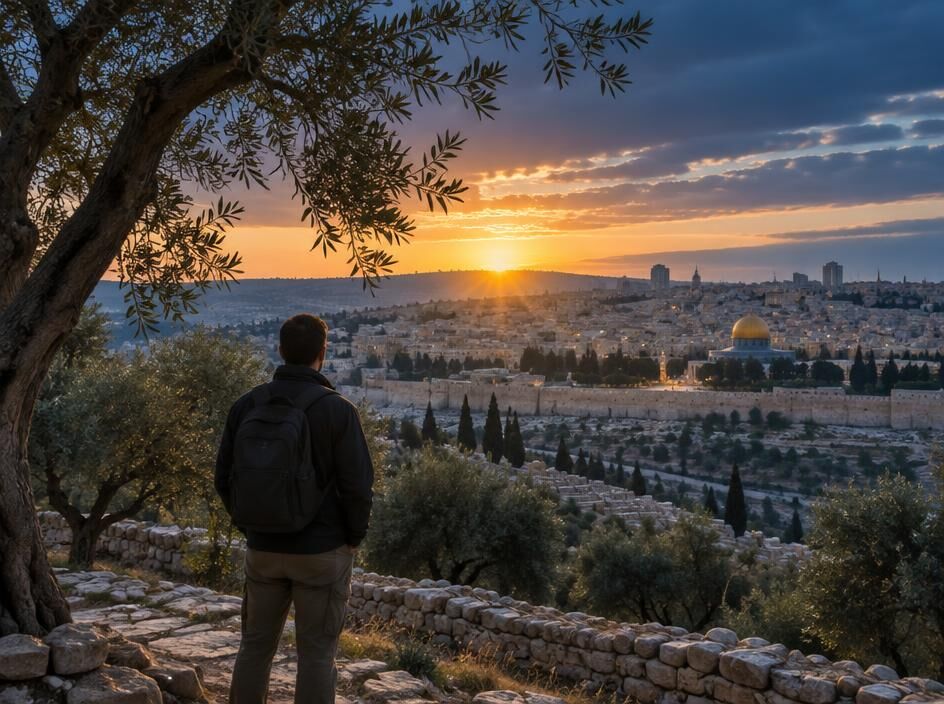
A Question About the Temple
When Jesus foretold the temple’s destruction, His disciples asked what lay ahead. Matthew 24 begins with His answer on the Mount of Olives.
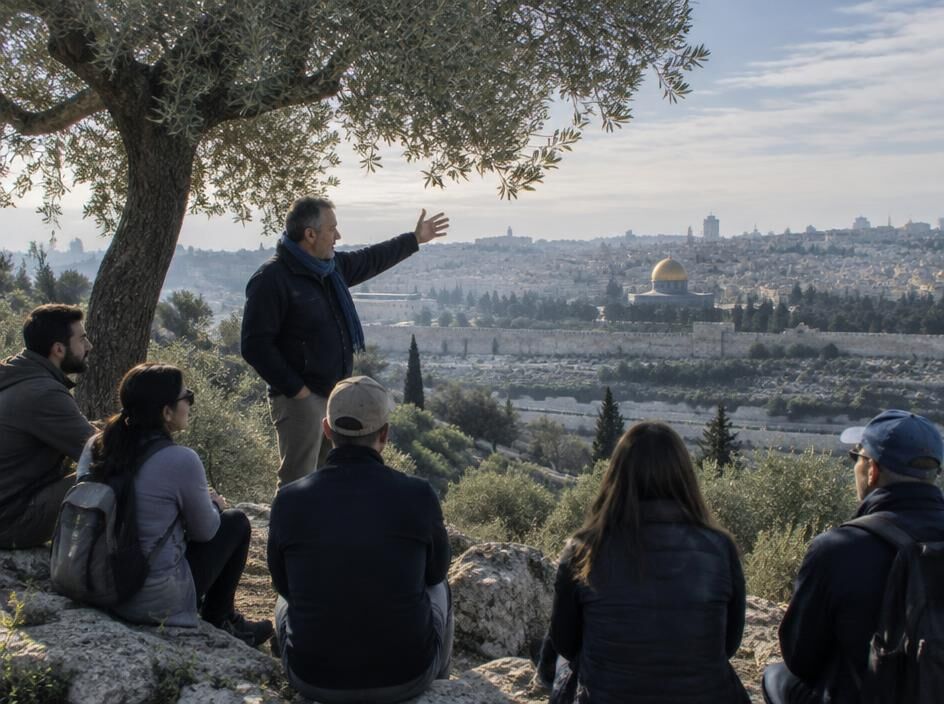
Prophecy Through Jesus’ Words
Jesus spoke of coming trials, warned against deception, and called His followers to remain watchful and faithful.
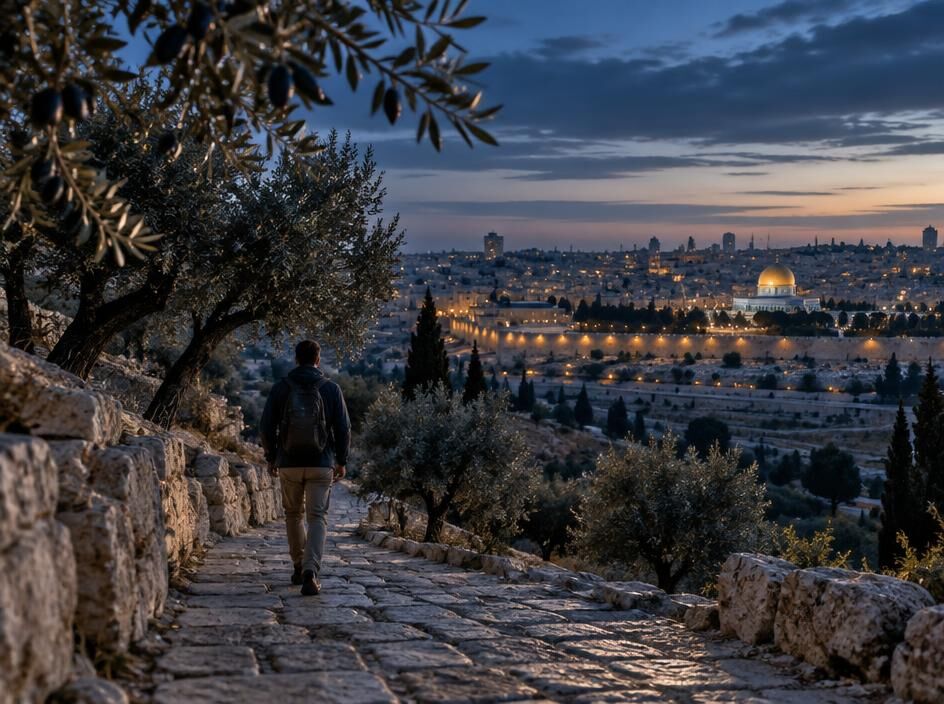
Hope Centered on Christ
The Olivet Discourse points beyond unsettling events to Jesus Himself—the One whose words endure and whose return gives believers hope.
Read Matthew 24 with Jesus at the Center
Open Matthew 24 and follow Jesus’ teaching from the Mount of Olives. Then explore more Bible prophecy articles that connect Scripture’s promises and warnings to Him.