
Matthew 24:1–3 Explained: The Temple Warning and Jesus’ Coming
Jesus' warning about the Temple opens the teaching we call the Olivet Discourse. As He leaves the Temple, His disciples point out its buildings, and He tells them they'll be torn down.
On the Mount of Olives, they ask when this will happen, what sign will mark His coming, and what He means by "the end of the age." We'll look closely at what Matthew says, the setting behind His words, and why Christians understand their prophetic meaning in different ways. Our Spirit-filled Pentecostal faith holds fast to Jesus' words while distinguishing Biblical text from interpretation.
Read Matthew 24:1–3 in the NKJV, then let's begin with the Temple warning that prompted the disciples' questions. For more on Matthew 24:1–3 and the disciples' questions, we'll keep the passage's setting in view as we go.
Matthew 24:1–3: The Temple Warning and the Questions
Matthew moves quickly through this exchange, but the order matters. Jesus predicts the Temple's destruction, and the disciples respond with questions about timing, His coming, and the end of the age. We should keep that sequence in view before deciding whether Matthew presents one event or several.
Why the disciples pointed out the Temple buildings
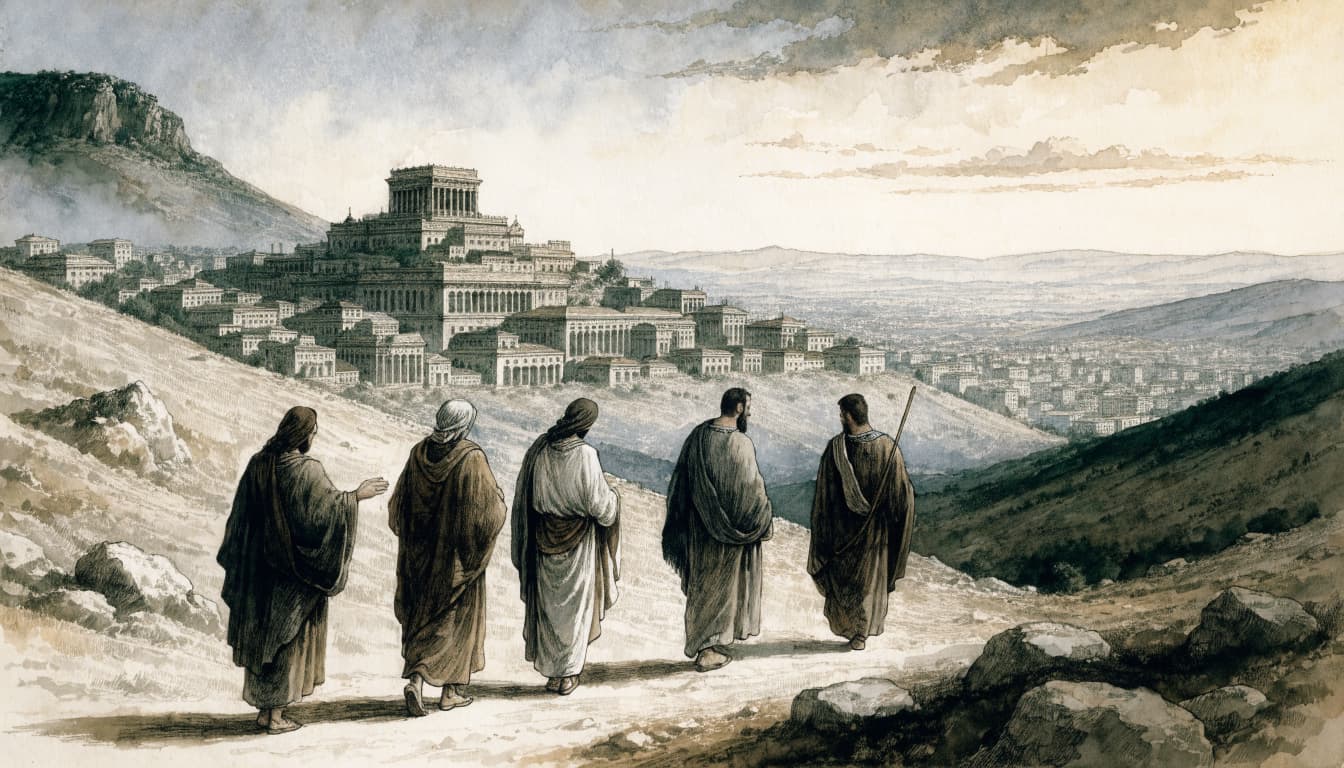
As Jesus leaves the Temple, His disciples point out its buildings. We can understand why they draw His attention to them. The Temple was Jerusalem's central place of worship and a visible part of the city's religious and public life. For the disciples, its apparent permanence made Jesus' prediction all the more startling.
The moment also follows the confrontations and teaching in Matthew 21–23. Jesus enters Jerusalem, teaches in the Temple, answers challenges, and speaks against the religious leaders' hypocrisy. We can read Matthew 21 in the NKJV as the earlier part of that setting. By the time Jesus departs, the Temple is already tied to the larger conflict over His authority and Jerusalem's response to Him.
Still, Matthew doesn't tell us exactly what the disciples had in mind when they pointed out the buildings. He simply records their gesture, then Jesus' answer. That answer changes the conversation.
What Jesus says about the Temple’s stones
Jesus tells them that the buildings will be thrown down, with "not one stone" left upon another. The words are direct and severe. A place associated with worship and public life would face destruction. Jesus doesn't soften the prediction or describe it as a minor disruption.
But verse 2 doesn't answer every question the disciples will ask. At this point, Jesus has announced what will happen to the Temple. He hasn't yet explained when it will happen, what signs will precede it, or how the prediction relates to His coming and the end of the age.
That distinction matters. The disciples' questions in verse 3 follow the Temple warning, but readers still have to consider how each question relates to the others. Matthew gives us the connection; he doesn't settle every interpretive question in these three verses. We'll keep that difference between what the text states and what we infer as we read on.
Why the Mount of Olives setting matters
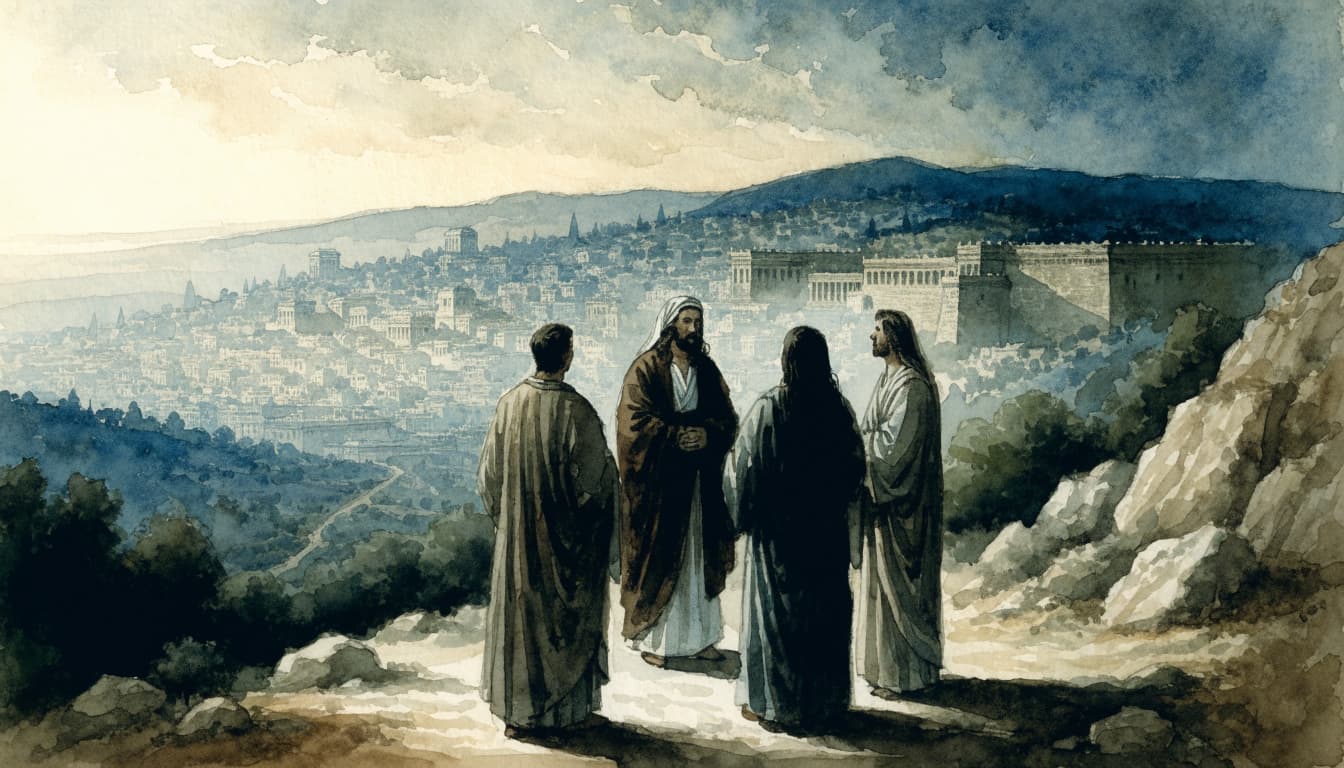
After leaving the Temple, Jesus sits on the Mount of Olives. There, the disciples approach Him privately and ask when "these things" will happen. They also ask about the sign of His coming and the end of the age. The setting links their questions to His prediction: "these things" most immediately points back to the Temple's destruction.
Matthew records the questions together, but he doesn't tell us whether the disciples expected all the events to happen at once. Nor does the location alone settle the meaning of the prophecy. It gives us the scene and the sequence, while Jesus' full answer supplies more context.
So we begin with the clearest point: Jesus' Temple prediction prompted the conversation. The disciples ask how to understand what He has just said, and their wording opens questions that Christians continue to examine. As we consider Matthew 24's signs and the disciples' questions, we'll keep the Temple warning at the center of the discussion.
The Temple’s destruction and its first-century setting
To hear the weight of Jesus' warning, we need to picture what the Temple meant to the people who heard Him. It was more than an impressive building. Its destruction would shake Jerusalem's religious and public life, and it would become a defining event in the history of the first century.
The Second Temple in Jewish life
The Temple in Jesus' day was the Second Temple, extensively renovated and expanded under Herod the Great. It was Jerusalem's central sanctuary, where Jewish worship and sacrifice took place. The Temple also shaped the city's public life and stood at the heart of Jewish identity.
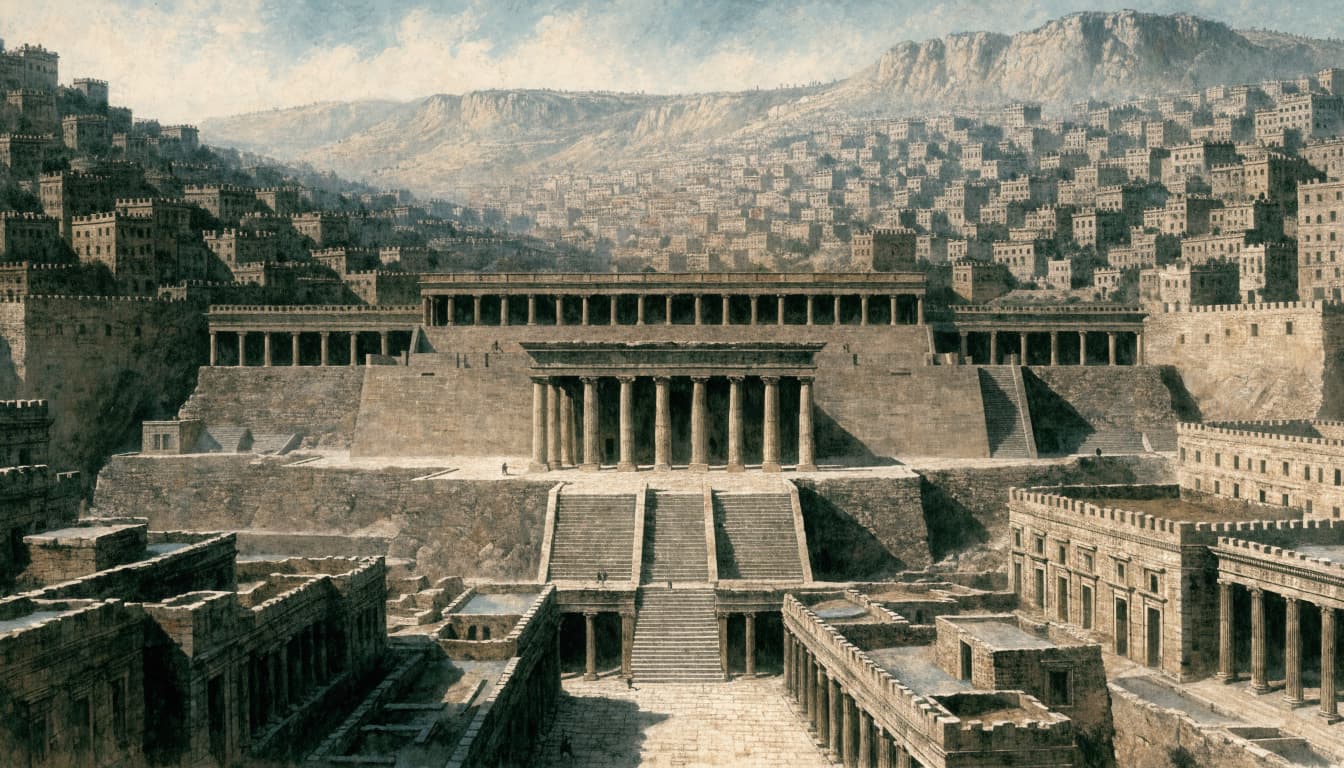
The scale and prominence of Herod's project help explain why the disciples pointed out the buildings as Jesus left. His prediction that they would be torn down would have sounded shocking. This was the sanctuary at the center of worship, not an ordinary structure that could be replaced without consequence. The Temple of Herod and its place in Jerusalem offers more historical background on the complex.
Matthew connects the disciples' reaction directly to Jesus' warning. That setting matters as we read Matthew 24 and the Olivet Discourse, but the historical background alone doesn't settle how every part of the prophecy should be understood.
Jerusalem’s fall in 70 AD
The Temple was destroyed in 70 AD during the First Jewish-Roman War, which began in 66 CE. Roman forces under Titus captured Jerusalem, and the city and sanctuary were devastated. The event provides a clear first-century setting for Jesus' warning about the Temple's destruction.
Flavius Josephus, a first-century Jewish historian who took part in the revolt, is an important ancient source for the war and the fall of Jerusalem. His account gives us a detailed description, but it should be read with care.
Josephus wrote under Roman patronage, and historians have debated some details, including how the Temple caught fire. His account informs our understanding; it doesn't resolve every disputed point. For a brief introduction to Josephus as a first-century historian, we can start with his life and historical context.
We should keep two things distinct. The Temple's destruction in 70 AD is an established historical event. What that event means for every part of Matthew 24 is a theological question, and Christians interpret the passage in different ways. The setting anchors the warning in real history, but it doesn't prove every conclusion readers draw about Jesus' coming or the end of the age.
What were the disciples asking Jesus in Matthew 24:3?
The disciples' questions follow Jesus' prediction that the Temple buildings would be demolished. In Matthew 24:3 in the NKJV, they ask when "these things" will happen, then ask about the sign of His coming and the end of the age. Their wording raises a fair question: are they asking three things, or two closely connected inquiries?
When will the Temple destruction happen?
The first question is about timing: "When will these things be?" The most direct reference for "these things" is Jesus' warning about the Temple. He had just told the disciples that its buildings would be thrown down, so the immediate subject of their conversation is clear.
We should begin there rather than assume the disciples were asking about a distant event alone. Matthew places the Temple prediction right before their question, and the disciples ask it after Jesus sits on the Mount of Olives. The sequence gives us a solid starting point, even if it doesn't settle how every part of the discourse fits together.
What sign points to Jesus’ coming?
The disciples also ask, "What will be the sign of Your coming?" Matthew uses the Greek word parousia, often translated as "coming" or "arrival." The Greek wording in Matthew 24:3 lets us see that this term appears alongside their question about the end of the age.
But what did the disciples understand by "Your coming"? The verse records what they ask. It doesn't tell us whether they fully understood how Jesus' coming related to the Temple's fall, or whether they expected those events to happen together. We shouldn't make their wording settle more than Matthew says.
That distinction matters for our reading. Christians differ on whether Jesus' coming here points to His future return, His vindication through judgment in history, or a passage that speaks to both. We can take the question seriously without pretending the verse answers every interpretive debate.
What does “the end of the age” mean?
Matthew says "the end of the age," not simply "the end of the physical world." The phrase points to the close or consummation of an age. Its wording alone doesn't tell us which age the disciples had in mind, or precisely how its end relates to the Temple's destruction and Jesus' coming.
Some Christians connect the phrase closely with Jerusalem's fall and the end of a historical or covenantal order. Others understand the Temple's destruction as one part of a wider prophecy that also looks toward Jesus' future return and final consummation. Still others see the first-century events as a pattern of what is yet to come. Jesus' teaching about Biblical prophecy can be read with these interpretive differences in view.
So, are there three questions or two? We can read the wording as three questions: when the Temple will fall, what sign points to Jesus' coming, and what sign points to the end of the age. We can also read the latter two as closely linked parts of one inquiry. The grammar allows both readings, and we shouldn't force it to decide the matter by itself.
How “coming” and “the end of the age” shape the passage
Two Greek expressions in the disciples' question help us read Matthew 24:3 with care. They clarify the words Matthew uses, but they don't settle every question about prophecy. We still need to follow the passage and Jesus' full answer, including His teaching about the beginning of sorrows.
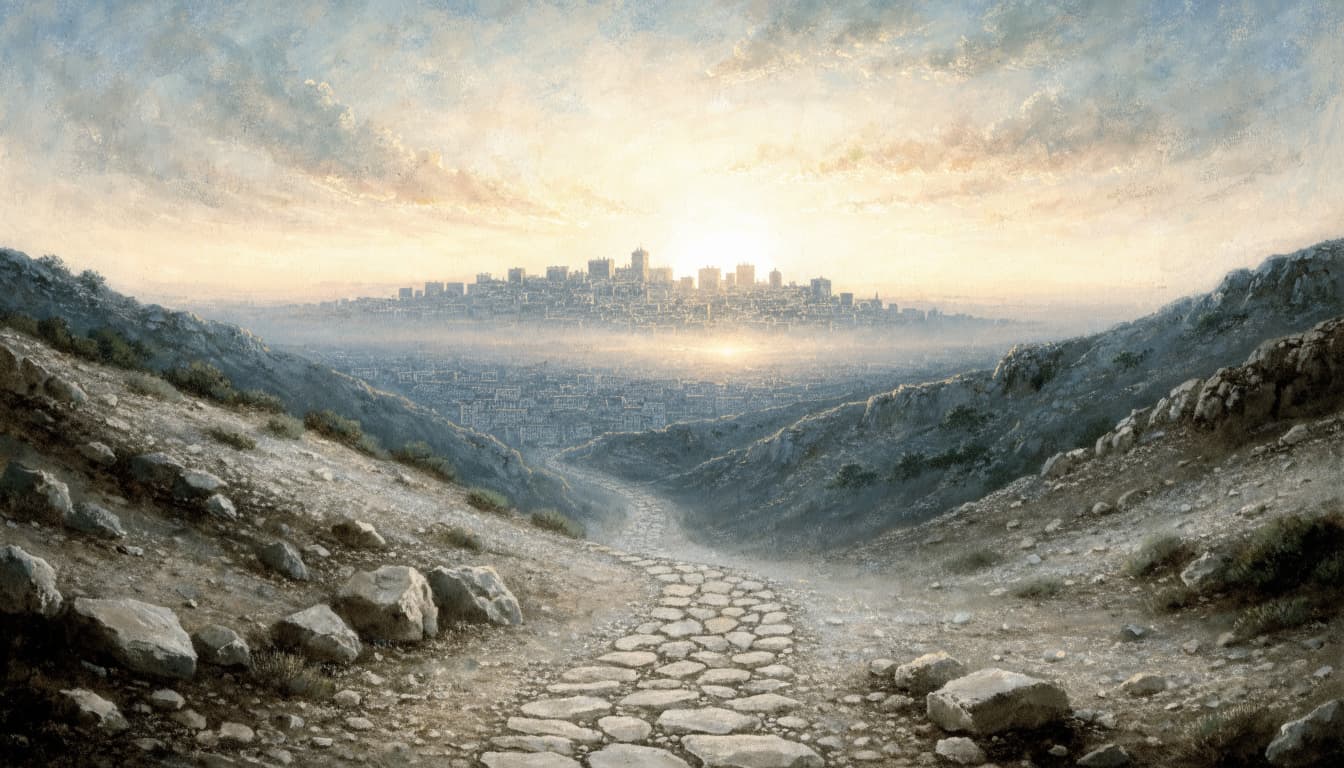
The meaning of parousia in Matthew 24:3
Matthew uses the Greek word parousia, which can mean "presence" or "arrival." In Matthew 24:3, it is translated as "coming." The word gives us the disciples' wording, but it doesn't tell us by itself exactly what kind of coming they mean.
Some Christians understand Jesus' coming here as His future, visible return. Others read it as His vindication through judgment in history, or see both a historical reference and a future fulfillment. The vocabulary alone doesn't prove one of those interpretations. We have to consider how Jesus uses the term across the discourse and how each reading accounts for the Temple warning.
Matthew uses parousia again in Matthew 24:27, Matthew 24:37, and Matthew 24:39. Those later references add context, but they don't erase the question raised in verse 3: how does Jesus' coming relate to the Temple's destruction and the end of the age? We should let the wider passage guide our answer rather than making one Greek word carry the whole argument.
The meaning of synteleia tou aiōnos
The phrase synteleia tou aiōnos is commonly translated "the end of the age" or "the consummation of the age." The Greek word for "age" means an age or era. By itself, it doesn't mean that the physical universe will end. English phrases such as "the end of the world" can suggest more than Matthew's wording says.
Matthew uses this phrase elsewhere in the Gospel. In Matthew 13:39–40 and Matthew 13:49, it appears in Jesus' teaching about the harvest and the close of the age. He also uses it in His promise to be with His disciples "to the end of the age" in Matthew 28:20.
Those passages help us see that Matthew uses "the end of the age" in more than one setting. They don't, on their own, identify which age the disciples mean in Matthew 24:3 or explain exactly how its end relates to the Temple's fall. We should keep the phrase's range in view, then read it alongside the events Jesus describes.
What Matthew, Mark, and Luke show about the Olivet Discourse
Matthew's account is part of a shared scene recorded in all three Synoptic Gospels. Jesus predicts the Temple's destruction, and the disciples ask when it will happen and what signs will precede it. Comparing the accounts helps us see the immediate subject without treating their differences as interchangeable.
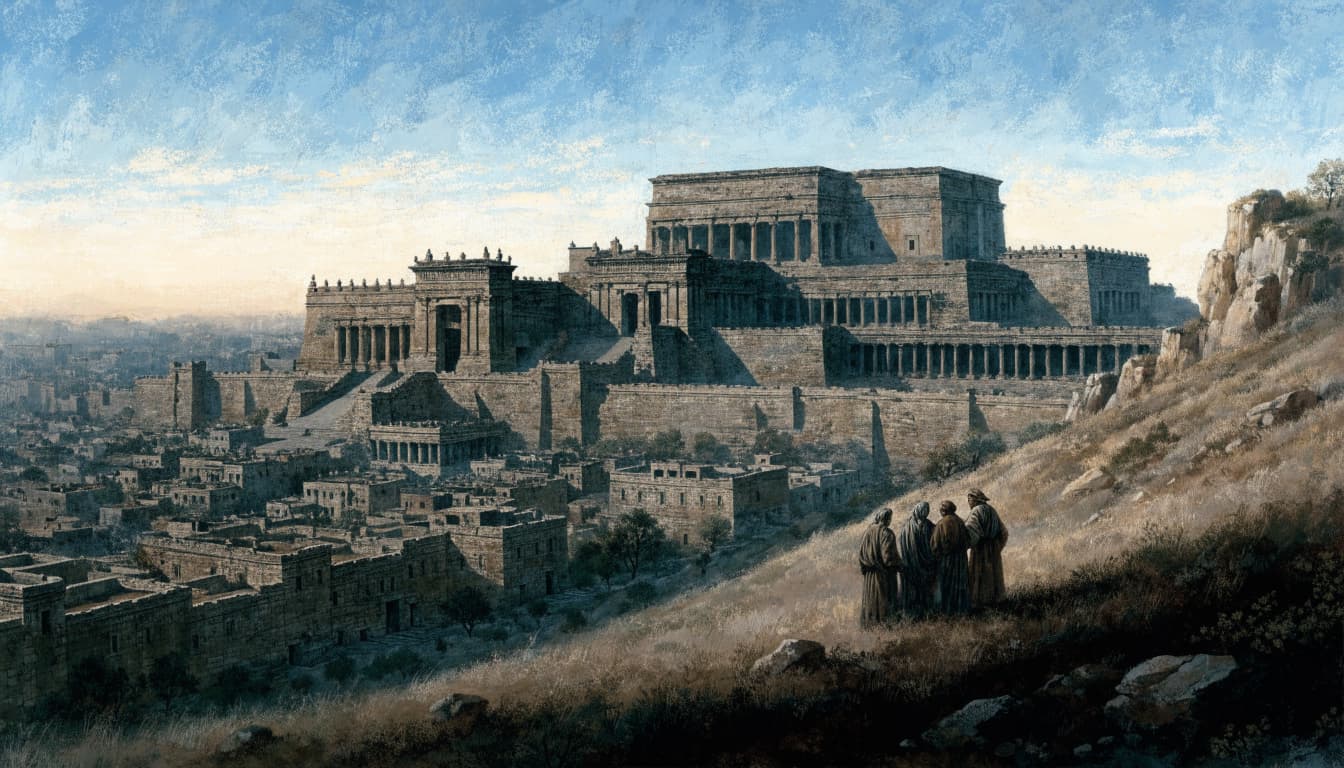
The shared Temple warning across all three accounts
In Matthew 24:1–3, the disciples draw Jesus' attention to the Temple buildings. He answers with a prediction of their destruction. Later, on the Mount of Olives, they ask when these things will happen and what sign will accompany His coming and the end of the age.
Mark and Luke preserve the same basic sequence. In Mark 13:1–4, a disciple comments on the Temple's impressive stones and buildings. Jesus says they will be thrown down, and the disciples ask when this will happen and what sign will show that the events are about to be fulfilled. Luke 21:5–7 also begins with people admiring the Temple's adornment. Jesus predicts its destruction, and the disciples ask about timing and signs.
The immediate setting is clear in all three accounts: the Temple warning prompts the disciples' questions. Mark and Luke phrase those questions more briefly than Matthew. They don't explicitly mention Jesus' coming or the end of the age in this opening exchange. That difference matters, but it doesn't make Matthew's added wording unimportant. Matthew gives us language the other two accounts don't include here, and we should read it on its own terms while keeping the shared setting in view.
This comparison helps us avoid two quick assumptions. The shorter questions in Mark and Luke don't prove that Matthew's wording is only an explanation, and Matthew's fuller wording doesn't prove that the disciples understood every event as separate. The three accounts establish the conversation's starting point; how the questions relate to one another still calls for careful reading. We can also follow Jesus' warnings in the Olivet Discourse without collapsing the Gospel accounts into identical wording.
Luke’s added detail about Jerusalem
Luke later describes Jerusalem surrounded by armies. That detail gives the discourse a concrete first-century setting and connects the Temple warning with the danger facing the city. It fits the historical crisis that culminated in Jerusalem's fall and the Temple's destruction in 70 AD.
Still, Luke's description doesn't settle every question about prophetic timing. It helps us understand the Jerusalem setting, but it doesn't by itself tell us how the Temple's destruction relates to Jesus' coming or the end of the age. We should let each Gospel contribute its details, then distinguish what the text says from the conclusions we draw.
How Christians understand the Temple warning and its prophetic horizon
Jesus connects the Temple's destruction to the disciples' questions, but Matthew 24:1–3 doesn't explain every detail of how those events relate to His coming and the end of the age. Christians read the passage through several broad approaches, with real differences within each one. We can weigh them against the Temple setting and the destruction of Jerusalem in 70 CE without claiming these three verses settle every debate.
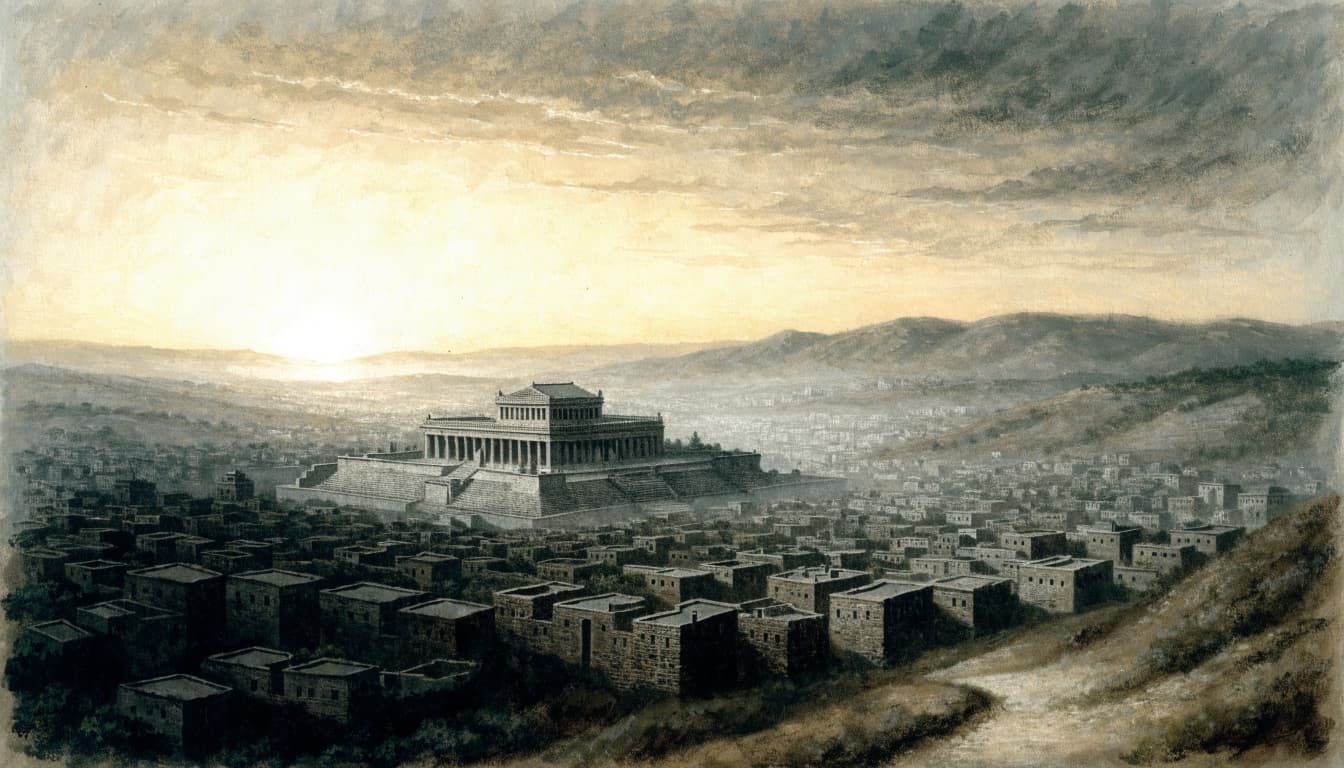
The first-century emphasis on Jerusalem’s fall
This approach reads the discourse mainly in light of Jerusalem's crisis and the Temple's destruction in 70 CE. The historical setting fits the warning: Jesus speaks about the Temple, and Roman forces later destroyed it during the First Jewish-Roman War. Any interpretation of the passage needs to take that history seriously.
Some interpreters understand Jesus' "coming" as royal vindication or judgment in history, rather than a reference only to His future return. They may also read "the end of the age" as the close of a historical or covenantal order, not the end of the physical world. These are interpretations of the prophetic language, not facts established by the wording of Matthew 24:1–3 alone. For a view that gives substantial attention to Jerusalem's fall while also recognizing a future horizon, see how Christians interpret Matthew 24 and the fall of Jerusalem.
The futurist view of a later return
A futurist reading sees Jesus addressing both the Temple's destruction and His future return, when God's purposes reach their final consummation. Some readers understand the disciples to have joined events in one question that Jesus later distinguishes in His answer. On this view, Jerusalem's fall is a real historical event, while parts of the discourse point beyond it.
This approach keeps Christian hope centered on Jesus' return. Still, we shouldn't treat its proposed sequence as the only possible reading of Matthew 24:1–3. The disciples ask about the Temple, Jesus' coming, and the end of the age, but these verses don't explain whether they saw one event or several. A commentary on Matthew's Olivet Discourse offers one perspective on how the warning and later expectation fit together.
A reading that sees both historical fulfillment and future hope
Mixed or typological readings hold that the events of 70 CE were historically real and may also point toward a future fulfillment. The Temple's fall can be read as a judgment in its own time and as a pattern that helps Christians understand the final consummation. This approach takes the first-century setting seriously while leaving room for the future hope emphasized elsewhere in Scripture.
Our independent Spirit-filled Pentecostal faith affirms that Jesus' words are trustworthy and that His return and God's purposes remain central. We also want to read the whole discourse carefully, rather than build a detailed timeline from three verses. Read Luke 21:20–24 in the NKJV alongside Matthew, and notice how Luke connects Jerusalem's crisis with armies surrounding the city. That historical detail matters, but it doesn't give us permission to set dates or make fear-driven claims. We can hold fast to Jesus' promise while admitting where faithful Christians differ.
Conclusion
Jesus predicts the Temple's destruction, and the disciples ask when it will happen, what will mark His coming, and how the end of the age fits into the picture. Matthew gives us that clear sequence, while the precise relationship among these events remains debated.
The Temple's place in Jerusalem's history matters as we read Jesus' words, but we should be careful not to claim more certainty than these verses provide. We can trust Jesus, study Scripture carefully, and remain watchful with hope in God's promises.
The Setting in Matthew 24:1–3
As Jesus Leaves the Temple, His Disciples Ask When Its Destruction Will Come
Why the Temple Warning Matters for Bible Prophecy
As Jesus departed the temple, His disciples drew His attention to its buildings. He answered with a warning: not one stone would be left upon another. Later, on the Mount of Olives, they asked when this would happen and what sign would mark His coming and the end of the age. Those related questions introduce the Olivet Discourse, but they should not be treated as though they all ask about one event.
The temple’s coming destruction showed that even Israel’s most imposing structure was not beyond judgment. The disciples’ further question about Jesus’ coming opens the wider prophetic discussion that follows. Reading His words in that setting helps us distinguish the immediate warning from the larger hope centered on Christ’s return.
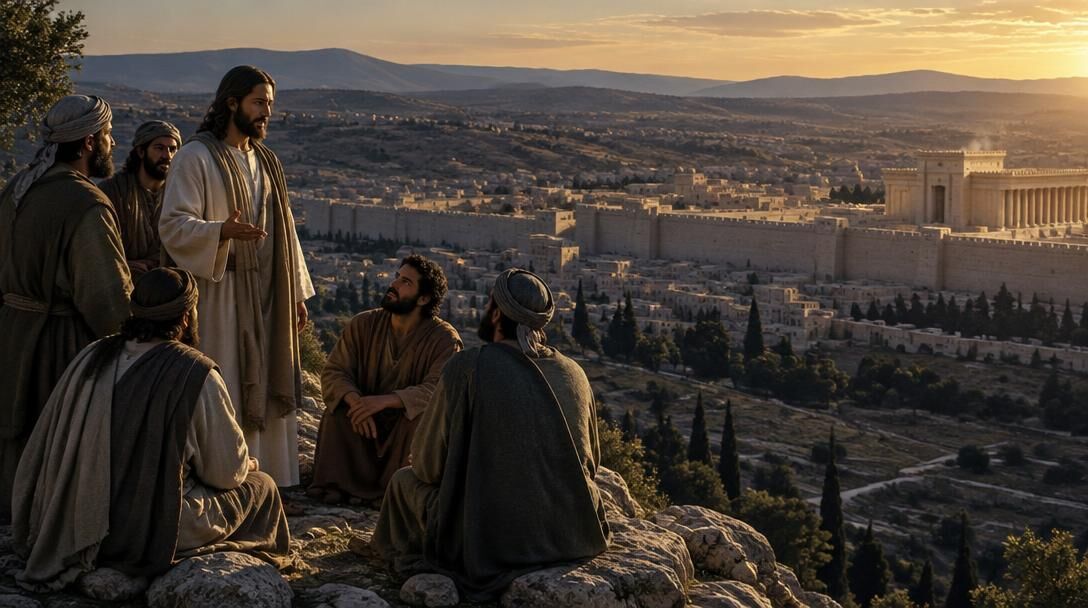
“Do you not see all these things? Assuredly, I say to you, not one stone shall be left here upon another, that shall not be thrown down.” — Matthew 24:2

Jesus Christ
Speaking of the temple, Jesus foretold its destruction, prompting His disciples to ask about His coming and the end of the age (Matthew 24:1–3).
From the Temple to the Mount of Olives
Matthew 24:1–3 moves from a startling prediction about the temple to the disciples’ private questions about what would follow.
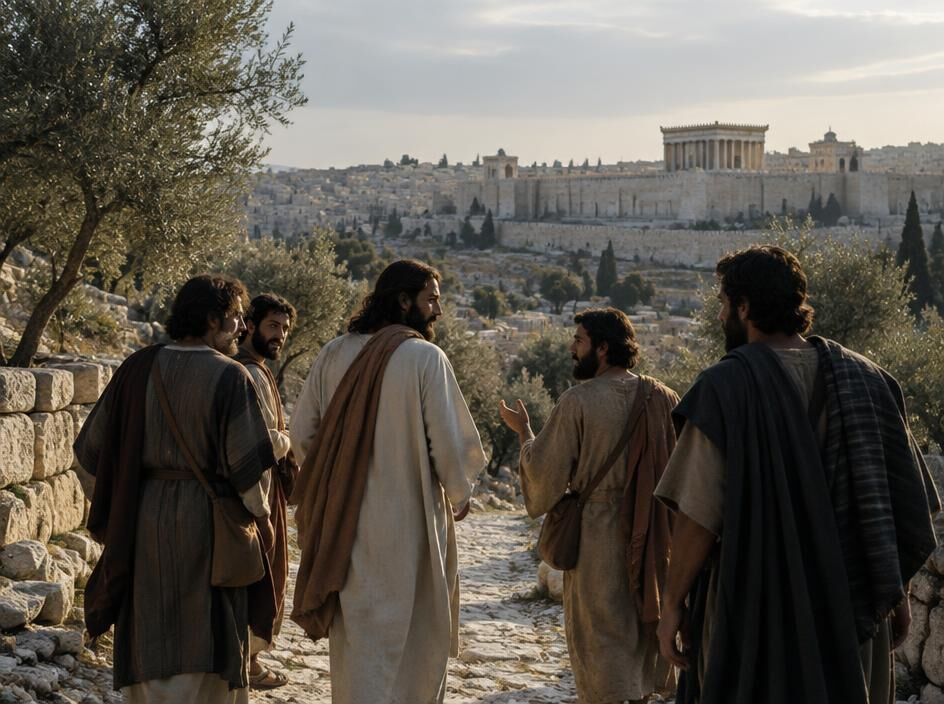
24:1
The Temple Comes Into View
As Jesus leaves the temple, His disciples draw His attention to its buildings.
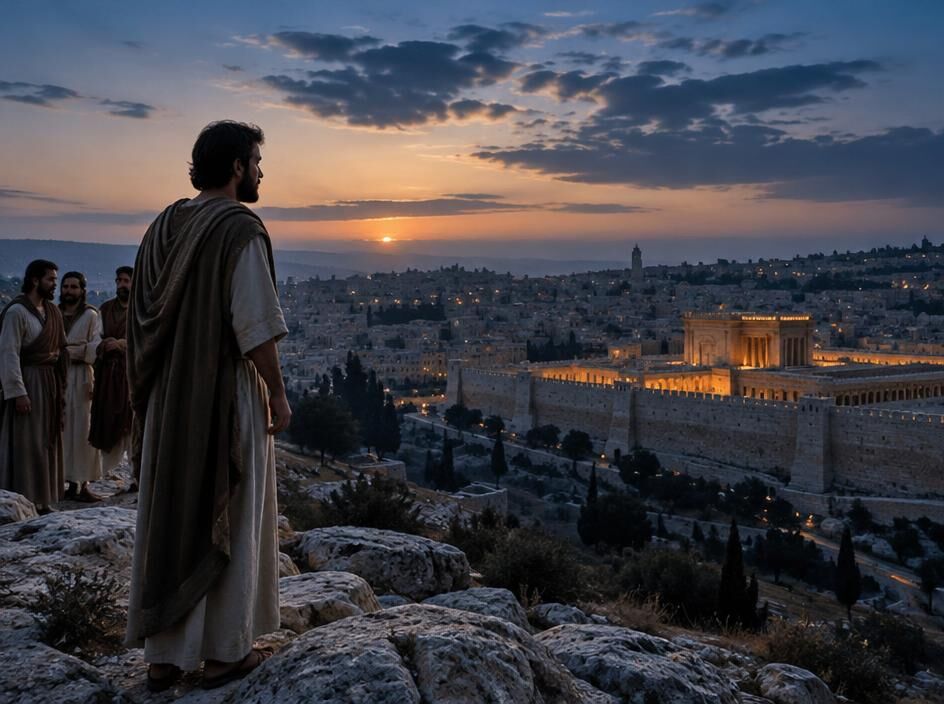
24:2
Jesus Foretells Its Fall
Jesus declares that the temple’s stones will be thrown down, warning that even this imposing place will not endure.
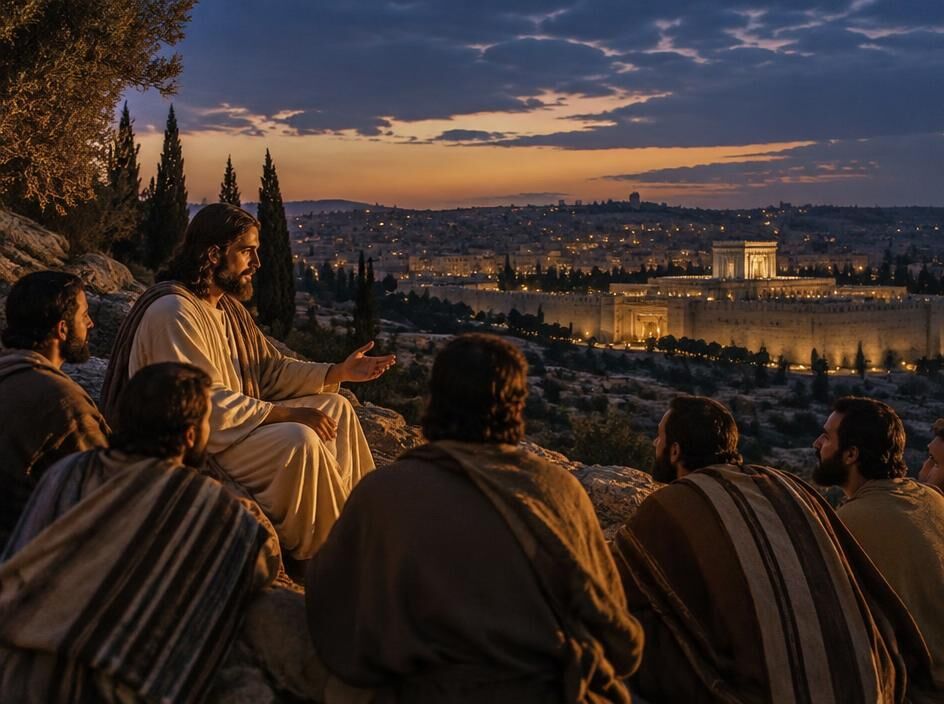
24:3a
A Private Question
Later, on the Mount of Olives, the disciples ask when these things—the predicted destruction—will happen.
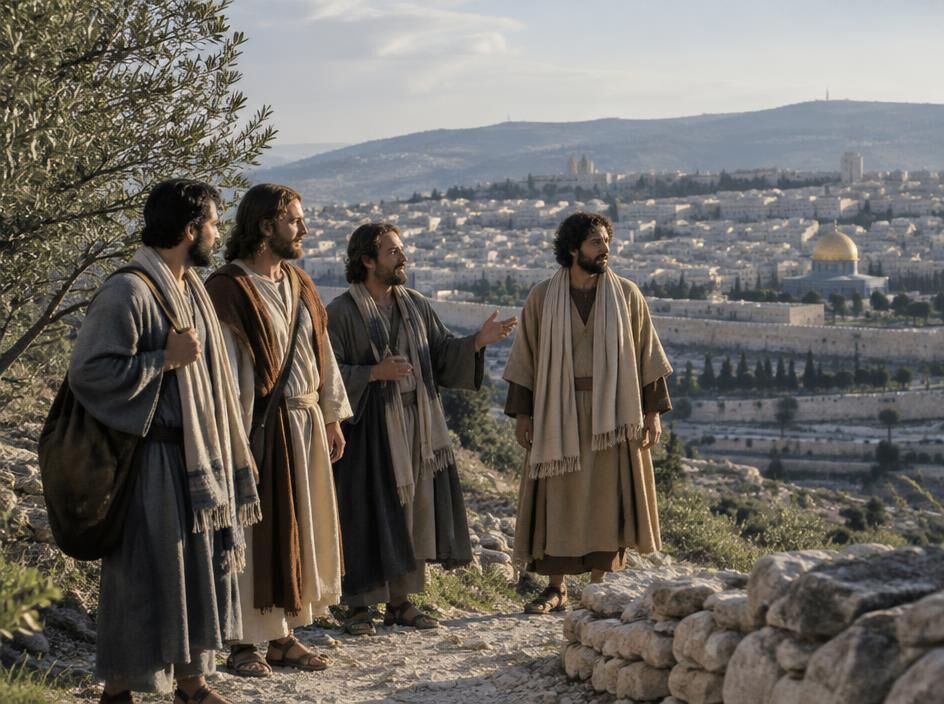
24:3b
His Coming and the End
They also ask for the sign of Jesus’ coming and the end of the age, raising questions beyond the temple itself.
Three Questions, One Crucial Distinction
The Temple’s Destruction
Jesus’ immediate warning concerns the temple buildings: their stones will be thrown down.
The Sign of His Coming
The disciples ask what will signal Jesus’ coming, a question to consider alongside—but not simply equate with—the temple’s fall.
The End of the Age
Their final question reaches beyond the temple to the end of the age, setting the stage for Jesus’ teaching that follows.
The Temple Warning in Its Biblical Context
In Matthew 24:1–3, Jesus tells His disciples that the temple’s magnificent buildings will be torn down. Later, on the Mount of Olives, they ask when this will happen and what sign will mark His coming and the end of the age. Those questions open a chapter that calls for attentive reading: follow Jesus’ answer through the surrounding verses, and distinguish what He says about the temple from what He says about His coming.
Bible Prophecy Ministries explores what Scripture says has happened, what lies ahead, and how prophecy centers on Jesus. In keeping with that mission, this passage is best read alongside the rest of Matthew 24 and the wider Biblical witness—not as an isolated prediction, but as part of Jesus’ teaching about faithfulness, discernment, and hope.

Keep Exploring Prophecy Through Scripture
Continue with other Bible Prophecy Ministries articles to examine prophetic passages in context and consider how their message points to Jesus. Each study offers another opportunity to read carefully, ask thoughtful questions, and grow in understanding.