
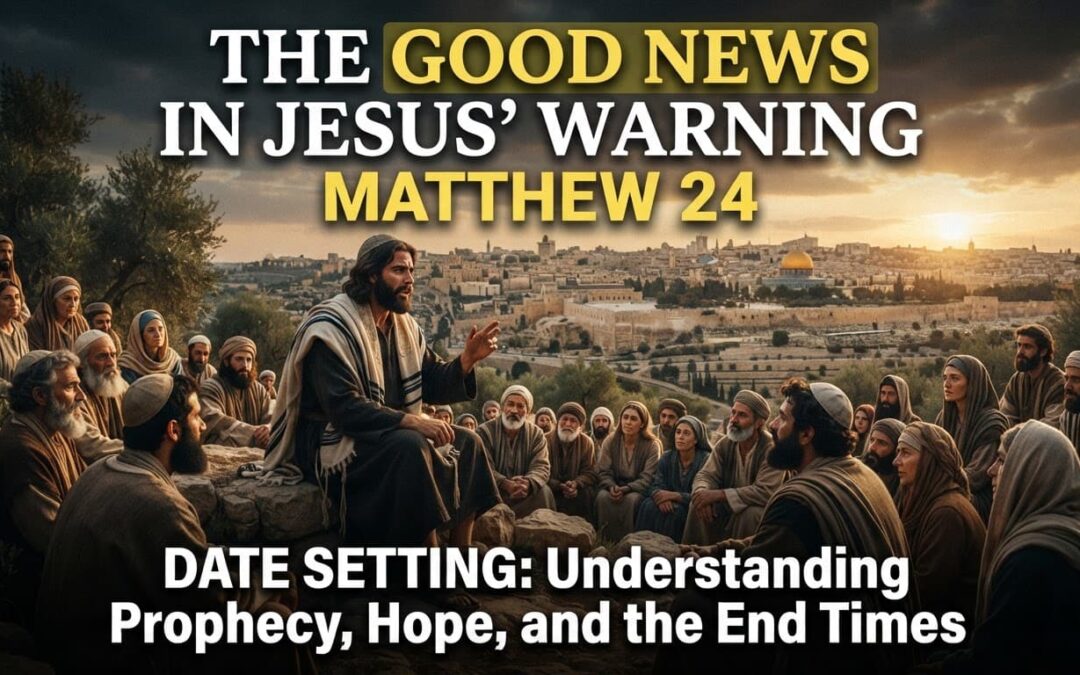
Signs Without Date-Setting: What Jesus Meant by “Not Yet”
Jesus named deception, wars, famines, and earthquakes, but He also cautioned His disciples not to mistake these troubles for proof that the end had arrived. When fear rises and confident predictions start making the rounds, that warning matters.
We read the Olivet Discourse from an independent, Spirit-filled Pentecostal viewpoint, while recognizing that Christians understand some details differently. Our focus is careful Biblical reading, discernment, and hope, not fear or date-setting. Let's begin with what Jesus meant when He said the end was "not yet," as we read the Olivet Discourse.
Signs Without Date-Setting: What Jesus Meant by “Not Yet”
Jesus names real troubles in the Olivet Discourse, but He also tells His disciples how not to read them. Wars, earthquakes, and famine are not permission to turn the news into a countdown. To hear His warning clearly, we first need to remember what prompted the conversation.
Read the warning in the setting of the Temple prediction
The scene begins with Jesus leaving the Temple. His disciples point out its buildings, and He predicts that they will be thrown down. Later, they ask Him about the timing and signs connected with what He has said. You can read the full chapter in Matthew 24 in the NKJV.
Matthew 24:1–3, Mark 13:1–4, and Luke 21:5–7 all connect the discussion to Jesus' Temple prediction, but they don't frame the disciples' questions in precisely the same way. Matthew includes questions about Jesus' coming and the end of the age. Mark and Luke phrase the exchange differently, with Luke's account also drawing attention to Jerusalem. We shouldn't flatten those differences or treat the three accounts as though every detail appears in an identical order.
That setting matters. The disciples aren't asking about an abstract sequence of disasters. They're responding to Jesus' words about the Temple, a central place of worship and a defining feature of Jerusalem. As we read the warnings that follow, we need to keep the Temple and city in view rather than assume every sign points only to one future moment.
“The beginning of birth pains” is not a timetable
In Matthew 24:8 and Mark 13:8, Jesus calls wars, famines, and earthquakes "the beginning of birth pains." The image describes distress and the start of a process. It doesn't give a countable formula, where a certain number of wars or earthquakes lets us calculate how close the end is.
Jesus makes that caution explicit just before the birth-pain image. In Matthew 24:6 and Mark 13:7, He says the end is "not yet." Luke 21:9 gives the same restraint in different words: these things must happen first, but "the end will not be at once." The accounts share the essential warning, even as they differ in wording and arrangement.
So when a frightening event makes headlines, we can take it seriously without announcing that it proves the end has arrived. Jesus names suffering; He doesn't hand His followers a calendar. For a closer look at how Matthew and Mark use this image, see Jesus' warning about the beginning of birth pains.
We understand the labor image as a sign that distress is underway, not a timetable for predicting Jesus' return. Birth pains point toward a process, but they don't tell us the date or hour. And they don't cancel the words that come first: the end is not yet.
How deception, wars, famine, and earthquakes function as warnings
Jesus names troubling events, but He also tells His followers how to respond: stay alert, keep faith, and don't let fear turn into prediction. These warnings call for discernment, not a countdown.
False claims about Jesus call for discernment
Jesus begins with a warning about deception. In Matthew 24:4–7 and Mark 13:5–8, He cautions that people will come in His name and lead many astray. Luke makes the danger plain: some will claim, "I am He," or say, "The time has drawn near" (Luke 21:8–11).
A confident voice, a dramatic testimony, or a prediction delivered with spiritual urgency doesn't make a claim true. We test it against Scripture and Jesus' own words. Does the teaching point people toward Him, or does it ask them to follow a person who claims special authority? We can also consider Scripture's test for false prophetic claims, which warns us not to accept a message just because someone invokes God's name.
Jesus' warning isn't a call to chase every new claim. It's a call to stay grounded, especially when someone insists that the time has arrived and demands an urgent response.
Conflict and disasters are serious, but not proof of the end
Jesus names wars and rumors of wars, nation rising against nation, famines, and earthquakes. Luke also mentions pestilences and terrors. These are not small troubles or abstract symbols. They mean real suffering for people caught in conflict, hunger, disease, and sudden disaster.

We should respond to suffering with compassion and practical care, not turn it into a chart. Jesus says wars and reports of wars must happen, but the end is not yet (Matthew 24:6; Mark 13:7). Luke adds that these events must happen first, but "the end will not come immediately" (Luke 21:9). His words place a clear limit on what we can claim: a war, famine, pestilence, or earthquake does not give us a date for His return.
That restraint matters when news spreads quickly and every disaster is framed as a sign that proves someone's prediction. We can take the events seriously without claiming more than Jesus said. The earthquake warning, for example, belongs alongside His words about wars and famine, not apart from them as a standalone countdown clue. Jesus directs us to remain faithful and discerning through upheaval, rather than declare that upheaval has revealed the date.
Why Christians interpret the Olivet Discourse in different ways
Jesus' words about the Temple, Jerusalem, and His return hold together, but Christians don't all agree on how the events fit. The discussion begins with His prediction that the Temple would be destroyed and the disciples' questions afterward (Matthew 24:1-3). Some readers give most weight to Jerusalem's fall in AD 70. Others emphasize recurring troubles, future events, or a connection between the first century and the final fulfillment. Each approach asks how Jesus' warning speaks to its original hearers and to the hope of His return.
The first-century setting and Jerusalem’s destruction
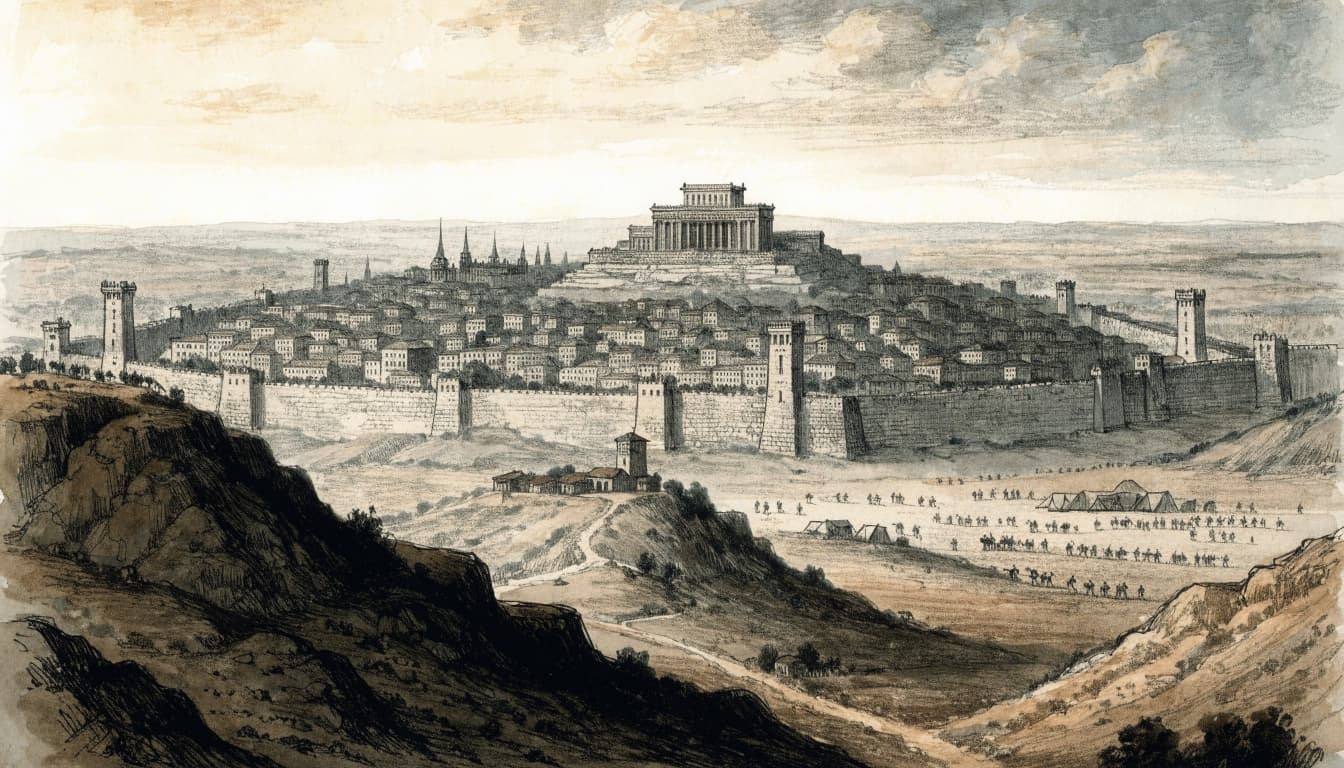
For some Christians, the Temple prediction anchors much of the discourse in the events that led to Rome's destruction of Jerusalem and the Temple in AD 70. This reading gives close attention to the disciples' immediate concern: Jesus had just said the Temple buildings would be thrown down. The Roman siege offers a historical setting for warnings about Jerusalem facing devastation.
Luke's account makes that connection especially direct. Jesus says that when His followers see Jerusalem surrounded by armies, they will know its desolation is near (Luke 21:20). That Jerusalem-specific wording helps explain why some readers understand at least part of the discourse as addressing events within the disciples' own generation. You can read more about the historical fulfillment of Luke's warning.
Still, we shouldn't treat Matthew, Mark, and Luke as interchangeable transcripts. They share important material, but each account has its own wording and emphasis. Luke's reference to Jerusalem surrounded by armies deserves attention on its own terms. We can recognize the force of that first-century setting without assuming it settles how every passage about Christ's coming and final hope should be read. For a broader look at how Jesus' Temple prophecy shapes interpretations of Biblical prophecy, the setting is a good place to begin.
Recurring troubles and future fulfillment
Another approach sees wars, disasters, and false claims as recurring features of the period between Jesus' first coming and His return. On this reading, the troubles Jesus named are real signs of a broken world, but they don't each point to a unique moment on a prophetic calendar. That fits the warning we've already seen: upheaval can occur while the end is still "not yet."
Some Christians also read the discourse in layers. Jerusalem's fall becomes a historical pattern that points beyond itself toward future events and Christ's final return. This view takes the Temple setting seriously while also making room for the passage's future hope. The first-century crisis matters, but it may not exhaust everything Jesus says about what lies ahead.
A future-focused reading places greater weight on events still to come, while a Jerusalem-focused reading stresses what Jesus' first hearers would have understood in their own time. These approaches differ, and Christians don't share one settled timeline. From our Spirit-filled Pentecostal viewpoint, we can hold firm to what Scripture says about Jesus' return without claiming more certainty than the passage gives us. These interpretations help us read the discourse; they don't give us permission to set a date.
What Jesus’ warning teaches about date-setting
Jesus' warning about the end calls for watchfulness, but watchfulness is not the same as knowing the date. Wars, famines, earthquakes, and false teachers matter because they bring real suffering and test our faith. They do not give us a timetable for Christ's return.
Separate watchfulness from claiming secret knowledge
In the Olivet Discourse, Jesus names turmoil and deception, then tells His disciples not to conclude that the end has arrived. The events must take place, but "the end is not yet" (Matthew 24:6-8). Turning those warnings into clues for naming a year reverses the point. Jesus tells His followers how to remain faithful amid upheaval, not how to calculate a date from it.
Readiness is active. We pray, obey Jesus, serve people in need, and stay alert to teaching that pulls people away from Him. Those practices matter whether the headlines feel calm or alarming. Jesus also says that no one knows the day or hour (Matthew 24:36; Mark 13:32). A warning to stay awake cannot authorize a claim of knowledge He says is unknown. For a Scripture-centered way to weigh such claims, see three anchors for studying Biblical prophecy.
How failed predictions can harm faith
Date-setting can leave people frightened and spiritually shaken, especially when a prediction is presented with confidence and urgency. When the date passes, some may lose trust in the person who made the claim, or even wonder whether they can trust Scripture. We should respond with compassion. Many who believed a prediction were sincere, and they deserve care rather than ridicule.
The Millerite movement offers a sobering historical example. William Miller announced that Christ would return between March 21, 1843, and March 21, 1844. After that period passed, October 22, 1844, became another expected date, associated with the Great Disappointment. The Encyclopedia of Seventh-day Adventists' account of the Millerite movement provides historical context for those expectations.

We don't bring up that history to mock people who hoped for Christ's return. We bring it up because even sincere believers can be hurt when confidence goes beyond what Jesus said. A date claim can shift attention away from the Gospel and from people facing war, hunger, disaster, or fear. They need prayer, practical care, and the hope of Christ, not pressure to interpret their pain as proof that someone has solved the prophetic calendar.
We can take Jesus' warnings seriously without turning them into a schedule. Watchfulness keeps our attention on faithfulness; date-setting claims knowledge Jesus withheld.
How believers can respond to troubling events with faith
Jesus' warning about troubling events calls for clear eyes and steady hearts. We can take suffering seriously, pray for wisdom, and care for people in need without turning every crisis into a prediction.
Practice discernment without fear
When a headline or prophetic claim unsettles you, pause before sharing it or accepting its conclusion. Read the whole passage in context, then compare the claim with Scripture. Jesus says wars and reports of wars will come, but the end is "not yet" (Matthew 24:6-8 in the NKJV). That warning should keep us from treating every hardship as a direct sign that the end has arrived.
We believe the Holy Spirit still gives wisdom and discernment to the Church. But a spiritual impression, dream, or prophetic word doesn't override Jesus' plain teaching. Paul tells believers to test everything and hold fast to what is good (1 Thessalonians 5:19-22 in the NKJV). We can pray, check the words against Scripture, and ask mature believers to help us weigh them. For more on reading prophecy in its Biblical context, keep the whole passage in view, not just a dramatic phrase pulled from it.
Sensational headlines thrive on urgency. A claim that insists you must believe it immediately deserves more careful thought, not less. We don't need to dismiss every warning or spiritual gift; we do need to test claims and refuse date-setting.
Turn concern into compassion and faithful service
Wars, hunger, illness, and disasters affect real people, not just our understanding of prophecy. Jesus' teaching should make us more attentive to their needs. We can pray for those who are suffering, then ask what practical help is within reach: a meal, a donation to trusted relief work, a ride, or a listening ear.

Faith becomes visible in ordinary acts of care. James describes a believer who offers kind words to someone without food or clothing but does nothing to meet the need (James 2:15-17 in the NKJV). His point is practical: compassion calls for action when we can help. If a disaster strikes your community, you might volunteer locally or support The Salvation Army's disaster relief efforts.
We can hold fast to hope in Jesus and His Kingdom while serving faithfully today. People facing loss need presence, prayer, and practical support, not confident claims that their suffering proves someone has decoded the end times.
The lasting message: stay faithful, but do not set dates
The Olivet Discourse leaves us with a clear responsibility: trust Jesus, weigh claims carefully, and keep living faithfully. He names deception and upheaval, but He does not say that each war or disaster proves the end has arrived. His warning keeps our hope anchored in Him, not in predictions that can't be supported by Scripture.
Hold to what Jesus said with humility and hope
Christians differ on how parts of the discourse relate to Jerusalem's destruction in AD 70 and to events still ahead. We can study those interpretations seriously without pretending every detail has been settled. Our Spirit-filled Pentecostal perspective gives us confidence in Jesus' return and in the Holy Spirit's work, while calling us to be careful about claims Scripture does not make.
Jesus says that no one knows the day or hour (Matthew 24:36). That should put a firm boundary around date-setting, even when a prediction sounds urgent or comes from someone we respect. We can keep studying prophecy, including Daniel's 70 weeks and their connection to Jesus, while admitting where faithful Christians disagree.

So what does readiness look like? We stay close to Jesus, test spiritual claims against Scripture, pray, serve our neighbors, and share the hope of the Gospel. Paul's call to stay awake and encourage one another offers a helpful picture of that daily faithfulness (commentary on 1 Thessalonians 5). We don't have to solve the timeline before we can obey.
The promise of Christ's return gives us hope, not a reason to panic. We can hold firmly to what Jesus said, speak humbly about what remains debated, and bear faithful witness today.
Conclusion
Deception, wars, famines, and earthquakes are serious, and the people suffering through them need our compassion and care. But Jesus cautions us not to treat these troubles as proof that the end has already arrived. They give us no grounds for date-setting.
We can seek the Holy Spirit's wisdom, test claims against Scripture, and remain faithful without fear. Jesus has promised to return, and our hope rests in Him, not in predictions about when. For more on the promise of Jesus' return and the limits of date-setting, keep that promise in view as you read the signs.

Recognize the Signs, Resist the Countdown
When Jesus spoke of wars, upheaval, and persecution, He warned, “the end is not yet” (Matthew 24:6). These events matter, but they do not give us a date for His return. His words call us to discernment rather than alarm: notice what Scripture says, refuse sensational predictions, and remember that no one knows the day or hour (Matthew 24:36). Biblical watchfulness keeps our attention on Jesus and shapes how we live today—with faith, endurance, and readiness—without claiming to know when future events will unfold.
Recognize the Signs, Refuse the Countdown
Jesus told His disciples to notice what was happening, yet warned them not to mistake troubling events for proof that the end had arrived. In Matthew 24:6, He said, “the end is not yet.” His teaching calls us to stay alert, test claims against Scripture, and trust the Father with the timing.
Read Signs in Context
Keep Watch Without Calculating
Center Every Prophecy on Jesus
“You will hear of wars and rumors of wars. See that you are not alarmed, for this must take place, but the end is not yet.” — Matthew 24:6 (ESV)
Jesus, speaking to His disciples about future events; His words call for discernment rather than alarm or a predicted date.
Frequently Asked Questions About Signs and Timing
Jesus gives us reason to be watchful, not a calendar to complete. These answers keep His words in view as we consider prophetic signs.
What did Jesus mean by “the end is not yet”?
In Matthew 24:6, Jesus says that wars and upheaval do not, by themselves, mean the end has arrived. His warning guards against treating every crisis as a final countdown.
Can Christians recognize signs without setting dates?
Yes. Jesus taught His followers to watch and remain ready, while saying that no one knows the day or hour of His coming (Matthew 24:36).
Does “no one knows the day or hour” rule out every attempt to calculate His return?
It rules out claims of certainty about the timing. Jesus directs His disciples toward faithful readiness, not formulas for identifying a date.
How should we read reports of wars, disasters, and unrest?
Read them alongside the whole of Jesus’ teaching. He said such events would occur, cautioned against alarm, and warned that the end was “not yet” (Matthew 24:6–8).
What should we do when someone announces a date for the end?
Compare the claim with Jesus’ words in Matthew 24:36 and avoid spreading it. A confident prediction should not outweigh His clear warning about what we cannot know.
What does watchfulness look like in everyday life?
Watchfulness means continuing in faith, prayer, love, and obedience. Jesus calls His followers to be ready whenever He comes, not to put life on hold for a forecast.
Follow the Signs. Keep Your Eyes on Jesus.
Jesus told us to recognize the signs without claiming to know the date. Continue exploring how Scripture points to Him—and how His promises call us to live with hope, discernment, and faithful readiness.