
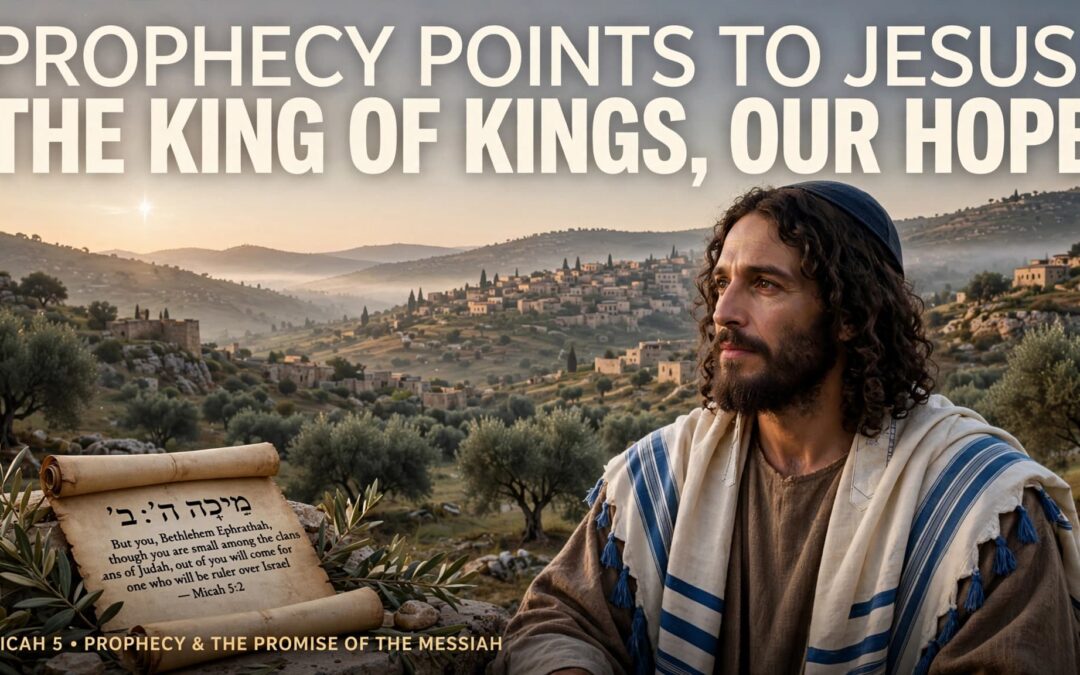
How Biblical Prophecy Points to Jesus, King of Kings
Biblical prophecy points to Jesus as both the suffering Savior and the risen King whose reign will never end. The cross matters, but it isn't the end of the prophetic picture: Jesus rose, was exalted, and will be acknowledged by every nation.
We see this hope rooted in God's promise to David and carried through the prophets' words about a King who rules with justice and shepherds His people. Let's begin with the promise of a lasting King from David's line, and see how it leads us to Jesus. God's promise of David's everlasting throne
How Prophecy Points to Jesus, King of Kings
Israel's hope for a lasting King grew from God's covenant with David. The prophets developed that hope, and the New Testament presents Jesus as its promised fulfillment. We need to read each passage in its own setting first, then see how Christians connect it to Him.
The promise of a King in David’s line
In the covenant passage in 2 Samuel 7, God promises David that his house, throne, and Kingdom will endure. The promise reaches beyond David's lifetime. His son Solomon would build the Temple and inherit the throne, but no single king in David's line fulfilled the promise of an unending reign. Israel's hope continued, even through seasons of division and exile.
Luke connects that hope directly to Jesus. The angel tells Mary that her Son will receive "the throne of His father David" and reign over Jacob's house forever (Luke 1:32-33). For Christians, this is more than a family line. Jesus is the King through whom God's promise to David reaches its lasting fulfillment.
We should be clear about the reading here. The covenant first speaks to David and his royal house in Israel's history. Christians believe its full messianic meaning comes into view in Jesus, while Jewish interpretations do not identify Him as that promised Messiah. Reading prophecy carefully means holding both the original setting and the New Testament claim in view. We can also read prophecy through its original context without treating every detail as a separate prediction.
A ruler whose reign reaches beyond Israel
Psalm 2 pictures a king whom God has anointed, with authority among the nations. In its original royal setting, the psalm speaks of God's chosen ruler and warns earthly kings to honor the Lord. The New Testament applies its language of kingship and sonship to Jesus (Acts 4:25-28; Hebrews 1:5). Christians see Jesus as the Anointed King whose authority extends beyond Israel.
Micah 5:2-5 gives the hope a place and a role: Bethlehem will be the birthplace of a ruler for Israel, and He will shepherd His people in the strength of the Lord. In Micah's setting, the prophecy offers hope amid danger and points toward a ruler who brings security and peace. Matthew 2:5-6 applies the Bethlehem passage to Jesus. His birthplace connects Him to the prophecy, while the Gospel's use of Micah also presents Him as Israel's shepherd-King.
That shepherding image matters. God's promised King does not rule by force alone; He gathers and cares for His people. And the promise is wider than one nation's borders. Psalm 2 places the nations under the King's authority, while Micah describes a reign marked by peace. Together, these passages help us see why Christians confess Jesus as King of Kings, even as we recognize that the fullness of His Kingdom is still ahead.
The prophets point through the cross to Christ’s vindication
The prophets don't leave us at the cross. In Isaiah and Psalm 22, suffering gives way to vindication and praise, a pattern Christians see fulfilled in Jesus. We should read these passages in their first setting, then consider how the New Testament applies them to Him.

Isaiah’s servant suffers and is lifted up
In Isaiah 52:13-53:12, the servant is first introduced as one who will be lifted up. Then the passage shows the cost of that calling: He is rejected, wounded, treated unjustly, and led toward death. Yet His suffering is not meaningless. He bears the sins of many, and the passage closes with His vindication and exaltation.
Christians understand this movement as fulfilled in Jesus, whose death bears sin and whose resurrection confirms that death did not have the final word. Acts 8:30-35 makes the connection explicit: Philip meets an Ethiopian official reading Isaiah, explains the passage, and tells him about Jesus. We see why Christians connect Isaiah's prophecy of the suffering servant with the cross and resurrection.
We should also read Isaiah carefully. The passage's original setting and the servant's identity have been understood in different ways. Some readers identify the servant with Israel or a faithful figure within Israel; Christians read the servant's suffering and vindication through Jesus. A commentary on Isaiah's servant song helps show why its historical context matters alongside its Christian interpretation.
Psalm 22 moves from anguish to worldwide praise
Psalm 22 begins with the cry, "My God, My God, why have You forsaken Me?" Jesus speaks these words from the cross (Matthew 27:46). The Gospel accounts also connect the psalm's images of mockery and divided clothing with the crucifixion (Matthew 27:35, 39, 43; John 19:23-24). For Christians, these echoes place Jesus' suffering within Israel's Scriptures.
But the psalm doesn't end with anguish. The speaker turns toward praise, and the vision widens: the ends of the earth remember the Lord, and families among the nations worship Him. In its first setting, Psalm 22 is the prayer of a suffering person who trusts God for deliverance. The Gospels apply its language to Jesus, while the psalm's closing praise points readers toward the wider reach of His Kingdom.
Here's the connection: the cross is central, but it isn't the end of the prophetic picture. The suffering servant is lifted up, the righteous sufferer praises God, and the nations are drawn into that praise.
The risen Jesus is enthroned as Lord
The prophetic picture of Jesus as King includes more than His birth and suffering. It also includes His resurrection and exaltation: God raised Him from the dead and gave Him a place of authority at His right hand. The apostles connect these events with Israel's Scriptures, while still reading each passage in its original setting.
Psalm 16 and the hope of resurrection
In Psalm 16:8-11, the speaker trusts that God will not abandon His faithful one to the grave or let Him see corruption. In its first setting, this is a confident prayer for God's protection and deliverance. The psalm doesn't lay out a detailed prediction of a future resurrection.
Peter makes that distinction clear in his sermon at Pentecost. David died and was buried, Peter says, so David's words reach beyond his own experience. Peter applies the psalm's hope to Jesus, proclaiming that God raised Him from the dead. You can follow the apostles' argument in Acts 2:25-36. Paul makes a related point in Acts 13:35-37: David's body saw decay, but the One God raised did not.
The apostles aren't erasing the psalm's earlier meaning. They see a fuller realization in Jesus, whose resurrection answers the hope David expressed. That difference matters when we read prophecy: a passage can speak faithfully in its first setting and take on a greater fullness in the New Testament's account of Christ. We can also trace Psalm 16 and the resurrection of Jesus through the apostles' teaching.
Psalm 110 pictures the King at God’s right hand
Psalm 110 opens with a royal invitation: "The LORD said to my Lord, 'Sit at My right hand'" (Psalm 110:1). In the psalm's royal setting, the king is given a place of honor and authority by God. The image is striking: this ruler reigns with God's favor, and his enemies are placed beneath his feet.
Peter applies this verse to Jesus after announcing His resurrection. Jesus has been exalted to God's right hand, Peter says, and God has made Him both Lord and Christ (Acts 2:34-36). Hebrews also uses Psalm 110:1, asking which angel God ever invited to sit at His right hand (Hebrews 1:13). The answer points to Jesus, the Son who reigns above the angels.
Yet the psalm's promise has a future horizon too. Jesus reigns now, but His enemies have not all been put under His feet. We see the prophetic sequence: suffering, vindication, then authority at God's right hand. The cross did not cancel the promise of a King. God raised Jesus, and the risen Lord reigns while we await the full display of His Kingdom.
The Kingdom of God will outlast every empire
Human empires can look permanent while they rule. Daniel's visions tell a different history: kingdoms rise, dominate, and fall, but God's Kingdom endures. Christians see that promise fulfilled in Jesus, though Daniel 2 does not name Him directly.

Daniel’s visions promise a Kingdom that cannot be destroyed
In Daniel 2:34-35, 44-45, a stone strikes the statue that represents a succession of earthly kingdoms. The statue breaks apart, while the stone becomes a great mountain and fills the earth. Daniel explains that God will establish a Kingdom no other power can destroy or inherit.
The vision contrasts human strength with God's authority. Empires may command armies, claim territory, and shape generations, but they do not last. God's Kingdom isn't another empire competing for a place in history. It is His rule, established by God and destined to remain.
Daniel 2 doesn't name Jesus as the stone or explicitly identify the Kingdom with Christ. Christians connect the vision to Jesus through the wider witness of Scripture: He proclaims God's Kingdom, and the New Testament presents Him as its King. We should keep the distinction clear. The vision gives us the promise of God's enduring reign; the Christian confession identifies Jesus as the King through whom that reign is revealed. For more on this connection, see Daniel's vision of God's everlasting Kingdom.
The Son of Man shares His rule with His people
Daniel's next vision gives us another striking image. In Daniel 7:13-14, "One like the Son of Man" comes before the Ancient of Days and receives dominion, glory, and a Kingdom. Peoples, nations, and languages serve Him, and His dominion will never pass away.
The New Testament connection is clear to Christians because Jesus repeatedly calls Himself the Son of Man. At His trial, He draws on Daniel's vision as He speaks of His authority and vindication. We see the title pointing beyond His earthly suffering to the reign God gives Him.
Daniel also says the holy ones receive the Kingdom (Daniel 7:18, 22, 27). The King and His people belong together: Jesus receives dominion as their representative, and they share in the Kingdom He inherits. His rule doesn't erase His people; He gathers them under His righteous reign.
Justice and peace mark the promised King’s reign
The promised King's authority is more than power over others. In Isaiah 9:1-7, the ruler from David's line establishes His Kingdom with justice and righteousness. Isaiah's promise of peace without end is a sharp contrast to the violence and instability of human rule. Christians see this hope fulfilled in Jesus, the Son given to us and the King whose reign continues.
Zechariah adds humility to the picture. In Zechariah 9:9-10, Zion's King comes humble, riding on a donkey. He brings peace to the nations, and His dominion reaches from sea to sea. Jesus' entry into Jerusalem echoes this image of a King who does not arrive with the usual show of military force.
So how do we hold the promise alongside the world we see? Christians believe Jesus reigns now, yet His Kingdom has not been fully seen in every nation and every life. We live in that already-and-not-yet hope: the King is enthroned, and we await the day His justice and peace are fully revealed.
Every nation will recognize the authority of Jesus
The prophets look beyond Israel's borders to a day when God's rule reaches every people. The New Testament names Jesus as the King at the center of that hope. As we connect these passages, we should keep their original emphasis in view: they speak of God's reign, the nations learning His ways, and worship that crosses every boundary.
The prophets picture the nations gathering to God
Psalm 72 describes an ideal king whose dominion reaches "from sea to sea," with rulers bowing before him and nations serving him (Psalm 72:8–11). In its royal setting, the psalm celebrates a king who rules with justice and brings blessing. Christians read this hope alongside the wider Biblical picture of the Messiah, whose Kingdom extends beyond one land or people.
Isaiah's vision adds an important detail. In Isaiah 2:2–4, nations stream to the Lord's mountain to learn His ways. They seek His instruction, and weapons are turned into tools for cultivation. The focus is more than recognizing a ruler. God teaches the nations, and His instruction leads to peace among them.
Together, these passages give us a wider view of the promised King. His authority reaches the nations, and His reign draws people toward God's ways. That hope fits with the Gospel proclaimed to all nations, though the prophetic visions describe God's future rule in their own distinct terms.
Every knee will bow and every tongue confess
Isaiah 45 declares that every knee will bow and every tongue will swear allegiance to the Lord (Isaiah 45:23). In its original setting, the passage announces the Lord's unmatched authority. Paul draws on that language in Philippians 2:9–11, where every knee bows and every tongue confesses that Jesus Christ is Lord, to the glory of God the Father.
That connection matters. Paul applies language of universal homage to God to Jesus Christ, openly naming Him as Lord. Christians understand this as a powerful witness to Jesus' divine authority and exaltation. The passage's own emphasis is clear: no power or person stands outside His lordship.
Universal acknowledgment, however, doesn't necessarily mean every person willingly believes and receives salvation. Paul describes a day when Jesus' authority will be confessed by all. The passage doesn't say that every confession comes from willing faith. We can affirm Jesus' universal reign without assuming every person is saved.
Revelation shows worshippers from every people
Revelation gives us a vivid picture of people gathered across national and language lines. In Revelation 5:9–10, worshippers praise the Lamb because He redeemed people for God from every tribe, language, people, and nation. Then Revelation 7:9–10 shows a great multitude from every nation standing before the throne and the Lamb, crying out in praise.
The vision moves beyond national divisions without erasing the people themselves. They worship together because of what the Lamb has done. Then Revelation 11 announces that the kingdom of the world has become the Kingdom of our Lord and of His Christ (Revelation 11:15).
We see the prophetic hope come into focus: the nations belong under God's rule, and Jesus Christ is confessed as Lord. Their worship is not a claim that every person has already chosen faith. It is the declaration that His authority will be recognized throughout the world.
Read prophecy with care and live in hope of Christ’s reign
Prophecy points us to Jesus, but not every passage points in the same way. We read each text in its own setting, then follow the New Testament's lead as it connects Israel's Scriptures to Christ. That keeps our interpretation grounded and our hope clear.

Distinguish prediction, fulfillment, and prophetic patterns
A direct prediction points ahead to a future person or event. Micah speaks of a ruler coming from Bethlehem, and Matthew applies that passage to Jesus (Micah 5:2-5; Matthew 2:5-6). The commentary on Micah's Bethlehem prophecy also shows how the Gospel connects the promised ruler with Jesus.
A New Testament application happens when an apostle or Gospel writer reads an earlier passage in light of Jesus. The earlier text still has meaning in its first setting, while the New Testament identifies a fuller meaning in Christ. We can learn more about how the New Testament connects Scripture to Jesus, while keeping the original audience and circumstances in view.
Typology is different from direct prediction. It describes a person, event, or pattern in Scripture that prepares us to understand a later work of God. Davidic kingship, for example, gives Israel a pattern of a shepherd-king who rules God's people. The New Testament presents Jesus as the Son of David whose reign fulfills that hope (2 Samuel 7:12-16; Luke 1:32-33). That doesn't mean every detail about David was a separate prediction of Jesus.
So we start by asking what a passage meant in its historical setting. Then we consider how the New Testament uses it. This careful reading helps us avoid forcing a direct prediction onto every similarity. For more guidance, see reading prophecy in its original context.
Let the King’s promised future shape life today
Jesus reigns now, and we still await the full display of His Kingdom. That hope gives believers a steady reason to endure suffering, pursue holiness, pray, and share the Gospel. The prophets' promises point us toward these faithful responses; they don't give us permission to invent new predictions.
When hardship comes, we can hold to the hope of resurrection and the promise that suffering will not have the final word (1 Peter 1:3-7). Hope also shapes how we live now. We pursue holiness because the King we await is holy (1 Peter 1:13-16), and we pray for God's will and Kingdom to come (Matthew 6:9-13).
As Spirit-filled believers, we also trust the Holy Spirit to empower our witness. Jesus promised His followers power to testify about Him, reaching beyond their own communities (Acts 1:6-8). We share the Gospel across cultures because Revelation pictures people from every nation worshipping the Lamb (Revelation 7:9-10). His reign is our hope, and faithful witness is part of how we live while we wait.
Conclusion
Prophecy carries us beyond the cross: Jesus suffered, rose, and was exalted to reign. Scripture points to a Kingdom that will endure, and to the day when every knee will bow and every tongue confess that Jesus Christ is Lord.
His Kingdom is already present through His reign and work, yet we still await its full public completion. The promised King will be openly acknowledged by every nation. We can trust Jesus, honor His authority, and live as witnesses to His Kingdom while we wait. Jesus is King of Kings, and no earthly power has the final word. Read more about Jesus, the King of Kings.
The Promised Messiah
How Biblical Prophecy Points to Jesus, King of Kings
From the promises of the Old Testament to the hope of His return, Scripture reveals one King at the center of God's unfolding plan: Jesus Christ.

One Story, One Sovereign King
The King Foretold Throughout Scripture
Biblical prophecy is more than a collection of predictions about distant events. It is a witness to God's faithfulness, tracing a promise from the earliest pages of Scripture toward its fulfillment in Jesus Christ. The prophets spoke of a ruler from David's line, a Servant who would bear the sins of many, and a Kingdom that would not pass away. These promises invite us to see Jesus not only as the Messiah who came, but also as the King of Kings whose reign brings the whole history into focus.
When we read prophecy with Jesus at its center, the connections between promise and fulfillment deepen our understanding of both His first coming and the hope of His return. The same Scriptures that point to His suffering and resurrection also call us to look ahead to His righteous reign. For believers, that is not merely a timeline to study; it is a reason to trust the One who keeps His word.
Every promise draws our eyes to Jesus.
The Promises of Scripture Lead to Christ
From Genesis to the prophets, the Old Testament builds a picture of the coming Messiah. God promises a descendant of Abraham through whom the nations will be blessed, a ruler from David’s line whose Kingdom will endure, and a Servant who will bear the sins of many. These promises unfold across centuries, yet they point toward one person: Jesus.
Jesus was born into David’s family, announced good news to the poor, gave His life for sinners, and rose from the dead. His first coming fulfilled the hope of a suffering Savior; His promised return will reveal the fullness of His reign. Reading prophecy with Jesus at its center helps us see that God’s Word is not a collection of disconnected predictions, but a faithful testimony to the King of Kings.
Eight Prophecies That Point to the Messiah
The Offspring Who Defeats Evil
Genesis 3:15 promises that the woman’s offspring will crush the serpent’s head. Jesus’ victory through His death and resurrection answers this earliest hope.
A Blessing for Every Nation
God tells Abraham that all nations will be blessed through his offspring (Genesis 22:18). In Jesus, the promise reaches people from every nation.
The Lion from Judah
Genesis 49:10 associates Judah with the ruler’s scepter. Jesus comes from this tribe and holds a kingship that will not pass away.
A King from David’s Line
God promises David a lasting throne (2 Samuel 7:12–16). Jesus, David’s descendant, is the promised King whose kingdom has no end.
Born in Bethlehem
Micah 5:2 names Bethlehem as the birthplace of a ruler for Israel. The Gospel accounts place Jesus’ birth in that very town.
The Servant Who Bears Our Sins
Isaiah 53 describes one who suffers for the transgressions of others. Jesus’ crucifixion reveals the depth of His saving mission.
The Pierced and Vindicated One
Psalm 22 portrays suffering that echoes the events of Jesus’ crucifixion, yet turns toward praise as God’s deliverance is proclaimed.
The Son of Man Given Dominion
Daniel 7:13–14 sees one like a son of man receiving an everlasting kingdom. Jesus uses this title for Himself, pointing to His ultimate reign.

“And he hath on his vesture and on his thigh a name written, KING OF KINGS, AND LORD OF LORDS.” — Revelation 19:16 (KJV)
John’s vision identifies Jesus as the victorious ruler whose promised reign will be fully revealed at His return.
Questions About Prophecy and Jesus
Which prophecies point to Jesus as the Messiah?
Christians see Jesus in promises such as the ruler from Bethlehem (Micah 5:2), the suffering servant (Isaiah 53), and the righteous king from David’s line (Jeremiah 23:5–6). Reading each passage in context helps show how these promises fit together.
Why does Jesus’ birth in Bethlehem matter?
Micah 5:2 names Bethlehem as the birthplace of a future ruler in Israel. The Gospels place Jesus’ birth there (Matthew 2:1–6; Luke 2:4–7), connecting his arrival to that ancient promise.
How does Isaiah 53 relate to Jesus?
Isaiah 53 describes a servant who suffers for others and is afterward vindicated. Christians understand Jesus’ death and resurrection as the fulfillment of that pattern of sacrifice and victory.
If Jesus is King of Kings, why did he suffer?
Biblical prophecy presents both a suffering servant and a reigning king. The New Testament teaches that Jesus first gave his life for sinners and will ultimately be acknowledged as King of Kings (Philippians 2:8–11; Revelation 19:16).
What can fulfilled prophecy mean for my faith?
Studying these passages can deepen confidence in Scripture and invite you to consider who Jesus is. Start by comparing the prophetic texts with the Gospel accounts, then reflect on what his life, death, and resurrection mean for you.
See How Every Promise Points to Jesus
Explore more Bible prophecy teachings to trace God’s promises through Scripture—and consider how their fulfillment in Jesus can strengthen your faith in the King of Kings.