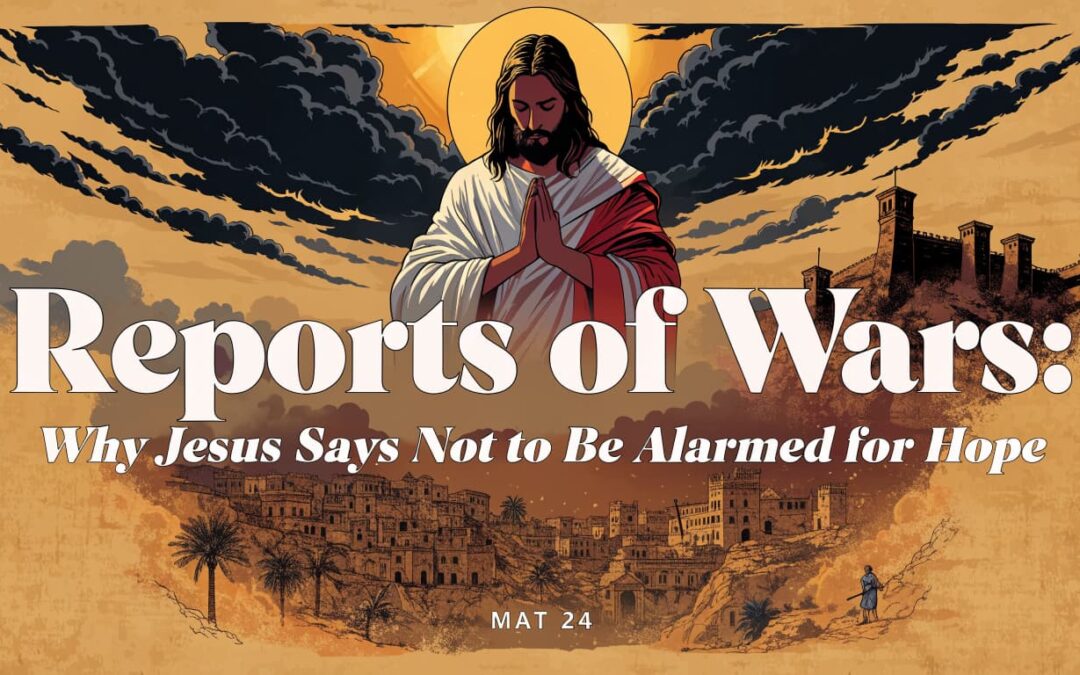
Wars and Reports of Wars: Why Jesus Says Do Not Be Alarmed
When wars and alarming reports dominate the news, fear and confusion can come quickly. Jesus spoke directly to this kind of distress: He told His followers not to be alarmed and reminded them that "the end is not yet" (Matthew 24:6-8).
We can take His words seriously without treating every frightening headline as a sure sign that the end has arrived. From our independent, Spirit-filled Pentecostal perspective, we'll stay close to Scripture, distinguish Jesus' teaching from modern guesses, and make room for compassion toward people suffering through conflict.
Let's look first at what Jesus meant by "wars and reports of wars," and why His command not to fear belongs right alongside that warning. Watch a Bible teaching on Matthew 24 and wars and rumors of war.
What Jesus Meant by “Wars and Reports of Wars”
Jesus spoke about conflict in a conversation with His disciples about the Temple and what lay ahead. The phrase can sound like a headline from our own time, but we need to read it with His full warning in view. He names wars and reports of wars, then tells His followers not to be alarmed.
The same warning appears in Matthew, Mark, and Luke
Matthew, Mark, and Luke preserve the same basic order. Jesus first warns against deception. Then He speaks of wars and reports of wars, tells His followers not to be troubled, and makes clear that the end does not immediately follow.
In Matthew 24 in the NKJV, Jesus says that many will come claiming to be the Christ and will deceive many. He then says His disciples will hear of wars and rumors of wars, but they must not be troubled because "the end is not yet." Mark follows the same pattern in Mark 13:5-8 and Luke in Luke 21:8-11: beware of deception, hear reports of conflict, and do not let fear take over. Luke makes the timing especially plain: these things must happen first, but the end will not follow immediately.
That sequence matters. If we quote only "wars and rumors of wars," we leave out the instructions Jesus placed beside it. He does not tell His followers to treat every report as proof that the end has arrived. He says not to be alarmed, and He says the end is not yet.
Matthew and Mark call the events that follow, including wars, famines, and earthquakes, the beginning of birth pains. Luke also describes upheaval and distress. The image is of beginnings, not a completed event or a date we can calculate. We can read more about Jesus' birth pains prophecy in Matthew 24, while keeping His command against alarm in view.
Jesus names conflict without giving a modern checklist
"Wars and reports of wars" includes both conflict itself and news that conflict is happening. That can sound familiar in any generation. But Jesus does not name a present-day country, point to one future war, or give a number of conflicts that would trigger the end.
The same is true of His mention of nations and kingdoms rising against one another. These words describe widespread strife; they do not give us a modern checklist for identifying a particular headline as the final sign. The passages offer no formula for adding up wars, measuring their intensity, or calculating when the end will come.
That doesn't mean we ignore suffering or treat war as insignificant. As followers of Jesus, we can grieve for people caught in conflict, pray for peace, and stay attentive to Scripture. But we should be careful about turning fear into certainty. Jesus' words give us a clear response: recognize the trouble, refuse deception, and do not assume the end has immediately arrived.
Why Jesus Says Not to Fear War News
Jesus' command not to be alarmed belongs at the center of His teaching about war. He names the distress His followers will hear about, then tells them how to respond. That matters when headlines are frightening and speculation spreads quickly. We can take war seriously without letting fear decide what Scripture means.
“Do not be alarmed” is part of the message
Matthew and Mark place Jesus' words side by side: His followers will hear of wars and reports of wars, but they must not be troubled, because "the end is not yet." In Matthew 24:6, the warning not to be alarmed is part of the same verse that says the end has not yet come. Mark 13:7-8 repeats the point, then describes wars, earthquakes, and famines as the beginning of birth pains.
Luke states the timing another way. When people hear of wars and uprisings, they must not be terrified, because these things must happen first and "the end will not come right away" (Luke 21:9-11). Jesus isn't asking His followers to pretend that conflict is harmless. He is correcting the conclusion that every report means the end has arrived.
That correction still matters. A frightening headline may move us to pray, grieve, or help where we can. It does not give us permission to turn fear into a prediction. Jesus' words keep our attention on what He actually said, rather than on confident claims about what a particular war must mean.
Steady faith can face real suffering
Calm faith is not indifference. People lose loved ones, homes, safety, and a sense of what tomorrow will bring. We should grieve with those who suffer, pray for peace and protection, and look for trustworthy reporting before sharing claims that may be false or unverified.
From our Spirit-filled Pentecostal perspective, courage comes as we trust God and seek the Holy Spirit's help. That doesn't mean we know what every headline means, or that we should dismiss real danger. It means we refuse to let panic lead us into speculation, hostility, or despair. We can ask God to protect civilians, strengthen those helping the wounded, and guide leaders toward peace.
We also need to be careful with spiritual language. A frightening event is not automatically a direct message from God about the timing of the end. Jesus gave His followers a clear word for times of conflict: don't be alarmed. We can hold onto that instruction while keeping our hearts open to the people living through war. When fear rises, Jesus' promise of peace and the Holy Spirit's help can remind us that faithful courage includes compassion, prayer, and clear-minded care.
The Beginning of Birth Pains Is Not the End
Jesus' image of birth pains helps us distinguish the start of distress from its completion. He names wars, upheaval, earthquakes, and famine, but He does not turn those events into a schedule for predicting the end.
“The end is not yet” sets a clear limit
In Matthew 24, Jesus tells His disciples they will hear of wars and reports of wars. His instruction follows immediately: "See that you are not troubled." He adds, "the end is not yet." Mark keeps the same order in Mark 13:7-8: wars will happen, but they do not mean the end has arrived.
That wording gives us a clear boundary. Jesus does not name a date, set a number of wars, or describe a measurable threshold that tells us when the end has come. He says these things must happen, then warns His followers not to treat them as proof that the end is here. Any claim that a particular conflict crosses a prophetic line goes beyond what these verses say.
We can take the warning seriously without turning it into a checklist. War brings real grief and danger, and we should pray for those who suffer. But Jesus' words direct us away from alarm and speculation, not toward a way to calculate the future.
Birth pains describe distress, not a timetable
Birth pains are the pains that begin the process of childbirth. The image makes sense in plain language: distress has started, but the birth itself has not taken place. Jesus calls wars, nation rising against nation, earthquakes, and famines "the beginning of sorrows" in Matthew. These events are serious, but the phrase "the beginning" does not mean the process is complete.
People sometimes interpret birth pains to mean that wars and disasters will grow more frequent or intense as the end approaches. That is an interpretation of the image, not a timetable Jesus states in these verses. The passage gives no way to measure such a pattern or use it to calculate how close the end may be.
The events Jesus names also include famine, alongside conflict and earthquakes. These are not abstract signs to tally from a safe distance. They bring suffering to real people, and we should respond with compassion rather than treat another person's hardship as proof of a date. For more on how food shortages fit into the passage, see our discussion of Matthew 24's warnings about conflict and food crises.
Jesus' comparison keeps both truths in view: distress is real, and its beginning is not its completion. So when headlines bring fear, we can remember His words, refuse confident predictions the passage does not make, and stay faithful to what He actually said.
How the Temple Context Shapes the Prophecy
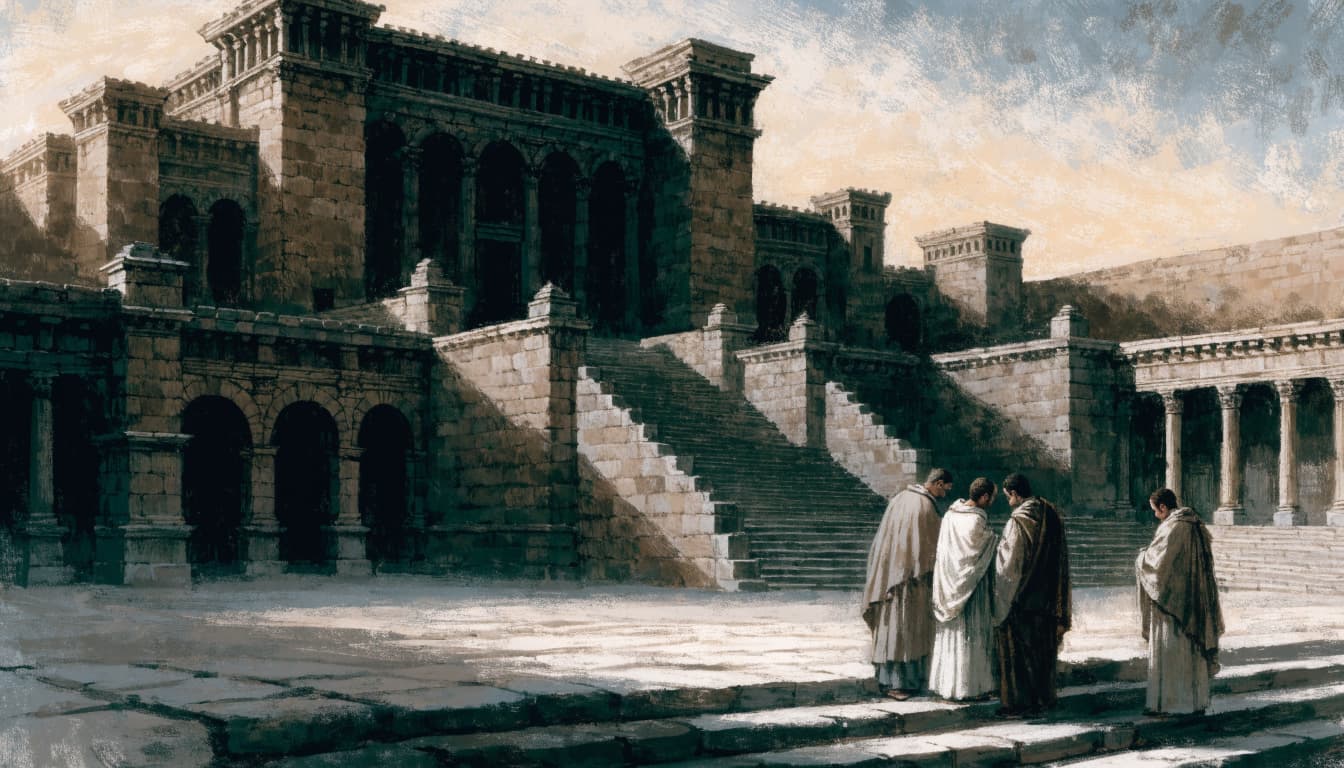
Jesus' words about wars and reports of wars come within a larger conversation about the Temple, Jerusalem, and what lay ahead. The disciples first point out the Temple buildings. After Jesus says they will be torn down, they ask when this will happen and what signs will accompany His coming and the end of the age (Matthew 24:1-3, Mark 13:1-4, Luke 21:5-7).
The disciples’ questions frame the teaching
The Temple is not a minor detail that we can set aside. It gives the discourse its starting point: Jesus predicts its destruction, and the disciples ask about the timing and the signs. Matthew, Mark, and Luke then record His warnings about deception, conflict, and upheaval (Matthew 24:4-8, Mark 13:5-8, Luke 21:8-11).
That sequence matters. Jesus speaks about wars and reports of wars in response to questions about events connected to the Temple and what was coming. He warns His followers not to be alarmed, and He says the end will not follow immediately. The passage itself gives us those instructions. It does not name a modern conflict or provide a calendar for predicting the end.
We can read the warnings with the Temple in view without claiming every part of the discourse has only one possible referent. The Olivet Discourse and the disciples' questions deserve to be read together, rather than isolating a phrase about war from the conversation that surrounds it.
Faithful Christians hold more than one reading
Christians differ on how the discourse relates to Jerusalem's destruction and Christ's future return. One approach gives substantial weight to Jesus' warning about the Temple and Jerusalem, seeing the city's destruction in AD 70 as a major fulfillment. Another approach reads the discourse as also looking beyond that event toward Christ's return. Some Christians see both a near historical fulfillment and a future horizon.
These are interpretive approaches, not conclusions stated in full by the verses about wars. The text clearly connects Jesus' teaching to the disciples' questions, and it clearly tells them not to treat conflict as proof that the end has arrived. How the different parts of the discourse relate to Jerusalem's fall and the future is debated. A closer look at the Olivet Discourse outlines some of the questions Christians consider.
So we should separate what Jesus says plainly from the larger conclusions readers draw. We can affirm His prophecy about the Temple, take the warnings seriously, and still admit where faithful Christians interpret the scope differently. That careful reading keeps us grounded in Scripture instead of making a confident claim the passage does not settle.
How to Read Today’s Wars Without Sensationalism
Headlines can feel urgent, and viral prophecy claims often make them feel even more so. But when we read Jesus' words about wars, we need to separate what the passage says from what someone claims it means for today.

Separate Scripture from headlines and predictions
When a post claims that a current conflict fulfills prophecy, pause before sharing it. Read the full passage, not just a clipped phrase or a dramatic caption. In Matthew 24:6-8 in the NKJV, Jesus says His followers will hear of wars and reports of wars, tells them not to be troubled, and says, "the end is not yet." The surrounding verses also mention deception, nations rising against nations, famines, and earthquakes.
That context gives us a simple way to weigh a claim:
- Identify what the passage actually says. Notice Jesus' warnings and instructions, not only the words that sound like today's headlines.
- Separate the text from someone's application. A preacher, commentator, or online post may connect a modern event with a passage. That connection is an interpretation, not automatically the meaning Jesus identified.
- Check whether the claim adds certainty the passage does not give. If it names a country, predicts a date, or declares a specific war proof that the end has arrived, ask where the text says that.
Applying Matthew 24:6-8 to a modern conflict is an interpretation, not an identification made by Jesus in the text. We can discuss possible applications with care, but we shouldn't present speculation as a direct word from God. And we don't need to repeat unverified reports to make a prophecy claim sound convincing.
Reject date-setting and claims of certain fulfillment
Jesus' words do not name modern nations, set a date, or give us a count of wars that signals the end. They tell His followers that conflict will occur, but they also tell them not to be alarmed. A headline alone cannot tell us that a particular prophecy has reached its final fulfillment.
Christians who study end-times passages may disagree about how Jesus' teaching relates to events in His own generation and to His future return. We can respect sincere differences while still being careful with claims of certainty. A confident tone doesn't turn an interpretation into Scripture.
So, when someone declares that a current war proves the end is here, return to the passage. What does Jesus actually say? What part comes from the commentator's application? And does the passage support the certainty being claimed? Those questions help us stay alert without giving fear the authority to interpret Scripture for us.
How to Respond With Prayer, Discernment, and Hope
Jesus' words call us to a steady response when war fills the news: pray, care for people in danger, and refuse panic. Faithful readiness doesn't mean we can explain every conflict. It means we keep following Him while we wait.
Pray and show compassion without spreading fear
When reports of war reach us, we can pray for civilians caught in danger, displaced families searching for safety, and people grieving loved ones. We can also ask God to guide leaders toward restraint, protect humanitarian workers, and strengthen peacemakers working for an end to violence.
Prayer should lead us toward compassion, not speculation. We can check a report before sharing it, avoid reposting graphic or unverified claims, and resist captions that declare a conflict proof of a prophetic timeline. A headline may deserve our attention, but it doesn't give us permission to frighten others with claims Scripture doesn't make.
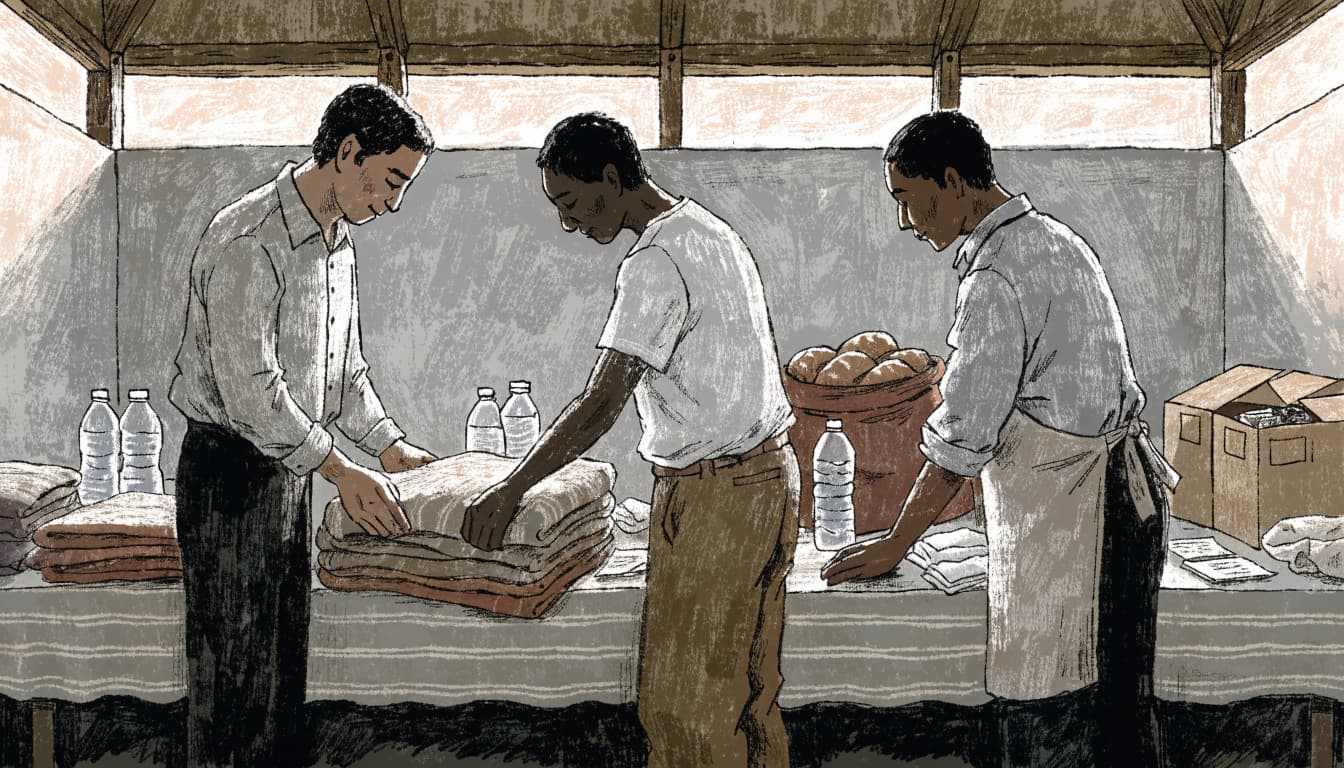
Where practical help is possible, we can support reputable relief efforts, give to trusted organizations, or help a family in our community who has been forced to flee. Even a small act of care matters to someone facing loss. For examples of prayer and practical support amid violence, see the Church's response to the Sahel crisis.
Stay watchful while trusting God’s timing
Jesus tells His followers to stay watchful, but watchfulness isn't a search for hidden dates. In Matthew 24 (NKJV), He speaks about readiness and warns that no one knows the day or hour. We can take His words seriously without turning each new war into a countdown.
So what does readiness look like in ordinary life? We keep faith with Jesus, serve our neighbors, and stay rooted in Scripture. We test dramatic claims against the whole passage instead of accepting them because they sound urgent. The Holy Spirit helps us discern and gives us courage to bear faithful witness, but a private impression should never be presented as certain prophecy.
We can ask the Spirit for wisdom, then remain humble about what we cannot know. Our response is clear: pray for people in danger, care for those harmed by conflict, test claims against Scripture, and remain ready for Jesus. We don't need panic to prove that we are paying attention.
Conclusion
Wars and alarming reports will come, just as Jesus said. But He also told His followers not to be terrified, and made clear that these events alone do not mean the end has arrived. That reminder keeps us from confusing a frightening headline with a certainty Scripture does not give.
So when conflict fills the news, let's stay grounded in Scripture, pray for those who are suffering, and care for the people around us. We can remain watchful without giving fear the final word, trusting God as we wait.
Where Jesus Speaks of Wars and Reports of Wars
Jesus gave this warning during a private conversation with His disciples on the Mount of Olives. After He foretold the destruction of the temple, they asked Him about the timing of these events and the sign of His coming. In Matthew 24:6–8, Jesus said they would hear of wars and reports of wars, then added, “See that you are not alarmed.” Parallel accounts appear in Mark 13:7–8 and Luke 21:9–11. His words place frightening news within a larger prophetic teaching: such events would occur, but they did not mean the end had already come.
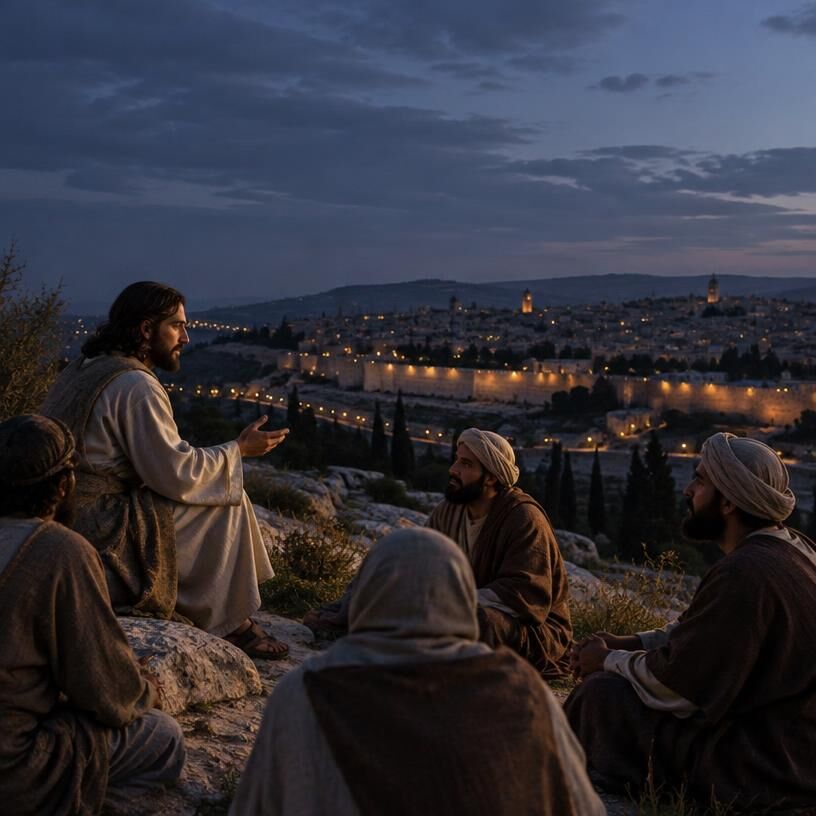

“And you will hear of wars and rumors of wars. See that you are not alarmed, for this must take place, but the end is not yet.” — Matthew 24:6
Jesus Christ, speaking to His disciples
Wars Are Not a Countdown to the End
At Bible Prophecy Ministries, our mission is to help readers understand what Scripture says about events past and future while keeping Jesus at the center. In Matthew 24:6, He tells His disciples they will hear of wars and reports of wars. He does not deny the reality or pain of conflict; He tells them not to be alarmed. These events must take place, yet He immediately adds, “the end is not yet.” That distinction matters. News of war should move believers to prayer, compassion, and faithfulness—not to declare that a particular conflict proves the end has arrived. Reading the whole passage helps us take prophecy seriously without treating every headline as a timetable.
What Jesus Says About Conflict
- Wars are real events, not a surprise to Jesus.
- Reports of wars can travel farther than the fighting itself.
- Conflict brings suffering that calls for compassion.
- Hearing of war does not identify a date for the end.
- Jesus says these things must take place.
- His words place events within a larger teaching.
- “Do not be alarmed” is an instruction, not a denial of danger.
- Fear need not govern how believers read the news.
- Prayer offers a faithful response to troubling reports.
- Care for those affected matters more than speculation.
- Calm attention leaves room for sober discernment.
- Trust in Christ steadies us amid uncertainty.
- Prophecy calls for careful reading of Jesus’ full statement.
- “Must take place” does not mean “the end is now.”
- “The end is not yet” rules out a hasty conclusion.
- No single war supplies a timetable in this verse.
- Fulfillment should be understood in its scriptural context.
- The focus remains on Jesus, not sensational headlines.
Frequently Asked Questions About Wars and Reports of Wars
Explore Jesus’ warning in its biblical context and find a grounded way to respond to troubling news.
Where did Jesus speak about wars and reports of wars?
Jesus used this phrase in His teaching on the Mount of Olives, recorded in Matthew 24:6 and Mark 13:7. He told His disciples they would hear of conflicts but should not be alarmed.
Why did Jesus say, “Do not be alarmed”?
Jesus acknowledged that wars would happen, but He did not want His followers ruled by fear. His words call for trust in Him rather than panic whenever frightening events unfold.
Did Jesus say every war means the end is near?
No. Jesus said these things must happen, “but the end is not yet” (Matthew 24:6). A conflict should not be treated as proof that a specific end-times timetable has begun.
What does “reports of wars” mean for readers today?
It refers to news of conflict as well as conflict itself. Today’s constant stream of updates can make those reports feel overwhelming, making Jesus’ call to remain steady especially relevant.
How should Christians respond to news of war?
Respond with prayer, compassion for those affected, and careful attention to the facts. Jesus’ warning invites believers to resist fear without ignoring suffering.
How can I study this prophecy without speculating?
Read Matthew 24 and Mark 13 in context, note what Jesus says and does not say, and keep the focus on His teaching. Compare related passages before drawing conclusions about current events.
Keep Studying Prophecy With Jesus at the Center
Explore related Bible prophecy articles to see how Scripture speaks to troubled times and points us back to Jesus.