
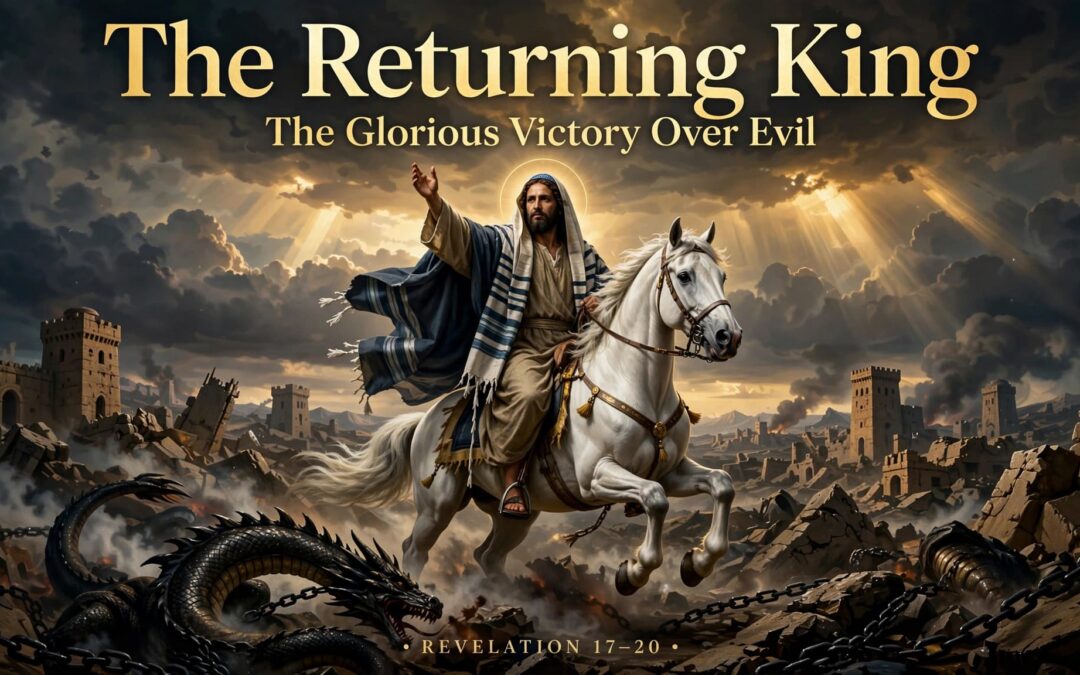
Babylon Falls, Christ Reigns: Meet the Returning King in Revelation 17–20
Babylon's corrupt power comes to an end, but Jesus appears as the righteous King no power can defeat. Revelation turns our attention from a world built on pride and injustice to the One who judges in righteousness and reigns.
We'll follow Revelation 17–20 as Babylon is exposed and falls, Heaven rejoices, and Christ appears as the Faithful and True rider. We won't pin Babylon on a modern nation or institution; we'll stay with what Scripture says and the hope it gives you.
Let's begin with the contrast at the heart of the vision: Babylon's fall and Christ's victory.
Babylon Falls, Christ Reigns, the Returning King Takes Center Stage
Revelation 17–19 changes the view before us. Babylon first appears alluring and powerful, then her judgment is announced, Heaven rejoices, and Jesus appears as the victorious King. The sequence takes us from corrupt power that seems untouchable to Christ's public victory.
What Babylon represents in Revelation
John's vision gives us concrete details. In Revelation 17:1–6, a woman sits on many waters and is linked with the kings of the earth. She wears purple and scarlet, displays gold and precious stones, and holds a cup filled with abominations. Her name is "Babylon the Great," and John sees her drunk with the blood of God's people and witnesses to Jesus.
The angel explains that the waters are peoples, multitudes, nations, and languages (Revelation 17:15). The woman is also called "the great city" that rules over the kings of the earth (Revelation 17:18). So the image joins political reach with luxury, idolatry, corruption, and violence against faithful witnesses. Babylon's influence is broad, and her splendor hides what she does.
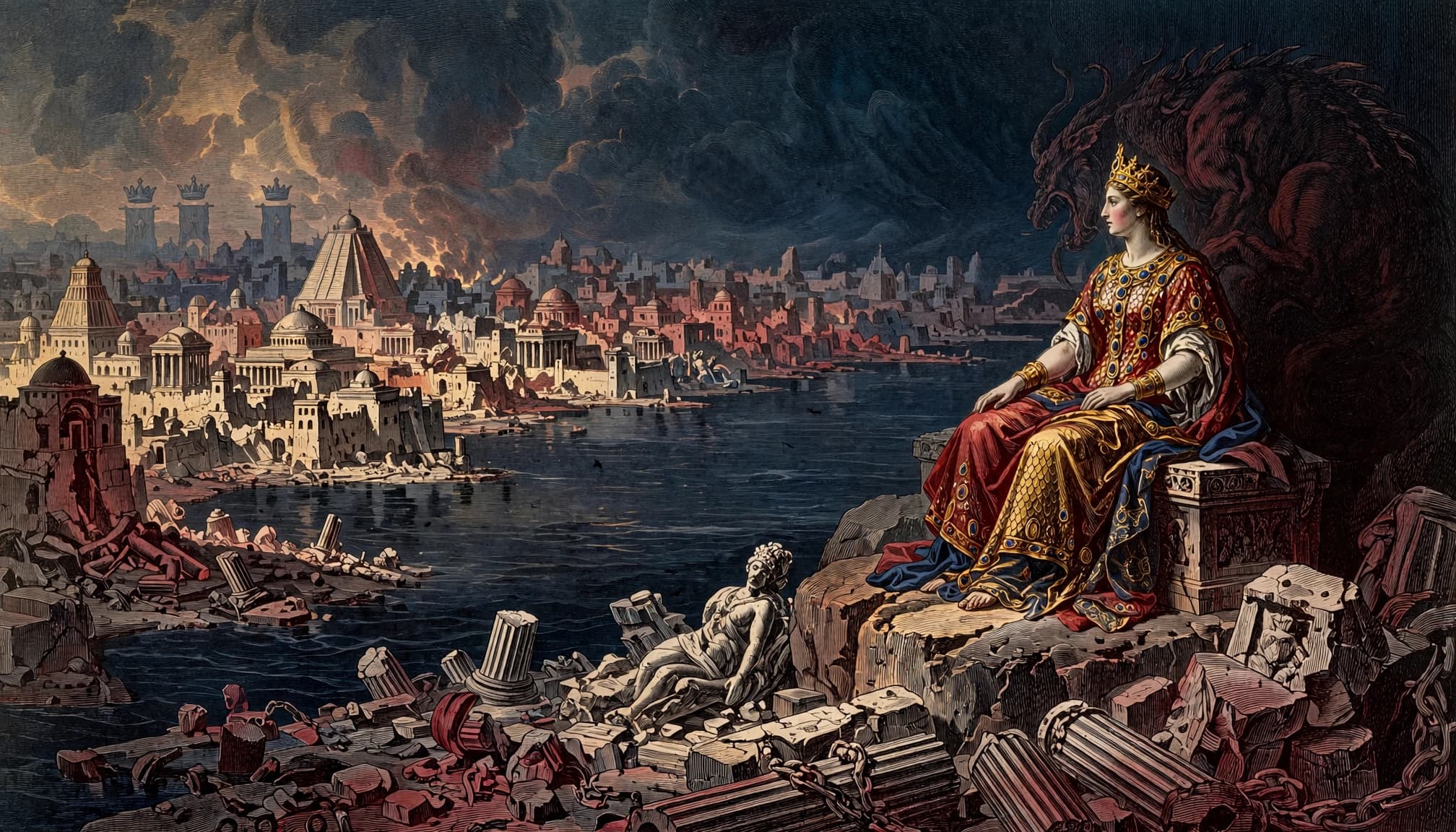
Revelation gives us these details directly. Identifying Babylon with a particular historical empire or seeing her as a symbol of recurring oppressive power involves interpretation. Readers have connected the image with ancient Rome and with broader patterns of empire, but the verses themselves do not name a modern nation or organization. For a closer look at Babylon's judgment in Revelation 17–18, we can follow the vision without confusing its imagery with a settled modern identification.
Why modern identifications need care
Babylon's warning still speaks to recognizable patterns: greed dressed up as success, rulers and institutions serving one another, deception that makes corruption seem normal, and persecution of those who remain faithful to God. We can examine those patterns in our own lives and societies without declaring that a specific country, church, or organization is Babylon.
That distinction matters. Revelation calls God's people to reject Babylon's sins, not to build certainty on a label the passage never applies to a present-day target. In chapter 18, the call to "come out of her" is a call to refuse participation in her wrongdoing. It does not ask us to guess which modern power will fall next.
As we read, let's keep both parts of the vision in view: Babylon's apparent strength and her real corruption. Her alliances, wealth, and influence do not make her righteous or permanent. Revelation exposes what lies beneath the splendor, then turns our attention to the King whose authority cannot be bought, borrowed, or overturned.
Why Babylon’s fall is a warning and a reason for hope
Revelation 18 shows Babylon at the height of her influence, then announces her sudden fall. The chapter warns us about a power built on luxury, deception, and violence. It also offers hope: God sees the people harmed by that power, and its apparent strength does not last.
The cost of a system built on luxury and injustice
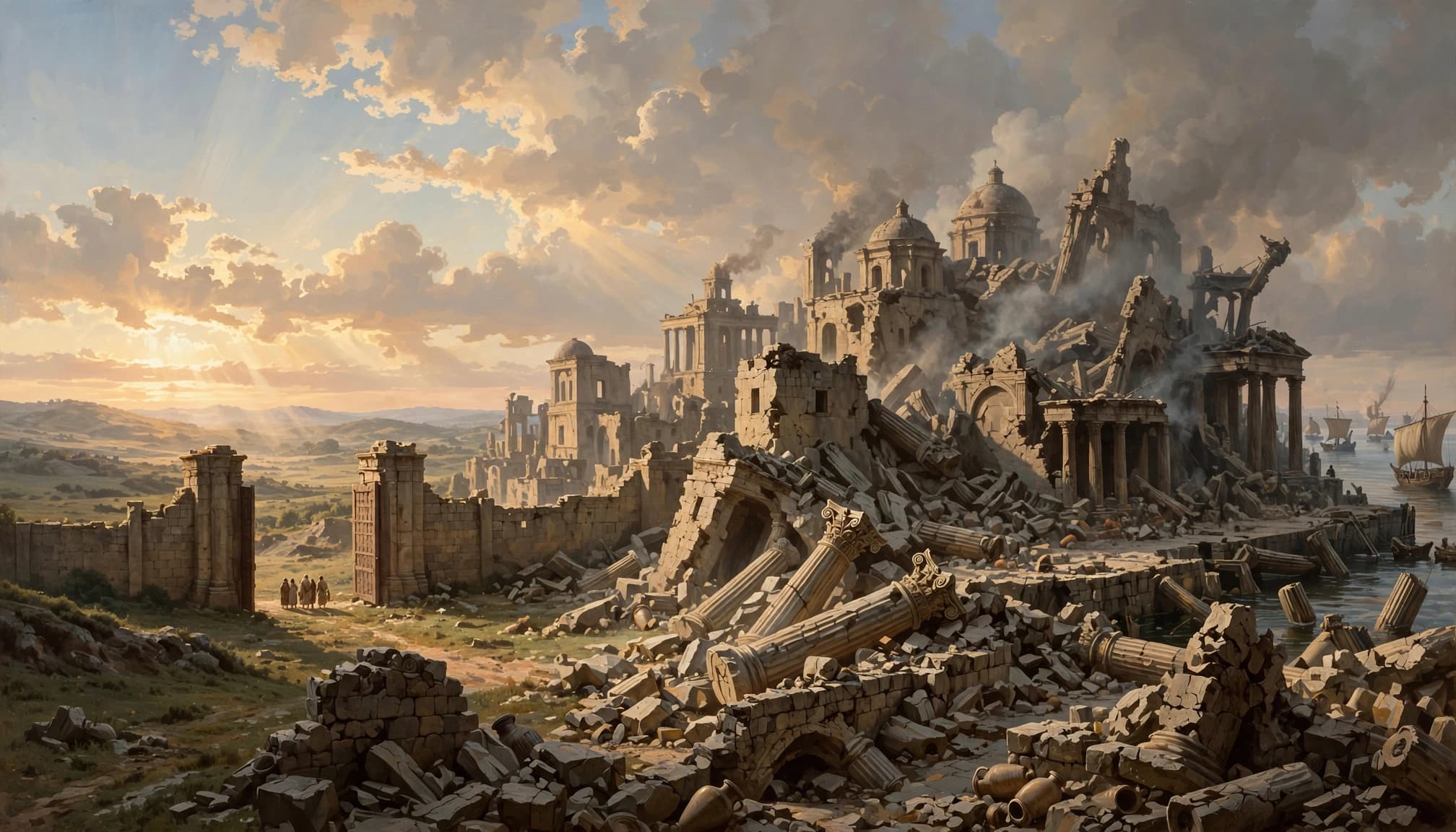
Babylon's influence reaches rulers, merchants, and traders. The city's wealth seems impressive, but Revelation 18:3 ties it to excess and corruption. Her partners grow rich through her luxury, while the trade described in Revelation 18:9-24 reveals what they value when she falls.
Kings, merchants, and seafarers mourn. They weep over lost influence, vanished trade, and riches that can no longer be gained. Their grief makes the source of their loyalty plain: Babylon's prosperity served them, so they grieve when it disappears.
But God's attention is on more than the collapse of a marketplace. Revelation 18:24 says the blood of prophets, saints, and others killed on the earth was found in her. Babylon's wealth cannot hide the lives destroyed to sustain her power. God remembers the victims, and His judgment exposes the violence beneath the splendor.
That is the warning: prosperity alone does not prove that a system is just, or that God approves of it. The fall of Babylon is a reason for hope because wealth, influence, and oppression cannot shield evil from God's judgment.
What it means to come out of Babylon
Then comes the call for God's people to leave Babylon's sins behind. In Revelation 18:4, the command to "come out of her" warns against sharing in her wrongdoing. It does not mean every believer must retreat from society or avoid people who live differently.
We can live among others while refusing the loyalties Babylon demands. That means rejecting greed when it treats people as tools, deceit when it protects our advantage, and idolatry when money, status, or power takes the place of God. It also means refusing to excuse harm just because it benefits us or the people we support.
This call begins with honest questions about our own conduct. Do our choices feed injustice? Do we stay silent when someone is exploited because speaking up might cost us? Coming out of Babylon means turning away from those sins in daily life, not simply pointing at someone else and assigning them the name.
Babylon's fall can unsettle us, but Heaven responds with a call to rejoice because God's judgments are just. We can hold on to that hope while practicing loyalty to God here and now. For more on Heaven's praise after Babylon's judgment, Revelation 19 continues the vision.
Meet Jesus, the Faithful and True rider on the white horse
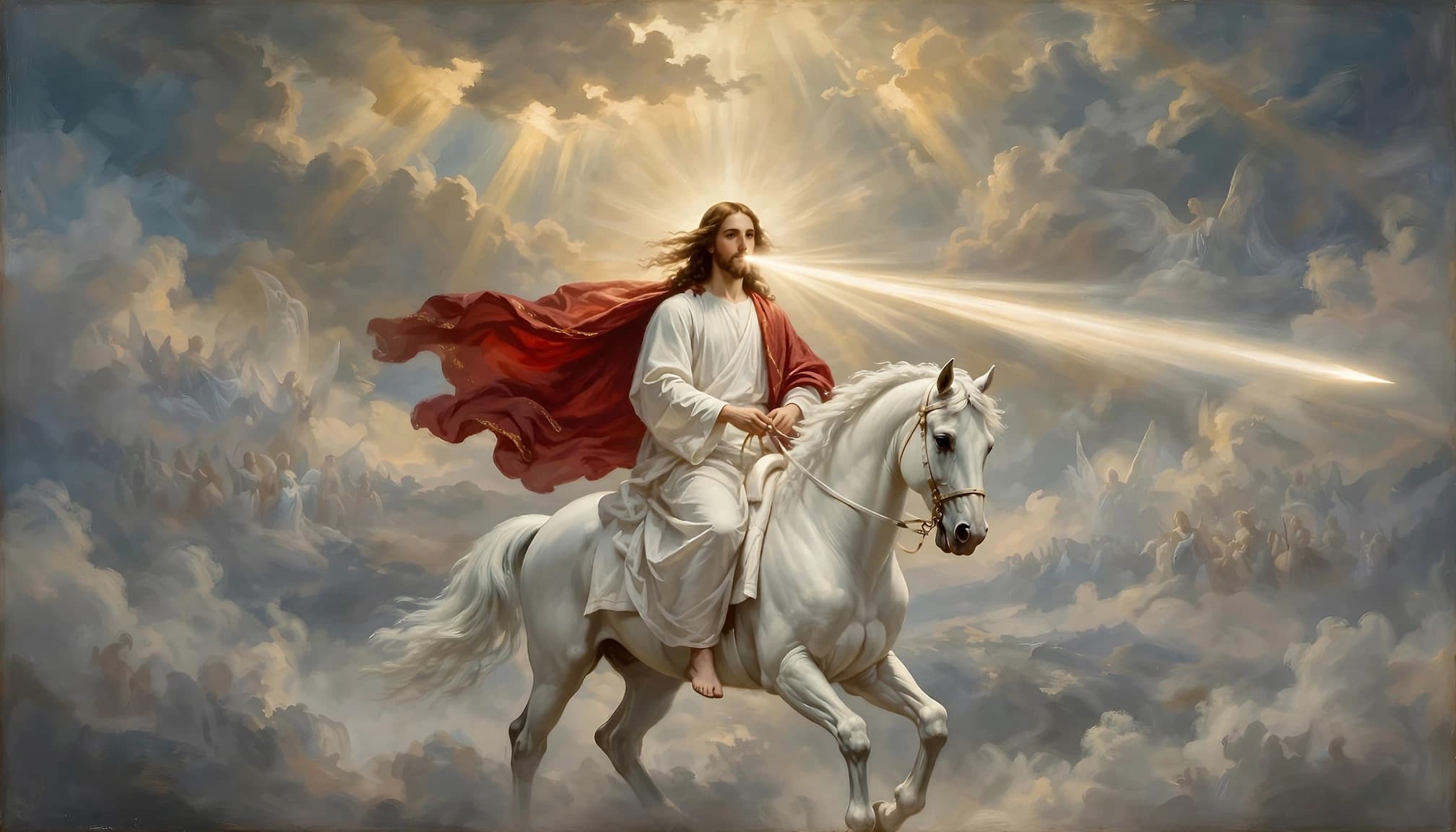
After Babylon's fall, John sees Heaven opened and a white horse appear. The vision shifts our attention from powers built on deception to the King whose authority is righteous and whose word is true. In Revelation 19, Jesus appears as more than a military champion. He is the trustworthy King who judges evil and rules the nations.
Faithful and True means His judgment can be trusted
John calls the rider "Faithful and True" and says He judges and makes war in righteousness (Revelation 19:11). That name reaches back to Jesus' description as "the faithful and true witness" (Revelation 3:14). The connection matters: the One who tells the truth about God is also the One who judges the world.
Babylon's power relied on luxury, corruption, and violence. Her rulers and merchants gained from a system that deceived nations and shed the blood of God's people. Jesus stands in direct contrast. He doesn't judge to protect His own interests or hide wrongdoing. His judgment is righteous because He is faithful and true.
That promise gives us a clear way to read the vision. Jesus sees what Babylon's splendor conceals, and no power can bribe or mislead Him. We can trust His judgment even when injustice seems to prosper. For another look at Jesus as the Faithful and True Rider, we can keep our attention on the character Revelation gives Him.
The Word of God and King of kings
John gives the rider another name: "The Word of God" (Revelation 19:13). The title echoes John's Gospel, where the Word is with God, is God, and becomes flesh (John 1:1–14). Revelation doesn't mark this as a direct quotation, but the connection helps us see who rides the white horse: Jesus, God's living Word.
The sharp sword coming from His mouth (Revelation 19:15) also points to the authority of His word. He defeats evil by His sovereign command, not through a conventional battle scene. The image echoes Psalm 2:7–9, where God's anointed King rules the nations with an iron scepter.
Then John sees the title written on the rider's robe and thigh: "KING OF KINGS AND LORD OF LORDS" (Revelation 19:16). No ruler stands above Him. The vision presents Jesus as the Word who speaks with divine authority and the King whose reign cannot be overturned.
How the rider’s symbols reveal the kind of King Jesus is
The rider's robe, the winepress, the armies of Heaven, and the iron scepter all tell us something about Jesus' reign. These images draw on earlier Scripture, but we should be careful not to claim more than Revelation says. The central point is clear: Christ judges evil with authority, and His victory is certain.
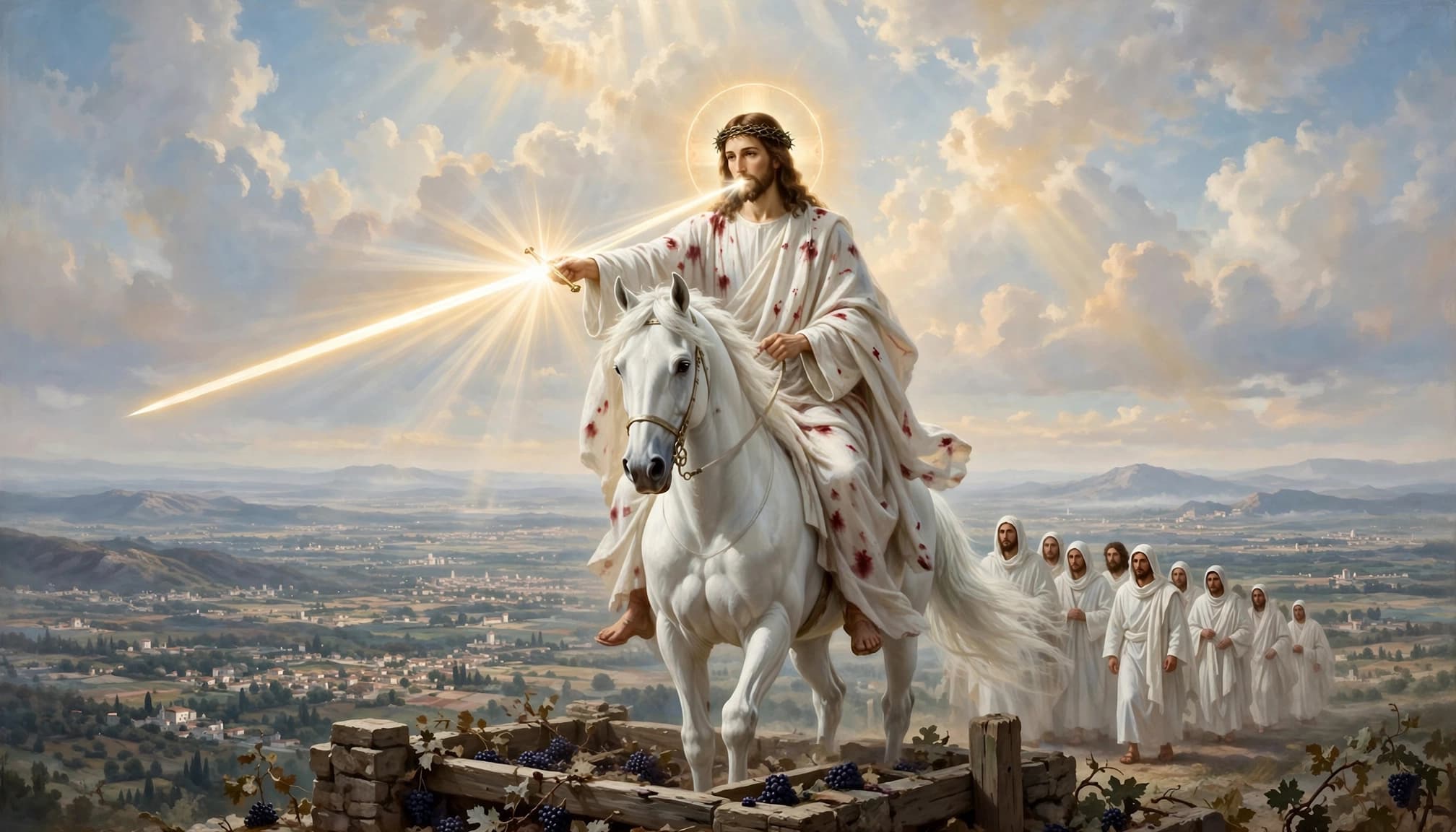
The blood-dipped robe and the winepress of judgment
John sees the rider wearing a robe dipped in blood (Revelation 19:13). A few verses later, the rider treads the winepress of the fierceness and wrath of Almighty God (Revelation 19:15). The image is not gentle or vague. Jesus comes to judge evil, and His judgment is decisive.
The vision echoes Isaiah's description of the Lord coming from Edom. There, the divine warrior's garments are stained as He treads the winepress in judgment. John draws on that imagery to show the rider's authority over those who oppose God.
But what does the blood on Jesus' robe mean? The passage doesn't settle whether it refers only to His own blood, only to the blood of His enemies, or evokes both. We should leave that question open rather than turning one possible reading into a certainty. What Revelation does make plain is that the robe and winepress belong to the vision of divine judgment.
Babylon's power brought suffering and death to God's people. Here, the rider confronts evil with righteous judgment. That contrast matters: Jesus doesn't rule through corruption or self-interest. His authority is God's, and His judgment is just. For a closer look at Christ's authority in the white horse vision, we can keep the whole scene in view.
The armies of Heaven and the iron scepter
The rider's followers wear fine linen, white and clean (Revelation 19:14). John identifies them as the armies of Heaven, but these verses don't tell us exactly who they are or define their full composition. We can say what the text says, and resist filling in details it leaves unstated.
Then John describes the rider ruling the nations with an iron scepter (Revelation 19:15). This echoes Psalm 2:7–9, where God appoints His King and gives Him authority over the nations. The scepter is a royal image, but it also carries the force of judgment. Christ's rule cannot be overturned by rebellious powers.
The armies follow the King, yet Revelation keeps the focus on Him. The decisive authority belongs to Jesus, not to the host behind Him. We see the same emphasis in the sword that comes from His mouth: His word carries out His judgment. No rival king can resist His command, and no power can keep His victory from coming.
How Christ’s righteous war differs from Babylon’s violence
Babylon's power depends on deception, exploitation, and the persecution of God's people. Christ's victory is different: He judges in righteousness, and His authority ends rebellion without giving His followers a model for human violence.
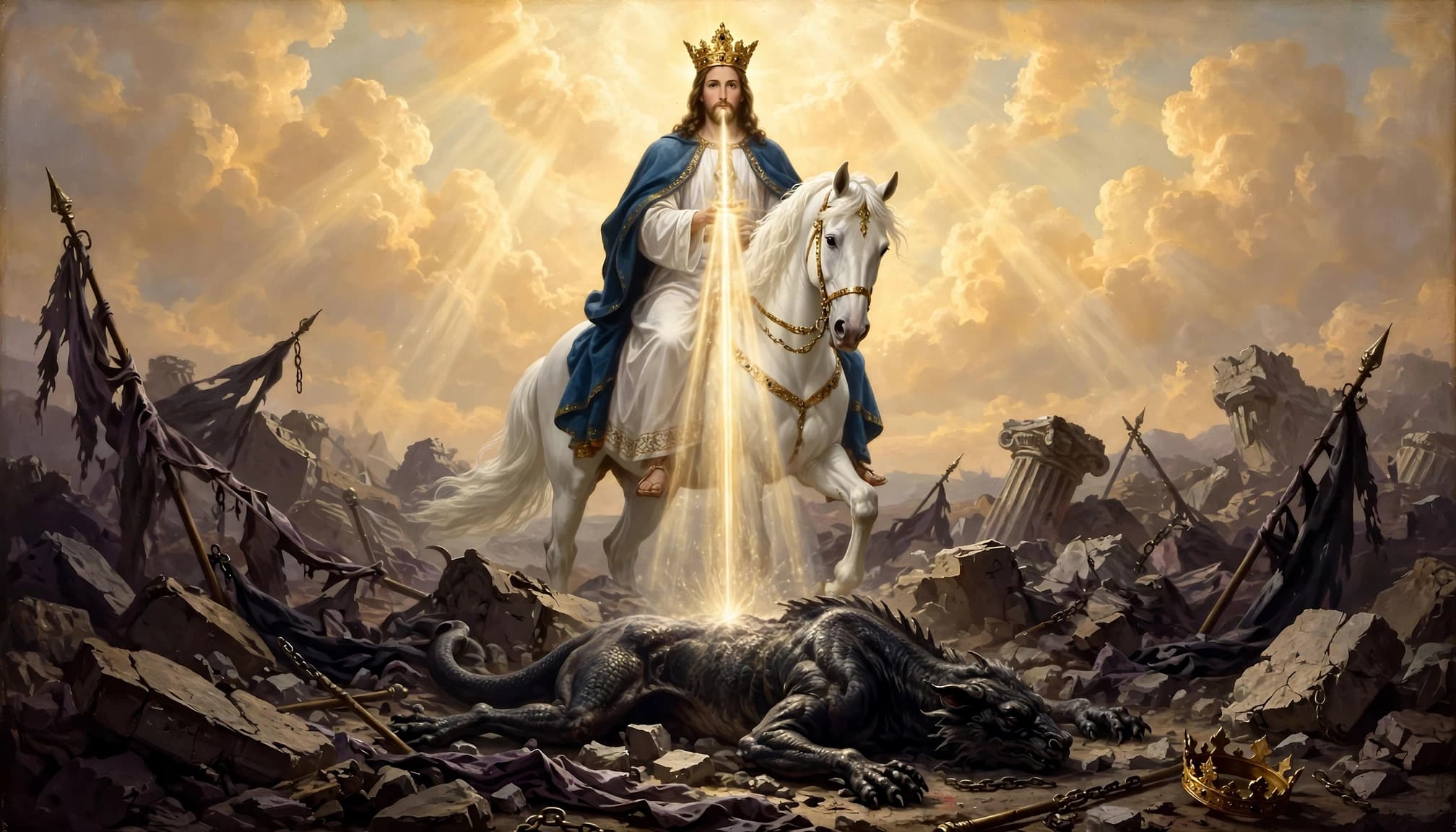
Judgment brings an end to deception and oppression
In Revelation 19:11–21, John sees the beast, the kings allied with him, and their armies gathered against Christ. Their apparent strength cannot hold. The beast and false prophet are captured, and the gathered forces are defeated.
This judgment answers the violence of Babylon. Revelation has already shown her wealth tied to corruption and her power stained by the blood of God's people. Jesus, by contrast, is called Faithful and True, and Revelation 19:11 says He judges and makes war "in righteousness." His judgment exposes evil and brings its rebellion to an end. He does not exploit the vulnerable or disguise injustice to protect His own advantage.
The sword from Christ's mouth points to the authority of His word. John's vision is not a battle plan for Christians or permission to attack those we oppose. The King Himself brings judgment. The image of His rule echoes Psalm 2:7–9, where God's anointed King receives authority over the nations. We can trust Christ to judge evil without taking vengeance into our own hands. For a closer look at Christ's righteous judgment in Revelation 19, we can keep that distinction in view.
A call to faithful witness before the King returns
Revelation's vision also brings us back to the choice facing believers: whom will we worship and obey? The beast demands loyalty that belongs to God. John later describes faithful witnesses who refused to worship the beast and held to their testimony about Jesus (Revelation 20:4). Their example calls us to steady faith, not panic or retaliation.
As Pentecostal believers, we trust the Holy Spirit to strengthen that witness. Jesus promised the disciples power to be His witnesses when the Holy Spirit came upon them (Acts 1:8). That power draws us toward faithful testimony, service, and obedience. It does not turn the church into another force seeking control.
So we resist the beast's demands by refusing to give worship, truth, or compassion to anything that opposes God. We speak of Jesus, live by the Holy Spirit, and leave judgment in the hands of the righteous King. Babylon's violence will not have the final word. Christ will.
What Revelation 20 teaches about Christ’s coming reign
Revelation 20 turns our attention from Babylon's fall and the beast's defeat to the hope of Christ's reign. John sees Satan bound, faithful witnesses raised to life, and those witnesses reigning with Jesus. Christians differ on how the thousand years fit into the timeline, but the promise at the heart of the vision is clear: Christ's faithful people will share in His victory.
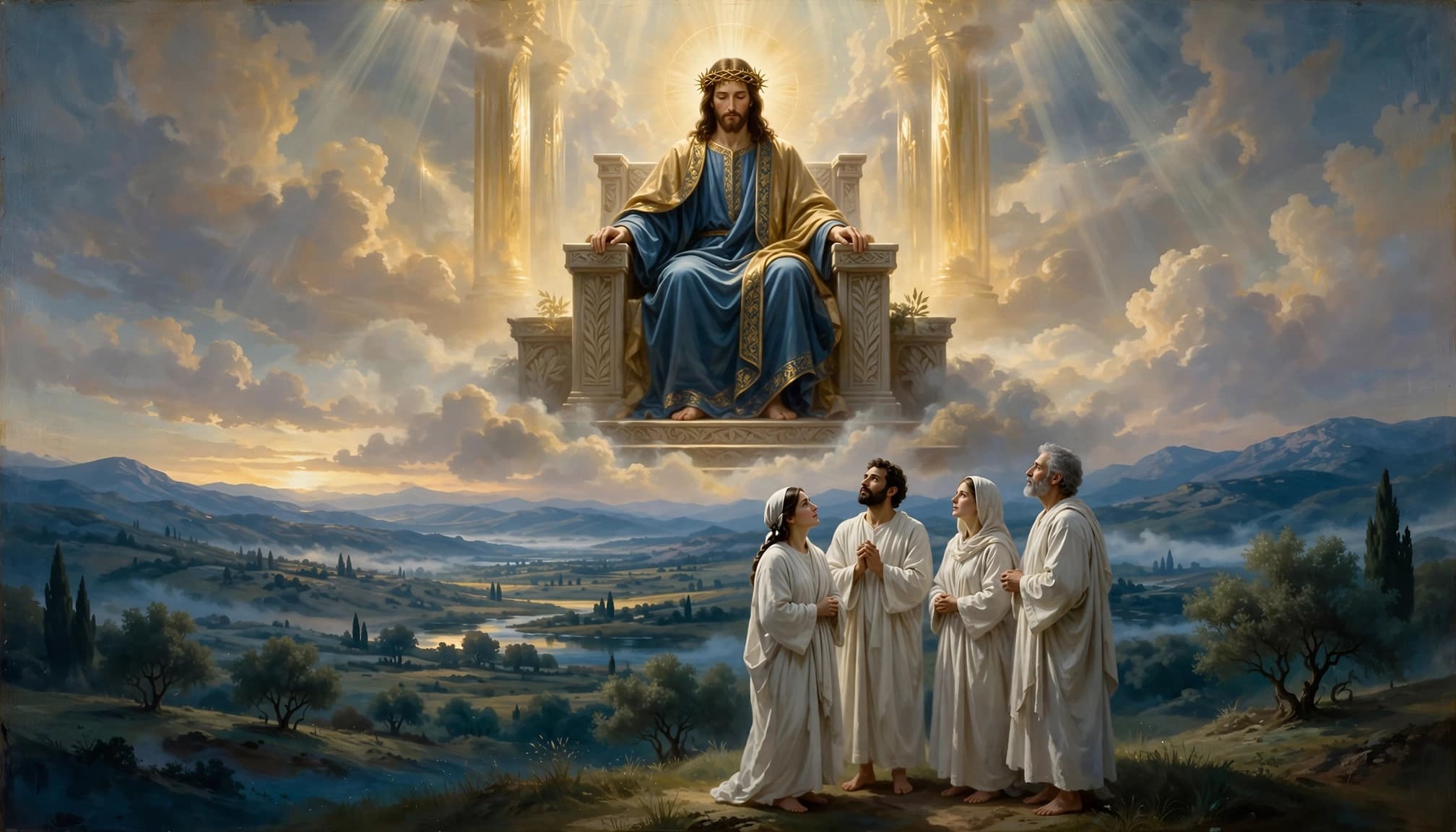
The promise given to those who remain faithful
In Revelation 20:1–6, an angel binds Satan so he can no longer deceive the nations during the thousand years. John then sees thrones and the people given authority to judge. Among them are those killed for their testimony about Jesus and God's Word. They refused to worship the beast or its image, and they live and reign with Christ.
That promise speaks directly to believers who face pressure to compromise their worship and witness. The beast may demand allegiance, and faithful obedience may carry a cost. Yet John's vision says death does not erase their testimony or separate them from Christ's reign. Those who share in the first resurrection are blessed and holy, and, as Revelation 20:6 declares, the second death has no power over them.
We can hold on to that hope without pretending perseverance is easy. Revelation honors those who remain faithful, even when their witness brings suffering. Their reward is life with Christ, service in His Kingdom, and freedom from the final judgment represented by the second death. For us, the passage calls for steady loyalty to Jesus, not fear-driven speculation.
Why Christians differ about the thousand years
The sequence matters, but Christians don't all read it the same way. In the premillennial reading held by the Assemblies of God, Christ returns before a future thousand-year reign on earth. Revelation 19's account of Christ's victory is followed by chapter 20's binding of Satan and reign with the saints. The Assemblies of God describes this as the most natural reading of the passage in its position on premillennial eschatology.
Other Bible-believing Christians understand the millennium symbolically. Many amillennial interpreters see it as Christ's present reign during the church age, while postmillennial interpreters expect a period of Gospel flourishing before Christ returns. These readings differ on the timing and meaning of the thousand years, and on whether the visions describe a strict chronological sequence. We can review different interpretations of Revelation 20's millennium while recognizing that the chapter itself has prompted sincere disagreement.
As Pentecostals, we read this passage with the hope of Christ's future return and reign. We also recognize that Christians who read the timeline differently still confess that Jesus reigns and will bring God's purposes to completion. Our confidence rests not on winning every debate about the thousand years, but on the promise that those who belong to Christ will live with Him.
Conclusion
Babylon's wealth, power, and violence pass away, but Jesus remains Faithful and True. He judges in righteousness and reigns as King of kings. We can keep our eyes on Jesus as King of Kings in Revelation 19, the righteous King whose authority no earthly power can overturn.
So let's reject Babylon's sins, remain faithful to Jesus, and live in hope of His return. The powers that oppose God will not have the final word. Christ reigns.
Babylon’s End. Christ’s Kingdom.
When Babylon Falls, the Returning King Reigns
Follow Revelation 17–20 from the judgment of a corrupt world system to the return of Jesus Christ and the triumph of His reign.
Revelation 17–20
Babylon Falls, Christ Reigns: Meet the Returning King in Revelation 17–20
Revelation 17–20 sets two destinies side by side: Babylon, dazzling in its power yet destined for judgment, and Jesus Christ, the faithful and true King whose reign cannot be shaken. As Babylon’s influence collapses, heaven calls God’s people to see beyond its promises of wealth and security.
The vision moves from the fall of the great city to the marriage supper of the Lamb, the return of Christ, and the defeat of those who oppose Him. These chapters do more than describe the end of evil; they reveal the One at the center of biblical prophecy. Jesus comes to judge with righteousness, conquer every rival power, and establish a reign that outlasts every earthly kingdom.
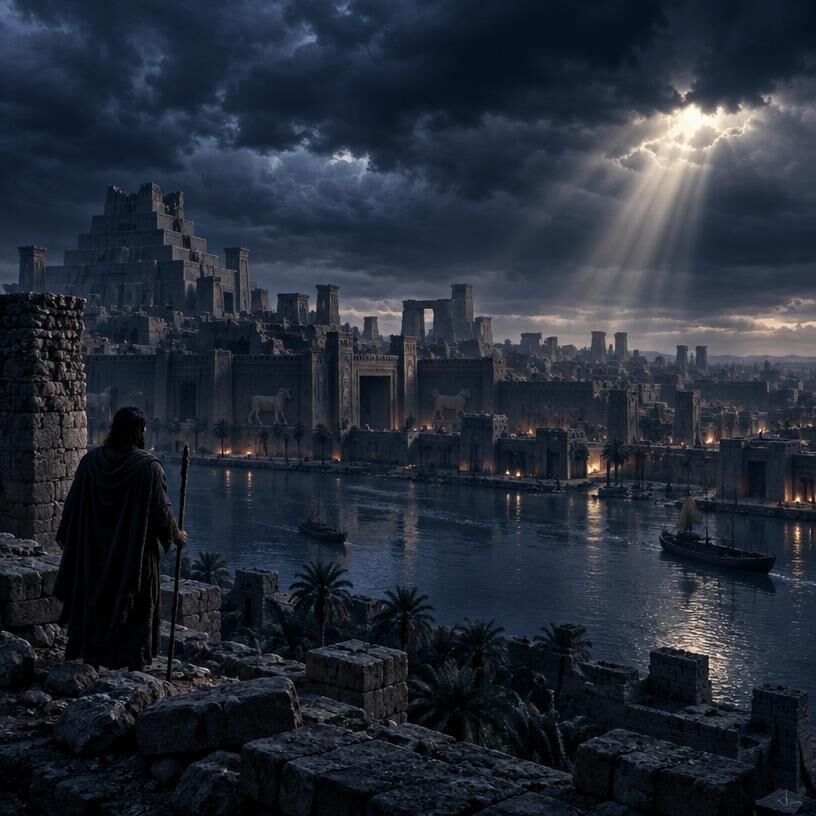
Revelation 17–18
Babylon’s Splendor Cannot Save Her
In Revelation 17–18, Babylon appears as both a seductive woman and a great city: a picture of worldly power, wealth, and false worship united in rebellion against God. She entices the nations, persecutes those faithful to Jesus, and trusts in a glory that cannot last. Yet her downfall is certain. The powers that once supported her turn against her, and God’s judgment brings her proud dominion to an end. At Bible Prophecy Ministries, we read this vision in the light of Scripture’s central promise: every kingdom opposed to God will fall, but Christ’s reign will endure.
“For in one hour is thy judgment come.” — Revelation 18:10 (KJV)
A warning to the fallen city of Babylon
From Babylon’s Ruin to the King’s Return
Babylon’s fall is not the end of Revelation’s story. In chapter 19, heaven answers the collapse of a corrupt kingdom with praise, and the vision turns to Jesus Christ, the rider on the white horse. Called Faithful and True, he judges with righteousness, bears the name King of Kings and Lord of Lords, and defeats the forces gathered against him. His victory rests not on the fleeting wealth or influence that sustained Babylon, but on his rightful authority and unfailing word.
Bible Prophecy Ministries exists to help readers trace how Scripture’s fulfilled and future prophecies point to Jesus. In studying the passage from Babylon’s judgment to Christ’s return, our mission is to keep the focus on the Returning King: faithful to his promises, victorious over evil, and worthy of the worship of every nation.
From Babylon’s Fall to the King’s Reign
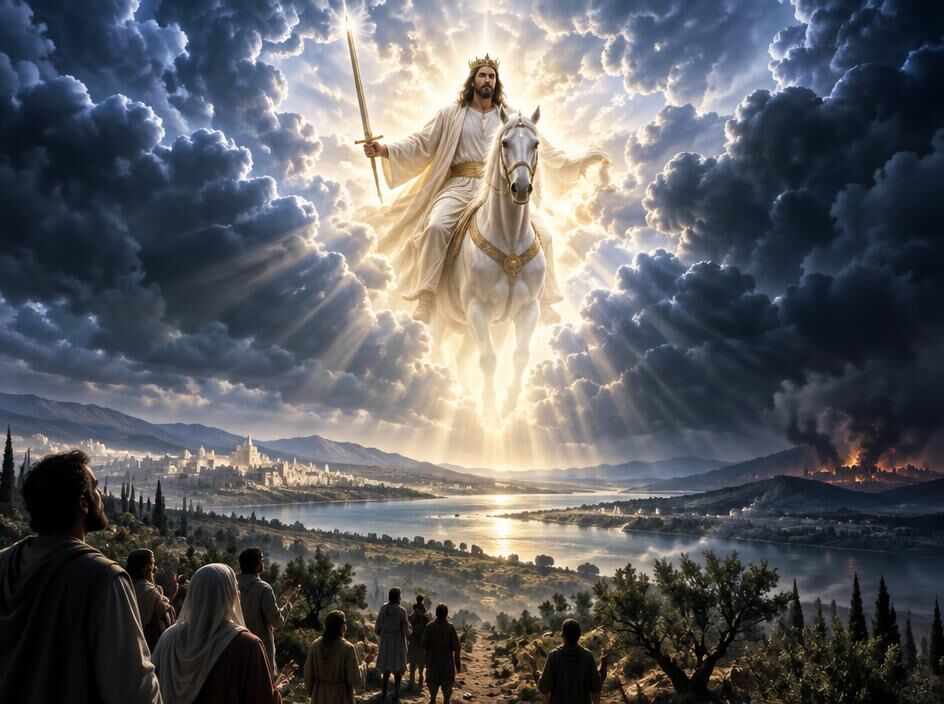
Christ Returns in Victory
Revelation 19 portrays Jesus as Faithful and True, the rider on the white horse who judges justly and defeats the gathered opposition to His rule.

Evil Meets Its End
The beast and false prophet are judged in Revelation 19. Revelation 20 then depicts Satan’s final defeat and God’s judgment before the great white throne.
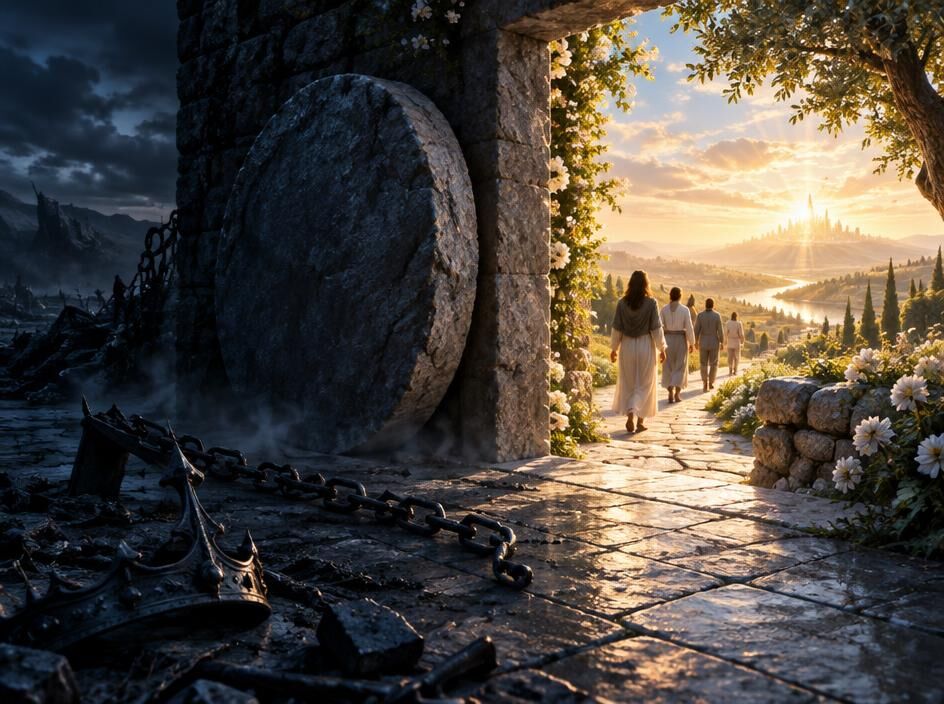
His Reign Gives Hope
Revelation 20 describes Christ’s reign and the vindication of those who belong to Him, pointing readers toward the hope of His righteous rule.
Questions About Babylon and the Returning King
Who or what is Babylon in Revelation 17–18?
Babylon appears as a powerful, corrupting figure associated with idolatry, wealth, and opposition to God. Christians differ on its precise historical and future referents, but the text clearly announces its judgment.
Why does Revelation describe Babylon’s fall?
Babylon’s fall shows that even a seemingly secure system cannot outlast God’s judgment. Revelation 18 calls God’s people to reject its sins rather than share in them.
How do chapters 17–18 connect to Christ’s return?
After Babylon’s judgment, Revelation 19 turns to heavenly praise and the appearance of Christ as the victorious rider. The sequence directs attention from the collapse of human pride to the authority of the King.
What does the rider on the white horse represent?
Revelation 19 names the rider Faithful and True and calls Him the Word of God. The passage presents Him as Jesus Christ, returning to judge and reign in righteousness.
Does Christ win through an uncertain battle?
No. Revelation 19 emphasizes His authority: the armies oppose Him, but their defeat is decisive. The vision portrays victory as belonging to Christ, not as a contest whose outcome is in doubt.
What happens to Satan in Revelation 20?
Satan is bound for a thousand years, later released for a brief time, and finally thrown into the lake of fire. Interpretations of the millennium vary, but the passage leaves no doubt about his ultimate defeat.
What is the millennium?
The millennium is the thousand-year period described in Revelation 20 during which Christ reigns. Christians understand its timing and nature differently, so it helps to read the passage alongside the rest of Scripture.
What is the great white throne judgment?
Revelation 20 depicts the dead standing before God as books are opened and judgment is given. It underscores the seriousness of God’s justice and the importance of the book of life.
How should readers approach Revelation’s imagery?
Begin with the text, its Old Testament echoes, and the message of Revelation as a whole. Recognize symbolic language without overlooking its central claim: Jesus reigns, evil is judged, and God keeps His promises.
Trace the Prophecy Back to Jesus
Read Revelation 17–20 in its Biblical context and follow the story from Babylon’s fall to Christ’s promised reign. Let Scripture shape your understanding of the King who returns.