Matthew 24: What Did the Disciples Ask About the End?
Jesus told His disciples that the temple would be torn down, and on the Mount of Olives they asked when it would happen and what would signal His coming and the end of the age. Those questions are connected, but they don't prove that every event in Jesus' answer happens at the same time.
When we read Matthew 24 alongside Mark 13 and Luke 21, we can keep the original setting in view and let the text guide our understanding. The focus stays on Jesus and His call to faithful watchfulness, not on trying to predict a date.
Let's begin with the questions the disciples asked and what Matthew tells us about that conversation. For a closer look at Jesus' Olivet Discourse in Matthew 24, we can read the passage with those questions in mind.
The Questions Behind the Prophecy: How Matthew Frames the Conversation
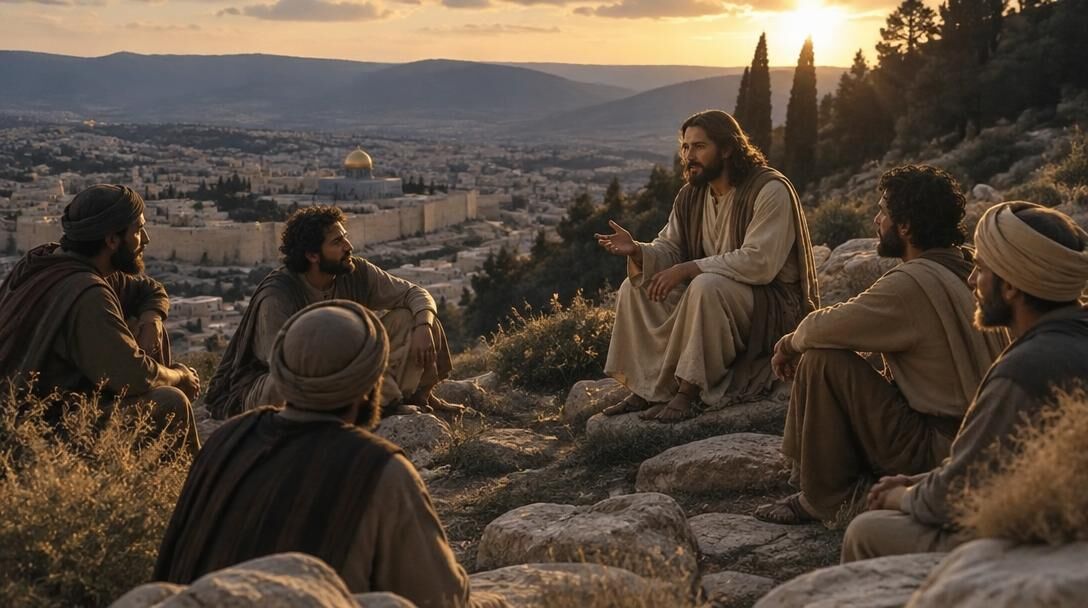
Matthew begins with a striking scene. Jesus leaves the temple, and His disciples point out its buildings. He tells them that the stones will be thrown down, then sits on the Mount of Olives. There, away from the crowds, they ask Him privately about what He has just said (Matthew 24:1–3).
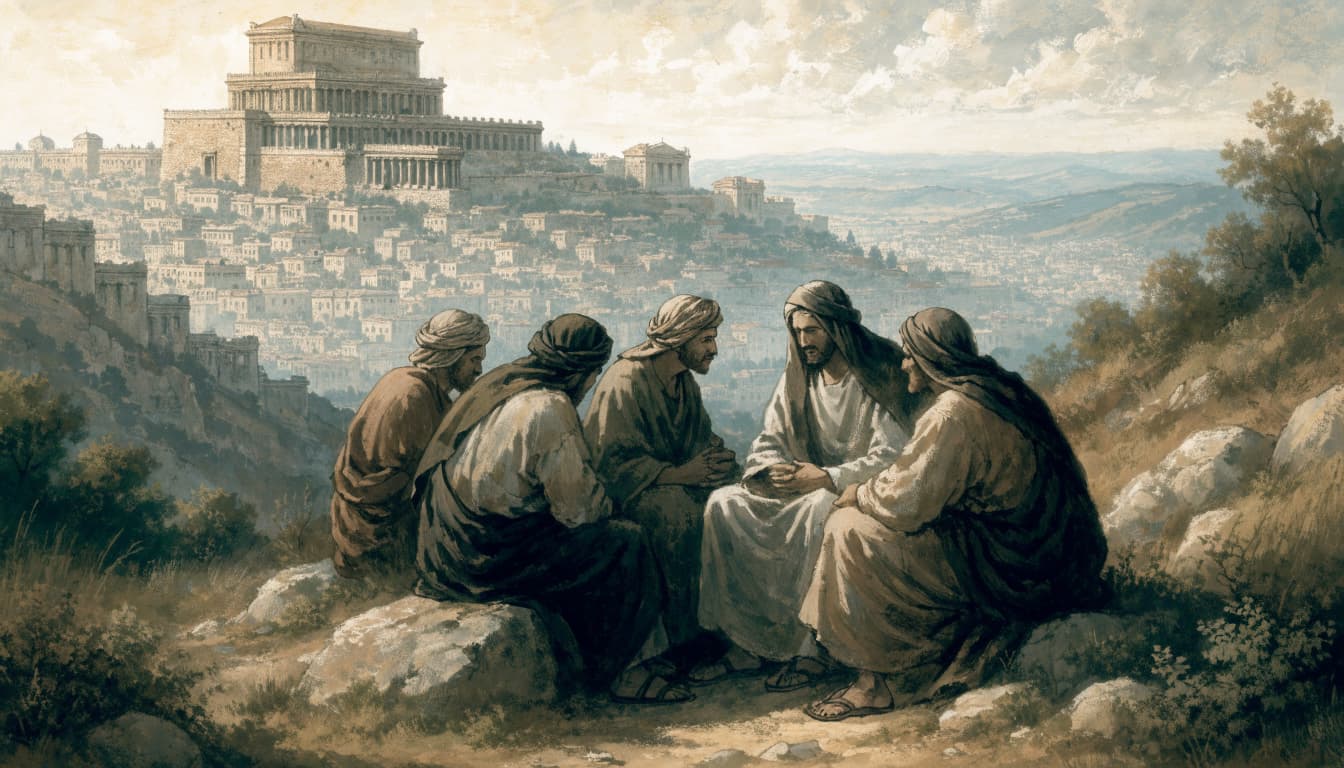
That order matters. The disciples don't begin with an abstract question about the end times. Jesus has just announced the temple's destruction, and their question grows out of that moment. We can read the full chapter of Matthew 24 in the NKJV with that setting in view.
The temple prediction sets the scene
The temple was central to worship and life in Jerusalem. So when Jesus said that not one stone would be left on another, His words would have sounded enormous. The disciples wanted to know when this would happen. They also asked what sign would accompany His coming and the end of the age.
Matthew tells us the conversation happened privately. Mark adds that Peter, James, John, and Andrew were the disciples who questioned Jesus (Mark 13:3). That detail gives us a clearer picture of the scene, but it doesn't change the order of events: Jesus predicts the temple's destruction, then His disciples ask what He means.
The connection between those things is where careful reading begins. The disciples' question joins the temple prediction with Jesus' coming and the end of the age. Does that mean they understood these as one event? The passage doesn't tell us exactly what they understood. We shouldn't assume they already had a settled timeline in mind.
For more on the setting and the questions that open the discourse, see our guide to Matthew 24 and the disciples' questions.
How many questions did they ask?
Matthew records two main questions in the disciples' words: When will these things happen? And what will be the sign of Your coming and of the end of the age? The second question joins two related ideas, Jesus' coming and the end of the age.
Some readers count three inquiries by treating the coming and the end of the age as separate topics. That's understandable, since Matthew names both. Still, the wording presents one sign-question that includes both ideas. Mark and Luke phrase the exchange more narrowly, asking when the predicted events will happen and what sign will show they are about to take place.
So, the number depends partly on how we divide the sentence. The more important point is that the disciples ask about timing and signs in response to Jesus' warning about the temple. We can't settle every interpretive question just by counting clauses.
The question is clear, but the timeline takes care
Matthew's wording brings the temple's destruction, Jesus' coming, and the end of the age into the same conversation. Christians differ on how the events in Jesus' answer relate to one another. Some read much of the discourse in connection with Jerusalem's fall in AD 70. Others see most of it as pointing to a future period and Christ's return. Still others understand the passage as addressing both a near historical crisis and a future fulfillment.
Those readings are interpretations of Jesus' answer. They shouldn't be confused with the disciples' exact question, or treated as though the question itself resolves the timing. The disciples ask what will happen and when. Jesus' response then gives warnings, signs, and instruction about readiness.
That distinction helps us avoid forcing a complete end-times chart into the opening verses. We can take the disciples' question seriously, notice its link to the temple, and keep reading to see how Jesus answers. His words call His followers to watchfulness, but they don't give us permission to claim a date He said no one knows.
What Did the Disciples Mean by the Temple’s Destruction?
The disciples' first question is direct: When would the events Jesus had just described happen? To hear it as they might have, we need to keep the conversation in Jerusalem and the temple prediction in view. That setting matters, especially when we compare Matthew's account with Mark and Luke.
“When will these things happen?”
Jesus had just left the temple when His disciples drew His attention to its buildings. He answered that the stones would be thrown down. Later, on the Mount of Olives, they asked Him privately when "these things" would happen (Matthew 24:1-3). The most immediate reference is Jesus' prediction about the temple.
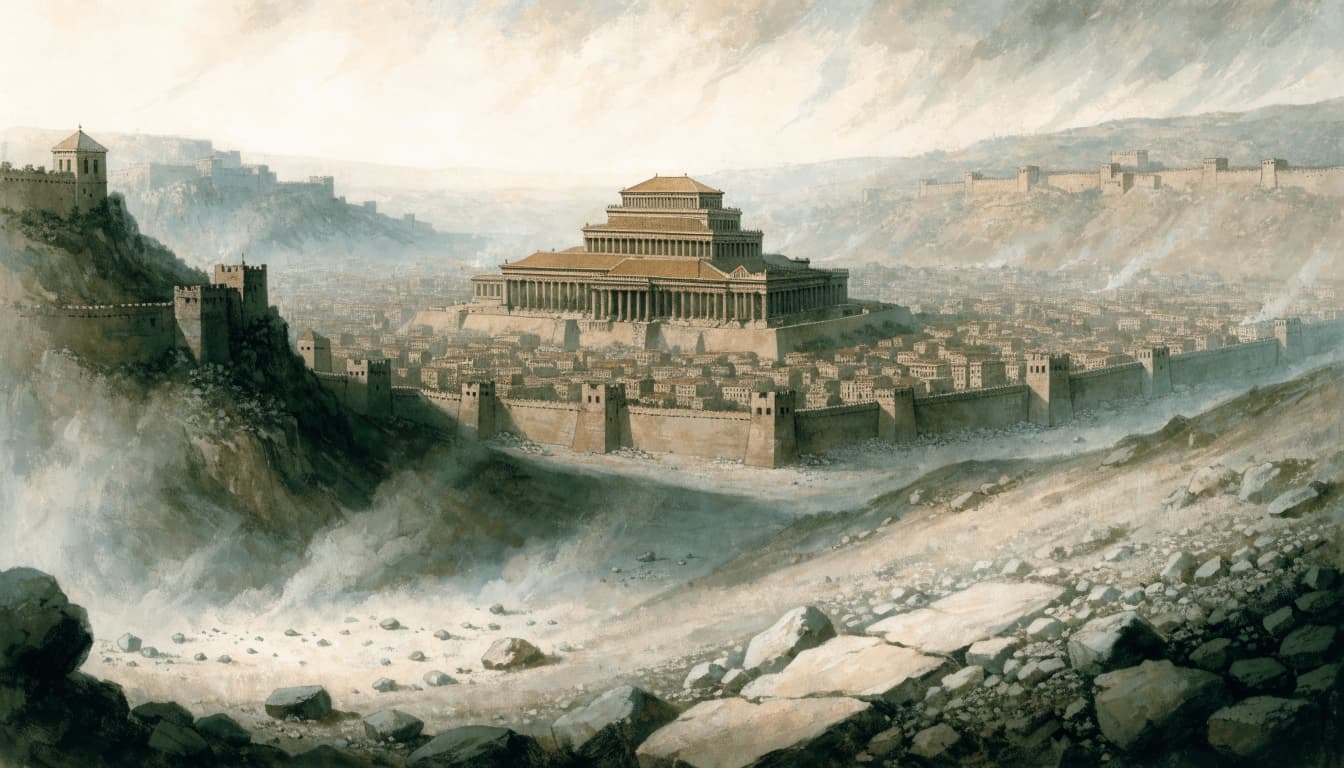
This wasn't a casual question about an ancient building. The temple stood at the center of worship in Jerusalem, and Jesus had announced its destruction. The disciples wanted to know when such a momentous judgment would take place. Mark names Peter, James, John, and Andrew as the ones who asked Him (Mark 13:3).
The parallel accounts help us hear the timing question clearly. Mark asks when "these things" will happen and what sign will show they are about to be fulfilled (Mark 13:1-4). Luke likewise records the question about when the events will occur and what sign will mark their approach (Luke 21:5-7). Matthew adds the wording about Jesus' coming and the end of the age. The accounts share the temple setting, while Matthew makes those additional themes explicit.
Why AD 70 matters, and what it doesn’t settle
The temple's destruction did happen. In AD 70, Roman forces under Titus captured Jerusalem and destroyed the Second Temple. The first-century historian Josephus describes the Roman sack of the city in his account of Jerusalem's fall. That history gives the disciples' timing question a concrete setting. Jesus' words concerned a real city and a real temple, not a vague symbol with no connection to their world.
Luke's parallel also describes Jerusalem surrounded by armies and its people facing distress (Luke 21:20-24). Those details make the Jerusalem crisis especially clear. For another look at how Christians connect the city's fall with prophecy, see Daniel's prophecy and Jerusalem's destruction in AD 70.
But the historical fulfillment of the temple's destruction doesn't, by itself, prove that every part of the Olivet Discourse refers only to AD 70. Christians read the rest of Jesus' answer in different ways. Some understand most or all of it in connection with Jerusalem's fall; others see much of it as pointing to events still future. Many distinguish between the near crisis and Jesus' future return. The disciples' first question establishes the immediate concern, but it doesn't settle every part of the timeline.
And Jesus doesn't give them a calendar date. Later, He says that no one knows the day and hour (Matthew 24:36). We can take the temple prediction and its fulfillment seriously without claiming the passage gives an exact date for every event Jesus describes.
How Should We Read Jesus’ Coming and the End of the Age?
The disciples' second question brings two ideas together: Jesus' coming and the end of the age. Matthew connects them in one question about a sign, but the wording alone doesn't tell us whether they happen at the same moment or at different times. Let's look closely at what Jesus' words do, and don't, establish.

What does “the end of the age” mean?
In plain language, an age is a period of time with a particular character or order. So "the end of the age" means the close of a period, not automatically the end of the physical world. The phrase does not define exactly which age Jesus has in mind, or how its end unfolds.
Matthew records the disciples asking, "What will be the sign of Your coming, and of the end of the age?" (Matthew 24:3). The Greek wording has one "sign" connected to both "Your coming" and "the end of the age." That makes it natural to read them as linked topics in one question. It doesn't prove they are identical, though, or settle whether they occur together.
The phrase has prompted different Christian readings. Some understand the end of the age in relation to Jerusalem's destruction and a transition in God's dealings with His people. Others understand it as the close of the present age at Christ's future return. We should be careful not to make the phrase settle more than the passage says. A commentary on Matthew 24 also notes the phrase's connection with the termination of an age or state of things.
Why is Matthew more explicit than Mark and Luke?
Matthew names both Jesus' coming and the end of the age. Mark records the disciples asking when the predicted events will happen and what sign will show that they are about to be fulfilled (Mark 13:4). Luke's account similarly asks when the events will take place and what sign will precede them (Luke 21:7).
That difference matters. Mark and Luke keep the focus closely tied to Jesus' prediction about the temple. Matthew makes the disciples' broader concern explicit by including Jesus' coming and the end of the age. We shouldn't erase that distinction, but we also shouldn't treat Matthew's wording as a complete timeline.
The word translated "coming" can refer to an arrival or presence. A commentary on Matthew 24:1–3 discusses that term and its use. In this conversation, the disciples connect Jesus' coming with the end of the age, but they don't explain how those ideas relate in time. Jesus' answer must guide us, and careful readers still disagree about how its events fit together.
What can we say with confidence?
We can say the temple prediction prompted the disciples' question. We can also say Matthew explicitly joins Jesus' coming with the end of the age, while Mark and Luke frame their wording around the events Jesus had just foretold. What we can't do is turn that wording into a settled chart without considering the rest of the discourse.
Some Christians read much of the passage in connection with Jerusalem's fall in AD 70. Others see much of it as pointing to a future tribulation and Christ's return. Many distinguish between events tied to Jerusalem's destruction and events still ahead. These are interpretations of Jesus' answer, not facts stated by the disciples' question itself. For sounder footing as we read prophecy, we can keep three anchors for studying Biblical prophecy in view.
Jesus also warns that no one knows the day and hour (Matthew 24:36). So we can discuss His coming and the end of the age with expectation, while holding our timelines with humility. The text calls us to watchfulness, not date-setting.
Which Warnings Point to Jerusalem, and Which Point Ahead?
Here's the central question: Did Jesus describe one connected sequence of events, or did He bring together a near crisis and events still ahead? The disciples linked the temple's destruction, Jesus' coming, and the end of the age in one conversation. But their question alone doesn't tell us how much time separates those events, if any.
The warnings that point to Jerusalem
Jesus' words begin with the temple in view. He predicts its destruction, and the disciples ask when "these things" will happen (Matthew 24:1-3). Luke's account makes the connection to Jerusalem especially direct: Jesus speaks of the city surrounded by armies and its people facing distress (Luke 21:20-24).
That language fits the Roman destruction of Jerusalem and the temple in AD 70. The preterist view understands all or most of the discourse as fulfilled in that first-century crisis. It takes the temple setting seriously and reads Jesus' warnings as addressing events within the disciples' historical world.
Still, the Jerusalem connection doesn't automatically settle what Jesus means by His coming or the end of the age. Matthew carries the conversation beyond the temple question, and we need to read those parts carefully too.
Three ways Christians read the timeline
Christians generally approach the timing in one of three broad ways. A futurist reading sees most of the discourse as describing a future tribulation and Jesus' return. A partial-preterist or mixed-horizon reading understands some warnings as fulfilled in Jerusalem's fall and other passages as pointing to events still ahead. A preterist reading places most or all of the fulfillment in the first century.
These are interpretive frameworks, not answers stated outright by the disciples' question. A comparison of major Olivet Discourse views outlines how readers connect the temple prediction, Jerusalem's fall, and Jesus' return. We can consider those views without treating one timeline as settled before we have read the whole passage.
For example, the signs Jesus describes in Matthew 24:4-14 include deception, conflict, hardship, and the preaching of the gospel. Readers differ on whether these warnings refer mainly to the period leading to Jerusalem's fall, a future period, or both. The wording and order of the passage matter, but they don't remove every question.
Keep the hope of His return in view
As Pentecostal Christians, we hold to the authority of Scripture and the hope that Jesus will return. That hope shapes how we read the discourse, but it doesn't give us permission to force every warning into a timeline we already favor. We can affirm Jesus' promised return while acknowledging that faithful Christians differ on how particular passages relate to AD 70.
The futurist view connects Matthew 24 closely with other passages about future events, including Daniel's 70 weeks and the futurist view. A mixed-horizon reading, meanwhile, sees Jerusalem's judgment as a real fulfillment that doesn't exhaust the passage's future hope. Both approaches ask us to take the whole witness of Scripture seriously.
Jesus also says that no one knows the day or hour (Matthew 24:36). That warning should shape every timeline we discuss. We can watch, pray, and remain faithful without claiming certainty where Jesus calls us to humility. The temple's destruction belongs to history; the hope of Jesus' return remains central, even as Christians continue to weigh how the signs connect these horizons.
Why Jesus Centers Watchfulness, Not Date-Setting
Jesus answers the disciples' questions with warnings and instructions, but He never gives them a calendar date. As we read Matthew 24 in the NKJV, we see His repeated concern: His followers must stay alert, endure hardship, and remain ready. That emphasis matters. Recognizing signs and warnings is not the same as knowing the day or hour.

Watchfulness means staying faithful
Jesus warns His disciples not to be deceived by false claims about the Messiah. He tells them to expect conflict, hardship, and pressure on their faith. Those warnings help His followers remain steady when events feel frightening or confusing.
But watchfulness is more than scanning the news for a possible sign. Jesus calls His people to live faithfully while they wait. We keep following Him, hold to the truth of Scripture, and refuse to let fear or speculation take over. That is what readiness looks like in ordinary life, not just during a crisis.
Jesus also says that no one knows the day or hour (Matthew 24:36). The warning is plain. We can discuss what the signs may mean, but we can't turn them into a date Jesus said no one knows.
Recognizing warnings is not knowing the hour
Here is an important distinction: Jesus gives warnings so His followers won't be caught off guard by deception or suffering. He does not give those warnings as pieces of a puzzle that let us calculate the exact time of His return. We can take His words seriously without claiming more certainty than He gives.
That matters whenever someone announces a date, builds a timeline around current events, or insists that a particular headline proves the end is about to happen. We should test those claims against Scripture. Does the teaching match what Jesus and the apostles actually said, or does it depend on speculation and selective readings?
As Pentecostal Christians, we believe the Holy Spirit helps the Church discern truth and remain faithful. We welcome His guidance, and we also test prophetic claims by Scripture. A sincere impression or confident prediction does not outrank the written Word. The Spirit who inspired Scripture will not lead us to contradict it.
Endurance is part of being ready
Jesus prepares His followers for more than waiting. He tells them to endure deception, opposition, and hardship without abandoning their faith. That message matters whether we understand the discourse as focused on Jerusalem's fall, Christ's future return, or both. Christians may differ on how the events fit together, but Jesus' call to faithful endurance remains clear.
We should also remember that readiness isn't panic. Jesus doesn't tell His disciples to withdraw from life or spend every day trying to decode the next event. He calls them to keep watch and remain faithful as servants who are ready whenever their Master comes.
So we can study the signs, talk honestly about prophecy, and hope for Jesus' return. But date-setting goes beyond what He revealed. Our confidence rests in Him, not in a timetable we have constructed.
Conclusion
The disciples asked when the temple would be destroyed and what sign would accompany Jesus' coming and the end of the age. Readers differ on whether Matthew's wording counts as two questions or three, but the setting is clear: Jesus' prediction about the temple prompted the conversation.
As we read, we should test our interpretations against the full Biblical context and keep Jesus at the center. He calls His followers to watchfulness, not date-setting.
We can return to Matthew 24 alongside Mark 13 and Luke 21, asking the Holy Spirit for prayerful discernment as we read.
A Conversation on the Mount of Olives
As Jesus left the temple, His disciples drew His attention to its magnificent buildings. He responded with a startling prophecy: not one stone would be left upon another. Later, while He sat on the Mount of Olives, the disciples approached Him privately to ask when these things would happen.
Their question did not stop with the temple. They also asked for the sign of His coming and of the end of the age. These words set the stage for Matthew 24: Jesus’ teaching on deception, distress, and hope. To understand that teaching, we must first recognize what prompted the disciples to ask and the distinct concerns their question brought together.
When Would the Temple Fall?
Jesus’ warning about the temple was immediate and concrete. The disciples had just admired the buildings, so His prediction of their destruction prompted a natural question: “When will these things be?” They wanted to know the timing of the event He had just described, not merely a general timetable for the future.
What Sign Would Mark His Coming?
In the same conversation, they asked about the sign of Jesus’ coming and the end of the age. These concerns reach beyond the fate of the temple to His return and the culmination of the present age. The disciples voiced them together, but careful reading keeps each concern in view as we follow Jesus’ answer through Matthew 24.
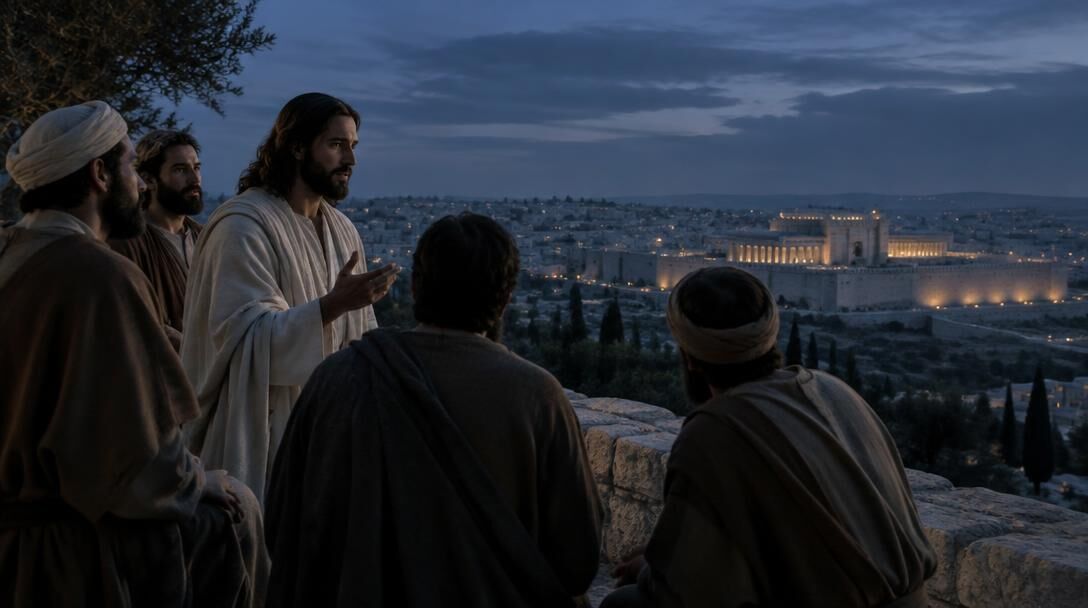

“Tell us, when will these things be, and what will be the sign of your coming and of the end of the age?”
The disciples to Jesus, Matthew 24:3
What Were the Disciples Asking?
After Jesus foretold the temple’s destruction, the disciples asked a question that joined its fate to his coming and the end of the age. Each part matters as we read his reply.
1
When Will the Temple Fall?
Jesus had just said that the temple’s stones would be thrown down. The disciples first wanted to know when that startling judgment would take place.
2
What Will Signal Your Coming?
Their question then turned to the sign of Jesus’ coming. His answer calls readers to distinguish his promised return from misleading claims and false messiahs.
3
What Marks the End of the Age?
Finally, they asked about the end of the age. Jesus speaks of turmoil and perseverance while warning that not every troubling event means the end has arrived.
Jesus’ Answer Calls for Discernment and Hope
At Bible Prophecy Ministries, our work centers on reading Biblical prophecy in its Scriptural context and showing how it revolves around Jesus. That mission shapes how we approach Matthew 24: we begin with the disciples’ question, the temple prediction that prompted it, and the words Jesus chose in response. This passage connects events near to the disciples with the expectation of his coming, so its details deserve careful attention rather than hurried conclusions.
Jesus warns His followers not to be deceived by false messiahs or alarmed by reports of wars and upheaval. He speaks of suffering, endurance, and the proclamation of the Gospel, then directs attention to the unmistakable significance of His coming. Bible Prophecy Ministries explores what Scripture says has happened and what remains ahead, inviting readers to test claims against the text, remain watchful without setting dates, and find hope in Christ’s promise to return.
Matthew 24: Questions About the End
Explore what the disciples asked Jesus on the Mount of Olives and how His answer points to the destruction of the temple, the end of the age, and His return.
What did the disciples ask Jesus in Matthew 24:3?
They asked when the temple’s destruction would happen, what sign would mark His coming, and what sign would mark the end of the age.
Why did the disciples ask about the temple?
Jesus had just said that its buildings would be torn down. Their question followed His striking prediction about a place central to Jewish worship.
What does “the end of the age” mean?
The phrase refers to the close of the present age, not necessarily the destruction of the physical world. The disciples wanted to know how that ending related to Jesus’ coming.
Is the temple’s destruction the same event as Jesus’ return?
Matthew records the questions together, but interpreters differ on how much of Jesus’ answer concerns the temple’s destruction and how much concerns His future return. Reading each passage in context helps clarify the distinction.
What does “coming” mean in the disciples’ question?
The disciples asked about Jesus’ coming, often called His return or second coming. Jesus later describes the Son of Man coming in power and glory.
Did Jesus give a date for His return?
No. Jesus told His followers to remain watchful and said that no one knows the day or hour of His coming except the Father.
Why does Jesus warn about false messiahs?
He says that some will claim to be the Christ and mislead many. His warning calls readers to test such claims rather than follow alarming reports.
Are wars and disasters proof that the end has arrived?
Jesus mentions wars, famines, and earthquakes, but says these are not the end itself. He urges His followers not to be alarmed by them.
How should Matthew 24 shape the way we live?
Jesus calls His followers to stay alert, endure faithfully, and avoid deception. The passage directs attention to Him rather than to attempts to calculate a date.
Keep Exploring the Words of Jesus
Continue studying Matthew 24 alongside related Scripture passages to see how Jesus’ teachings illuminate prophecy and point to His return.