
The Testimony of Jesus: Where to Begin Studying Prophecy
How do the Bible's prophetic passages connect to Jesus, and why does His reign matter today? We can begin with Isaiah's suffering servant and Daniel's Son of Man, then see how the Gospels connect these Scriptures to Jesus and Revelation presents Him as the returning King.
These passages belong to Scripture's larger witness, not a collection of isolated predictions. As we read, we should pay attention to each passage's context, then compare its words with how the New Testament presents Jesus. That's a clear place to start, and it helps us see how Scripture points to Jesus.
What Does “The Testimony of Jesus” Mean in Scripture?
In plain language, the testimony of Jesus is Scripture's witness to Jesus. In Revelation 19:10, the angel tells John that "the testimony of Jesus is the spirit of prophecy." Christians understand this as prophecy bearing witness to Jesus, while the phrase can also point to the testimony Jesus gives. Either way, He remains at the center.

A connected witness, read with care
When Christians say the Bible bears witness to Jesus, we're describing a connected reading of Scripture. The New Testament presents Jesus in light of Israel's Scriptures, and Jesus Himself teaches His disciples to read those Scriptures in relation to His suffering and glory (Luke 24:25–27).
That doesn't mean every prophetic passage names Jesus directly, or that every connection works the same way. We should distinguish direct quotations, likely echoes, and conclusions drawn by reading passages together. A quotation is explicit. An echo uses familiar words or images without naming its source. A theological conclusion may connect several passages, even when no single verse spells out the whole idea.
That distinction helps us avoid forcing a connection onto a text. First, we ask what the passage says in its own setting. Then we consider how the New Testament applies it to Jesus.
What Revelation 19:10 means
John sees an angel and falls before him, but the angel refuses worship and points him back to God. Then comes the phrase "the testimony of Jesus," followed by the statement that it is "the spirit of prophecy." Revelation's wording connects prophetic witness with Jesus, but Christians explain that connection in two related ways: prophecy testifies about Jesus, and Jesus gives the testimony that prophecy carries.
We read this as a Spirit-filled Pentecostal Christian understanding of the passage. The Holy Spirit empowers believers to bear witness to Jesus, and prophecy belongs to God's message. Christians across traditions share the conviction that Jesus is central to Biblical prophecy, though they may differ on how particular prophetic texts apply to Him. Our reading shouldn't claim that every interpretive detail is settled.
For a closer look at these two readings, see what Revelation means by the testimony of Jesus.
Prophecy points to Jesus in different ways
Consider Isaiah's servant passage, which Christians connect with Jesus' suffering and death (Isaiah 52:13–53:12). Then read Daniel's vision of "one like the Son of Man," who receives an everlasting Kingdom (Daniel 7:13–14). Revelation 19 depicts the returning King as "Faithful and True" (Revelation 19:11–16).
These passages don't all make the same kind of claim. Some connections are stated directly in the New Testament; others emerge as we compare images, themes, and the wider witness of Scripture. That careful reading gives us a sound place to begin studying prophecy about Jesus.
How Isaiah 53 Shows the Suffering Servant’s Path to Vindication
Isaiah's servant passage gives us a clear place to begin studying prophecy about Jesus. Read Isaiah 52:13–53:12 as one complete unit, not as a chapter that starts at Isaiah 53. Its opening lines introduce the servant's future exaltation, while the rest of the poem describes rejection, suffering, and vindication.

Read the Servant Passage in Its Wider Setting
Isaiah 40–55 speaks to a people facing humiliation and exile, yet it also announces comfort, restoration, and God's saving work. The chapters around the servant passage matter, too. Isaiah 52:1–12 pictures Zion's restoration, and Isaiah 54 continues with promises of renewal after the servant's suffering. These themes help us see why the poem moves toward hope instead of ending at the servant's death.
Pay attention to who speaks and how the servant is described. The speakers shift, and the poem presents a servant who suffers on behalf of others, bears their wrongdoing, and is ultimately honored. We shouldn't flatten those images into a verse-by-verse prediction list. The movement matters: rejection and suffering do not have the final word.
Christians read this servant as Jesus, whose suffering and death bring salvation and whose resurrection is His vindication. Jewish interpreters have understood the servant in different ways, including as Israel, and Jewish interpretation is not uniform. We can state the Christian reading clearly while recognizing that the passage has a wider interpretive history. For a scholarly discussion of that history, see J. E. Rembaum's study of Jewish interpretations of Isaiah 53.
Notice How the New Testament Applies Isaiah’s Words to Jesus
Acts gives us a direct example. In Acts 8:32–35, Philip meets an Ethiopian official reading Isaiah's words about a servant led like a lamb to slaughter. When the official asks whom Isaiah describes, Philip begins with that Scripture and proclaims Jesus. The passage itself supplies the starting point, and Philip explains its connection to Him.
Other New Testament passages make related connections, but they do so in distinct ways. Matthew 8:17 directly applies Isaiah's language about bearing infirmities to Jesus' healing ministry. In Luke 22:37, Jesus directly cites Isaiah's words about being counted among transgressors and applies them to what is about to happen to Him. First Peter 2:22–25 draws on the servant's suffering and language about bearing sins to describe Jesus.
These connections aren't all identical. Some are direct quotations; others apply or echo Isaiah's images. Keeping that distinction in view helps us read carefully and see why Christians recognize Jesus in the servant's path from suffering to vindication. We can explore Isaiah's prophecy of the suffering servant with both the passage's context and the New Testament's testimony in view.
What Daniel 7 Reveals About the Son of Man and His Kingdom
Daniel 7 gives us a vision of violent kingdoms, a heavenly court, and a ruler whose dominion will never end. The chapter's own interpretation matters as much as its symbols. Let's follow the vision before connecting it with Jesus.
Follow the Vision from the Beasts to Everlasting Dominion
Daniel sees four beasts rise from the sea, each more terrifying than the last. They picture kingdoms marked by violence and power. Then the scene shifts: the Ancient of Days takes His seat, the court convenes, and judgment turns against the beastly powers (Daniel 7:9–12).
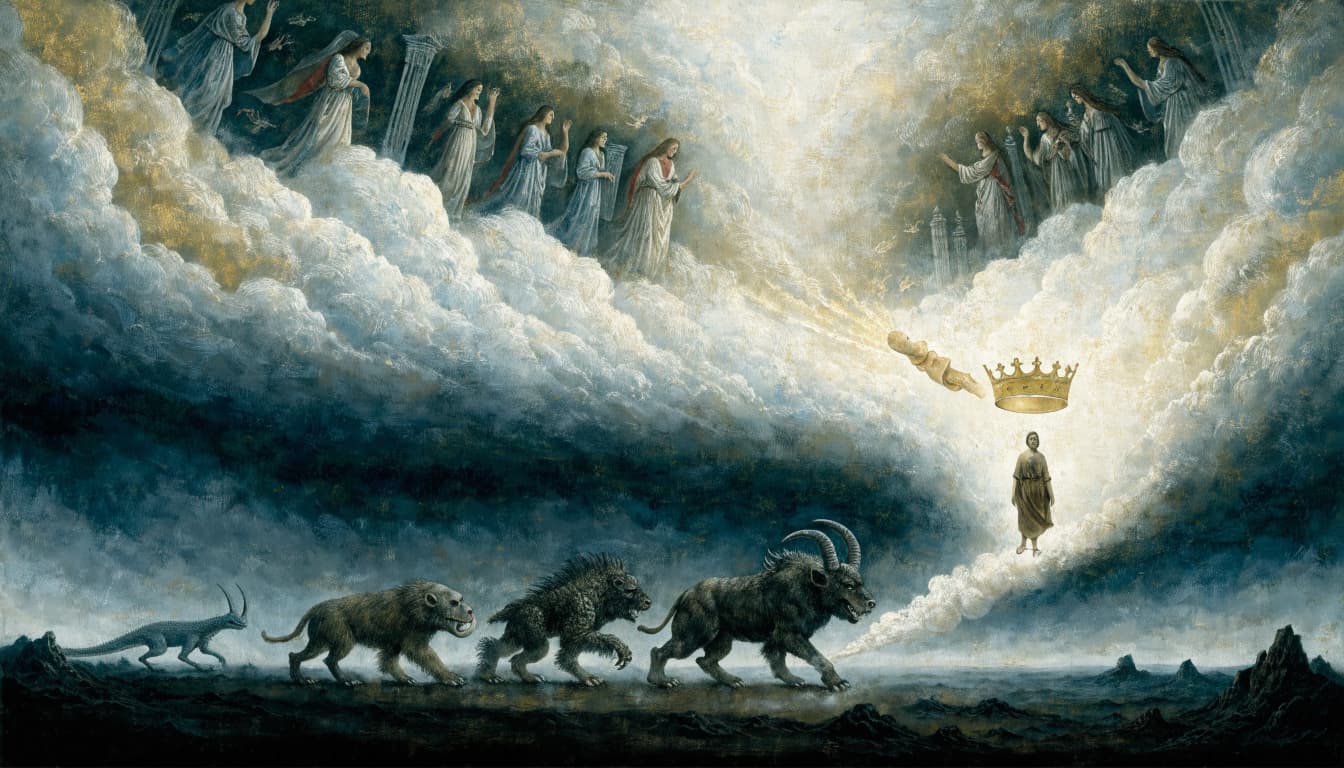
Then Daniel sees "one like the Son of Man" coming with the clouds of heaven. He approaches the Ancient of Days and receives dominion, glory, and a Kingdom that will not be destroyed (Daniel 7:13–14). The contrast is striking. The earthly rulers appear as beasts, while the ruler God appoints appears humanlike and receives authority from heaven.
Daniel's vision doesn't leave the meaning entirely open. Its interpretation says the holy ones of the Most High will receive the Kingdom and possess it forever (Daniel 7:18, 22, 27). So the Kingdom belongs to the humanlike figure, and the holy ones share in its promise. The text holds both ideas together.
That connection matters. The vision offers hope to God's people under the threat of violent earthly powers. Empires may dominate for a time, but they face judgment. God's Kingdom endures. For another look at this promise, see Daniel 7's Son of Man and everlasting Kingdom. Scholars also discuss how the holy ones relate to the humanlike figure in this study of Daniel 7's heavenly court.
Connect Daniel’s Son of Man to Jesus’ Words
In the Gospels, Jesus often calls Himself the Son of Man. The title takes meaning from its setting, so we shouldn't assume every use points to Daniel 7 in exactly the same way. Some sayings focus on Jesus' authority and earthly ministry; others speak of suffering, judgment, or future glory.
Mark 14 gives us a particularly clear connection. At His trial, Jesus speaks of the Son of Man seated at the right hand of Power and coming with the clouds of heaven (Mark 14:61–62). The cloud imagery recalls Daniel's vision, where the Son of Man receives dominion from God. Christians therefore understand Jesus' words as identifying Him with the promised ruler, even as His accusers hear a claim to divine authority.
Daniel 7 doesn't answer every end-times question, and we shouldn't force it to settle debates it doesn't address. Its central promise is clear: beastly powers do not rule forever. Jesus' words place Him within that hope, and the Kingdom He receives is shared with the holy ones of the Most High.
How the Gospels Present Jesus as the Fulfillment of Prophecy
The Gospels connect Jesus' mission with Scripture in more than one way. Sometimes they quote a passage directly. At other times, an event echoes Scripture, or a Gospel writer explains how an event fulfills it. These connections belong to the Gospels' witness to Jesus, but we should still distinguish what the text says from the broader theological conclusions we draw.
Recognize the Different Ways the Gospels Use Prophecy
A direct quotation names or repeats Scripture. In Matthew 8:17, Matthew connects Jesus' healing ministry with Isaiah's words about bearing infirmities. The quotation makes the connection plain.
An allusion is subtler. A Gospel may use words, images, or patterns that recall an earlier passage without quoting it directly. We can recognize the echo, but we should be careful not to treat every similarity as proof of a direct prediction.
Sometimes the Gospel writer presents an event as fulfilling Scripture. Matthew describes Jesus' return from Egypt and then quotes Hosea's words, "Out of Egypt I called My Son" (Matthew 2:13-15). Hosea's words first describe Israel's history. Matthew uses that Scripture to interpret Jesus' journey, presenting Him as the Son who embodies Israel's story.
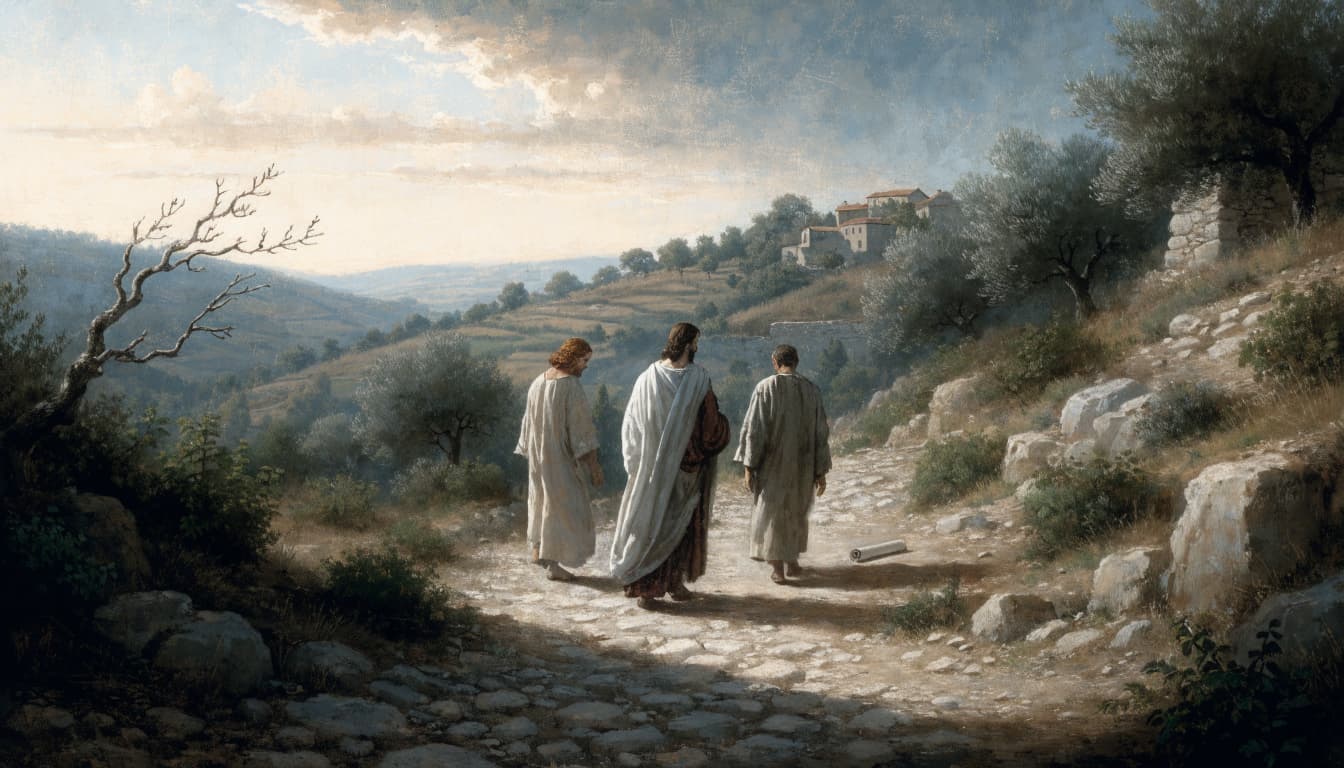
So, what should we look for? First, read the earlier passage in context. Then notice whether the Gospel quotes it, echoes it, or explicitly interprets an event through it. That keeps us from flattening every connection into the same kind of prophecy. Jesus also taught His disciples to read Scripture in light of His mission. On the road to Emmaus, He explained what Moses and the Prophets said about His suffering and glory (Luke 24:25-27). Later, He connected the Law, the Prophets, and the Psalms with His suffering, resurrection, and the proclamation of repentance (Luke 24:44-47). For another look at Luke 24 and the fulfillment of Scripture, we can follow how Jesus Himself directs His disciples to read.
See How Jesus’ Suffering and Resurrection Belong Together
Jesus' own predictions make the connection between Scripture and His mission even clearer. In Mark 8:31, He tells His disciples that the Son of Man must suffer, be rejected, be killed, and rise again. Later, He describes what will happen in Jerusalem: He will be handed over, mocked, killed, and raised on the third day (Mark 10:33-34).
Then Jesus explains the purpose of His service: He came "to give His life a ransom for many" (Mark 10:45). The cross is central to His mission, but it isn't the end of it. In the Gospel witness, suffering leads to resurrection, and resurrection opens the way to glory and future judgment. Christians read these passages as part of Jesus' fulfillment of God's prophetic promises, while keeping the Gospel writers' words distinct from the wider conclusions we draw across Scripture.
Why Revelation 19 Shows That Jesus’ Reign Still Matters
Revelation 19 brings the vision of Jesus as the returning King into sharp focus. After the judgment of Babylon in Revelation 17–18, heaven opens, and John sees Jesus ride out as the One who judges evil and rules with authority. This scene gives us hope, but it also calls us to read Revelation carefully.

Read Revelation’s Images Alongside Its Biblical Echoes
John describes the rider with titles that tell us who He is: "Faithful and True," "the Word of God," and "King of kings and Lord of lords" (Revelation 19:11–16). These names point to Jesus' authority and faithfulness. They also frame the vision's images of judgment and victory.
Revelation uses symbolic apocalyptic language, drawing on images Scripture has already used. The iron rod recalls the royal rule in Psalm 2, while the image of striking the earth with the word of judgment echoes Isaiah 11:4. Those connections help us read the scene as a declaration of God's appointed King's authority. We don't need to turn every image into a literal forecast to take its message seriously.
The point is clear: Jesus judges rightly. His title "Faithful and True" tells us His judgment isn't corrupt or arbitrary. For a closer look at Jesus, the Faithful and True King, we can keep the titles in view alongside the symbols. Together, they show a King whose authority rests in truth and whose rule confronts evil.
Understand the Hope and Purpose of His Kingdom
The rider's victory matters because evil does not get the final word. Revelation 19 presents Jesus as the victorious returning King, defeating the powers that oppose God and bringing righteous judgment. His reign offers hope to people who have suffered under injustice, because the One who rules sees truly and judges faithfully.
The scene also points beyond itself. Revelation goes on to describe the defeat of the beast and later events in chapters 20–22. Christian traditions differ on the sequence and meaning of those end-times events, including how to understand the millennium. Revelation 19 gives us a clear picture of Jesus' victory, but it doesn't settle every timetable on its own.
So we can hold firmly to what the passage says without claiming more than it does. Jesus returns as King. His rule is just, His victory over evil is certain, and His Kingdom endures. That hope still matters, especially when injustice makes it seem as though evil has the upper hand.
Where to Begin Studying Prophecy About Jesus
We can begin with four connected readings: Isaiah's servant, Daniel's Son of Man, the Gospel accounts, and Revelation's returning King. Read each passage in its setting, then follow the connections Scripture makes to Jesus. A context-first approach to studying prophecy helps us avoid turning a few familiar verses into claims the full passage doesn't make.

Use Three Questions to Read Each Passage Carefully
As we study, we can ask three questions each time:
- What does the passage say in context? Notice who is speaking, who first heard the message, and what comes before and after the verses. Read Isaiah 52:13–53:12 as a complete unit, then look at Isaiah 52–54 to see how the servant's suffering sits within themes of humiliation, restoration, and hope.
- How does the New Testament connect this passage to Jesus? Look for a direct quotation, an echo, or a Gospel explanation. In Acts 8:32–35, for example, Philip begins with Isaiah's servant passage and proclaims Jesus. That is an explicit connection in the New Testament.
- What does the passage reveal about His suffering, victory, or Kingdom? Daniel 7 contrasts violent kingdoms with the everlasting dominion given to one like a Son of Man. Jesus' words in Mark 14:61–62 connect that imagery with His identity and coming glory.
These questions keep us attentive to what the text states. A direct quotation is clear evidence; a broader conclusion may come from reading several passages together. We should name that difference instead of presenting every connection as an explicit prediction. When wording matters, compare translations and check cross-references. Prayer and openness to the Holy Spirit can accompany this careful reading, but neither replaces attention to context.
Build a Short Reading Plan Without Skipping Context
We don't need to cover every prophetic passage at once. Set aside several days and follow a simple path:
- Read Isaiah 52–54, giving special attention to Isaiah 52:13–53:12.
- Read Daniel 7 in full, including the vision's interpretation later in the chapter.
- Compare the relevant Gospel scenes, such as Acts 8:32–35 and Luke 24:25–27.
- Read Revelation 17–22, then focus on Revelation 19:11–16.
Keep a few notes as you go. Record repeated themes, questions you can't answer yet, and the places where the New Testament directly connects a passage with Jesus. Reading whole sections gives those connections room to make sense. And when a question remains, we can carry it into the next reading rather than forcing an answer from a single verse.
Conclusion
Isaiah presents the servant's suffering and vindication. Daniel shows the Son of Man receiving an everlasting Kingdom, the Gospels connect Jesus with Scripture's witness, and Revelation portrays Him as the victorious King. Read these passages in context, with care and prayer, and keep Jesus at the center of Biblical prophecy.
His reign matters because the prophetic witness points to His authority and promised victory. When injustice and evil seem to hold power, we can look to Jesus, the King whose Kingdom will endure.
Start With the One Scripture Reveals
The Testimony of Jesus: Where to Begin Studying Prophecy

What Is the Testimony of Jesus?
Revelation 19:10 declares that “the testimony of Jesus is the spirit of prophecy.” This phrase directs us beyond predictions alone to the witness Scripture bears about Christ.
From the promises spoken through Israel’s prophets to the visions in Revelation, Biblical prophecy reveals His identity, His saving work, and His promised return. To study prophecy faithfully, begin by asking what each passage teaches about Jesus and how it fits within God’s unfolding plan of redemption.

Begin With Jesus, the Heart of Prophecy
Bible Prophecy Ministries approaches prophecy as the unfolding testimony of Jesus throughout Scripture. From God’s promises in the Old Testament to their fulfillment in Christ and the hope of His return, the ministry’s mission is to help readers see how what has happened and what is still to come point to Him.
Begin with the promises made to Abraham and David, read the prophets alongside the Gospels, and follow the apostles’ explanations of Jesus’ life, death, and resurrection. As you study, ask what each passage reveals about God’s faithfulness, His purposes, and the Messiah at the center of the story.

“For the testimony of Jesus is the spirit of prophecy.” — Revelation 19:10
This verse keeps the focus of prophetic study on Jesus: prophecy bears witness to who He is and what God accomplishes through Him.
1
Start With the Gospel Accounts
2
Trace the Promises to Christ
3
Compare Scripture With Scripture
Frequently Asked Questions About Studying Prophecy
Begin with Jesus, read each passage in context, and let Scripture guide your understanding.
Where should I begin studying Bible prophecy?
Start with the Gospels and the prophecies they connect to Jesus. Then read passages such as Isaiah 53, Daniel 7, Matthew 24, and Revelation 1, noting how each points to His identity and kingdom.
What does “the testimony of Jesus is the spirit of prophecy” mean?
Revelation 19:10 directs attention to Jesus as central to prophecy. As you study a prophetic passage, ask what it reveals about His person, work, or coming reign.
Do I need to understand every symbol in Revelation first?
No. Begin with what the text states clearly, then compare its imagery with earlier Scripture, especially Daniel and the prophets. You can keep studying without settling every difficult detail at once.
How can I read a prophecy in its proper context?
Read the surrounding chapter, identify the speaker and audience, and consider the passage’s original setting. Pay attention to whether its language is poetic, symbolic, or part of a vision.
Should I use current events to interpret prophecy?
Let Scripture set the meaning before considering possible connections to current events. Be cautious about identifying people or predicting dates when the biblical text does not do so.
How can I check whether an interpretation is sound?
Compare it with the passage as a whole and with other relevant Scriptures. Be wary of claims that depend on isolated verses, overlook context, or draw attention away from Jesus.
Keep Exploring Prophecy Through Jesus
Read the prophetic passages for yourself, beginning with Revelation 19:10 and the Scriptures that testify about Jesus. Explore more studies to see how the Bible’s promises center on Him.