
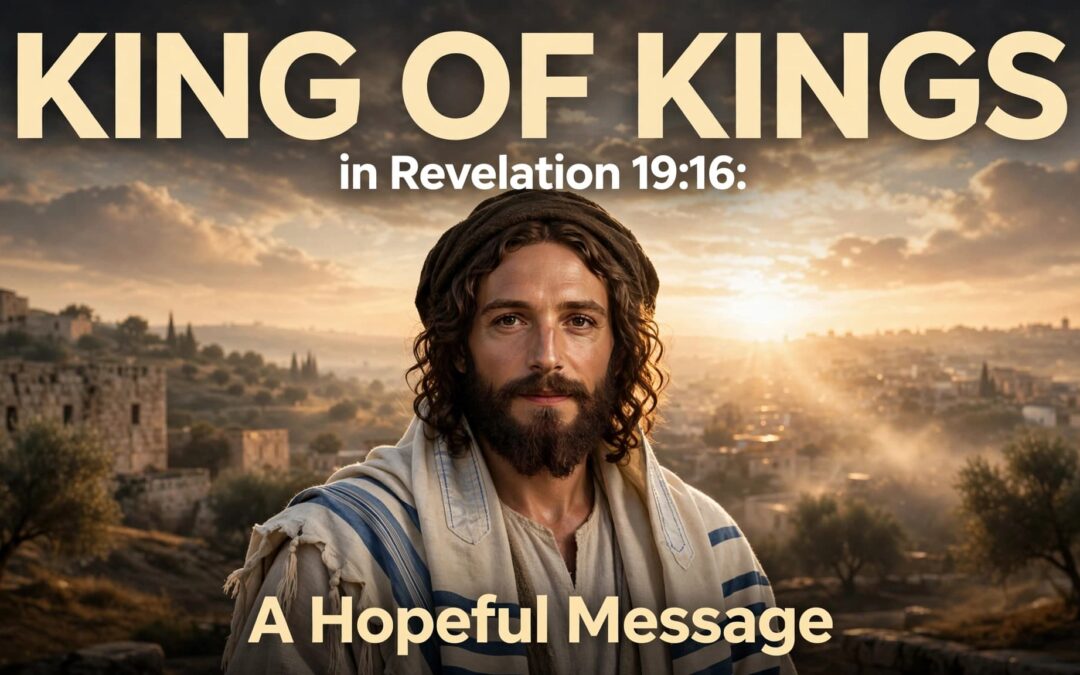
Jesus, King of Kings: What Revelation 19:16 Means
What does Scripture mean when it calls Jesus "King of kings"? Revelation 19:16 gives the answer: His authority surpasses every earthly ruler, and His victorious reign cannot be overturned.
That title matters when the world feels shaped by rulers and powers that seem impossible to challenge. We see the prophetic witness to Jesus across Scripture, pointing to the promised King and helping us understand why His reign gives believers hope.
Let's look first at what Revelation means by "the testimony of Jesus" and how prophecy points us to Him. For a closer look, explore the meaning of the testimony of Jesus.
What Does “The Testimony of Jesus” Mean in Scripture?
Revelation 19:10 brings together two important ideas: the testimony of Jesus and the purpose of prophecy. John falls before an angel, but the angel stops him and says to worship God. Then comes this key line: "the testimony of Jesus is the spirit of prophecy."
Christians understand "the testimony of Jesus" in two related ways. It can mean the witness about Jesus, or the testimony given by Jesus. Both readings keep Him at the heart of prophecy. The first points to the message believers proclaim about Christ; the second points to Jesus as the source of the message He reveals. Either way, the angel is clear about one thing: worship belongs to God, not to angels.
Why prophecy keeps pointing readers to Jesus
Biblical prophecy does more than predict future events. It reveals God's purposes and directs our attention to the Messiah, His character, and His reign. Some prophecies address a particular crisis or audience in their original setting. We should not assume every passage names Jesus explicitly there. Yet, as we read Scripture as a whole, we see a growing witness to God's promised King.
That witness matters in Revelation. The book shows Jesus as the Lamb who conquers, the faithful King whose authority no earthly ruler can overturn. Prophecy points to who He is and what God is doing through Him. For a closer look at the phrase in Revelation 19:10, see what the testimony of Jesus means.
How the New Testament connects Jesus with prophecy
The Gospels connect Jesus' entry into Jerusalem with the prophetic picture of Israel's King arriving humbly on a donkey. That connection helps explain why the crowd's welcome matters: Jesus is presenting Himself as the promised King, even as events move toward His rejection and crucifixion.
The New Testament also reads royal passages such as Psalm 2 and Psalm 110 in light of Jesus. Psalm 2 speaks of God's anointed King amid opposition from the nations. Psalm 110 pictures the King seated at God's right hand, with His enemies placed beneath Him. The New Testament uses these passages to explain Jesus' authority, victory, and exaltation. You can read Psalm 110's announcement of the Messiah's reign.
Taken together, these connections form a cumulative witness. They don't require us to flatten every passage into a direct prediction. They show how Jesus fulfills God's promises and why Revelation presents Him as King of kings.
Which Old Testament prophecies point to Jesus’ reign?
The Old Testament describes God's King in several forms: a covenant promise, royal psalms, prophetic oracles, and visions. Some New Testament writers quote these passages directly, while other connections come from reading their themes together. That distinction helps us see how Christians understand Jesus' kingship without ignoring each passage's original setting.
God’s promise to David and the everlasting throne
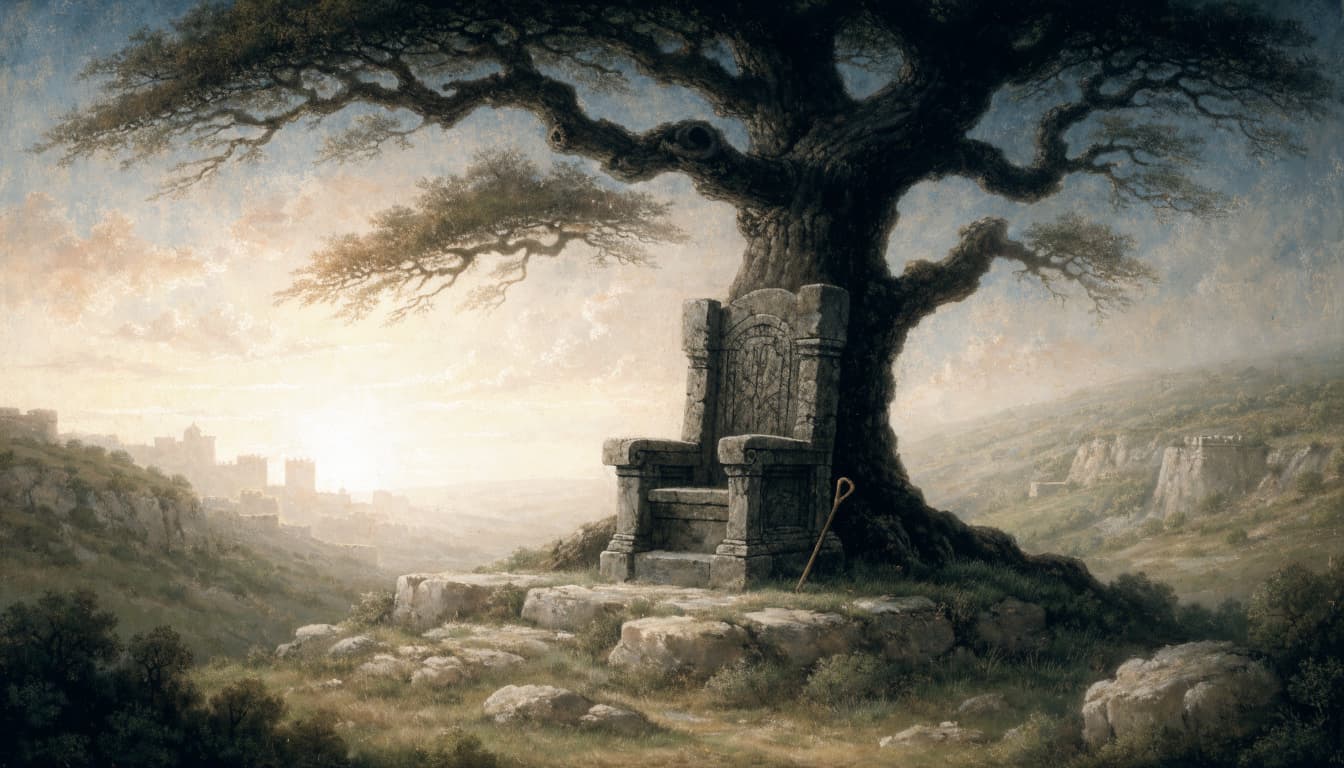
In 2 Samuel 7:12-16, God speaks to David through the prophet Nathan. David wants to build a house for God, but God promises to establish a house, or royal dynasty, for David. His descendant will build a house for God's name, and God will establish his kingdom and throne forever. The promise first concerns David's royal line and his son Solomon. Yet the promise of an enduring throne reaches beyond any one king.
Centuries later, Israel's monarchy fell. The promise still stood. In Luke 1:32-33, the angel Gabriel tells Mary that Jesus will receive the throne of His father David and reign over Jacob's house forever. This is an explicit New Testament connection: Luke applies David's promised throne to Jesus. We can read more about Jesus as the promised King on David's throne.
Royal psalms and the promised ruler
Psalm 2 is an enthronement psalm, a royal poem about God's anointed king. It pictures rulers and nations resisting the LORD and His anointed, while God declares the king's authority over the nations. Acts 4:25-28 explicitly applies the psalm's opposition to Jesus, including the actions of Herod, Pontius Pilate, Gentiles, and Israel's leaders. The psalm's royal language helps explain why Revelation portrays Jesus as King over every earthly power.
Psalm 110 offers a different portrait. In this royal psalm, the king sits at God's right hand until his enemies are subdued. He is also called a priest forever in the order of Melchizedek. Jesus cites the psalm in Mark 12:35-37, and Hebrews 5-7 develops its connection to His priesthood. For a closer look at the psalm's royal and priestly images, see a commentary on Psalm 110.
The prophets’ picture of a just and universal King
Isaiah 9:1-7 is a prophetic oracle spoken into Judah's fear and political crisis. It looks ahead to a child who will reign on David's throne, with justice and peace that have no end. Christians connect this hope with Jesus, especially through Luke 1:32-33. Isaiah 11:1-10 adds another image: a shoot from Jesse's stump, ruling with righteousness and bringing peace. Romans 15:12 quotes Isaiah 11:10 as a promise of hope for the Gentiles.
Micah 5:2-5 names Bethlehem as the place from which a ruler for Israel will come. Matthew 2:5-6 explicitly cites this passage when the priests and scribes explain where the Messiah is to be born. Daniel 7:13-14 gives a wider vision: one like a son of man receives an everlasting dominion over all peoples. Jesus uses the title "Son of Man" for Himself, and in Mark 14:62 He speaks of coming with the clouds and sitting at God's right hand.
These passages don't all function as direct predictions in the same way. Some are explicitly applied to Jesus in the New Testament; others contribute a broader Christian picture of His righteous, peaceful, and universal reign.
Why Is Jesus Called the King of Kings?
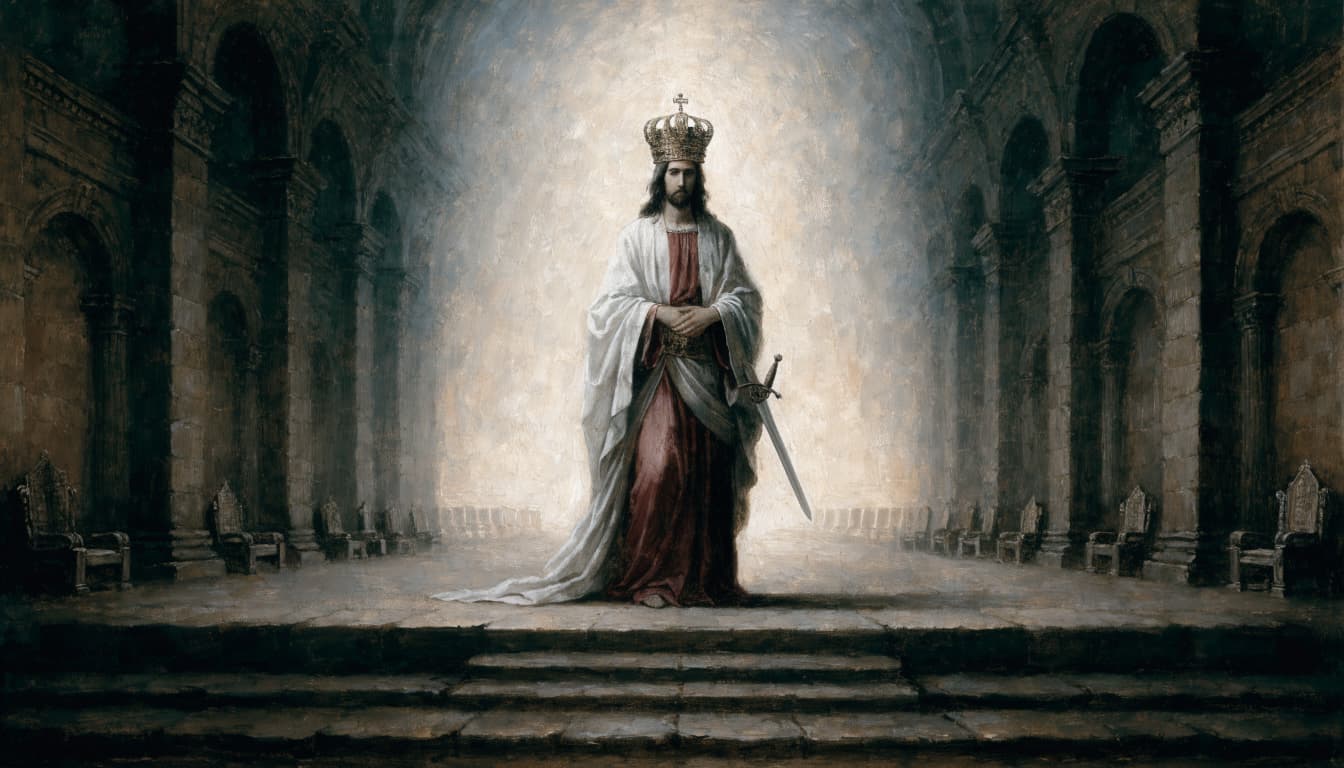
Revelation calls Jesus "King of kings and Lord of lords" because His authority rises above every earthly throne. The title doesn't place Him among a group of powerful rulers. It declares that no ruler can claim the highest place, and no earthly kingdom can overturn His reign.
In the ancient world, kings could use "king of kings" as a royal superlative. The phrase communicated great power over other rulers. Revelation takes that familiar language and applies it to Jesus, making a claim about His supreme authority. We see the title written on the victorious Rider in Revelation 19:16, at the climax of a vision where He defeats the forces gathered against Him. The full chapter of Revelation 19 gives the wider picture of His victory.
What the title says about Jesus’ authority
Jesus isn't simply the strongest ruler in a contest among kings. Revelation places Him above every human authority. Political leaders may command armies, shape laws, and appear to hold the future in their hands. Yet none can take His place or claim the final word over God's purposes.
The title also points to more than a temporary victory. Human kingdoms rise and fall, but Jesus' reign cannot be defeated or overturned. That doesn't mean every event in history already looks peaceful or just. Revelation shows opposition to God as real, while declaring that opposition won't have the last word. The Rider is called "Faithful and True" before He appears as the conquering King. His authority belongs to Him, and His judgment is righteous.
So when we call Jesus King of kings, we're confessing that no earthly power outranks Him. That conviction matters when a ruler or government seems impossible to challenge. Our hope rests in Christ, not in the permanence of any human kingdom. We can also read more about Jesus' sovereign rule over earthly powers.
How Revelation 17:14 strengthens the picture
Revelation makes this point earlier, too. In Revelation 17:14, the kings unite against the Lamb, but the Lamb conquers them. John identifies Him as "Lord of lords and King of kings," then describes His followers as called, chosen, and faithful. The scene makes the title more than a declaration of rank. It shows His authority holding firm when rulers actively oppose Him.
That picture connects with Revelation 19, where the victorious Rider defeats the gathered forces of evil. The Lamb who conquers in chapter 17 is the King whose victory is displayed in chapter 19. His followers don't win by claiming earthly power for themselves. They belong to Him and remain faithful to Him.
Paul also uses the title in 1 Timothy 6:15. In that verse's immediate grammar, the phrase is commonly understood to refer to God the Father, who will display Christ's appearing at the appointed time. Revelation applies the same royal title to Jesus. We should notice that distinction while holding together the Biblical witness: God reigns, and Revelation presents Jesus as the Lamb who shares supreme authority over every opposing power.
What Does Revelation 19:16 Reveal About Jesus’ Victory?
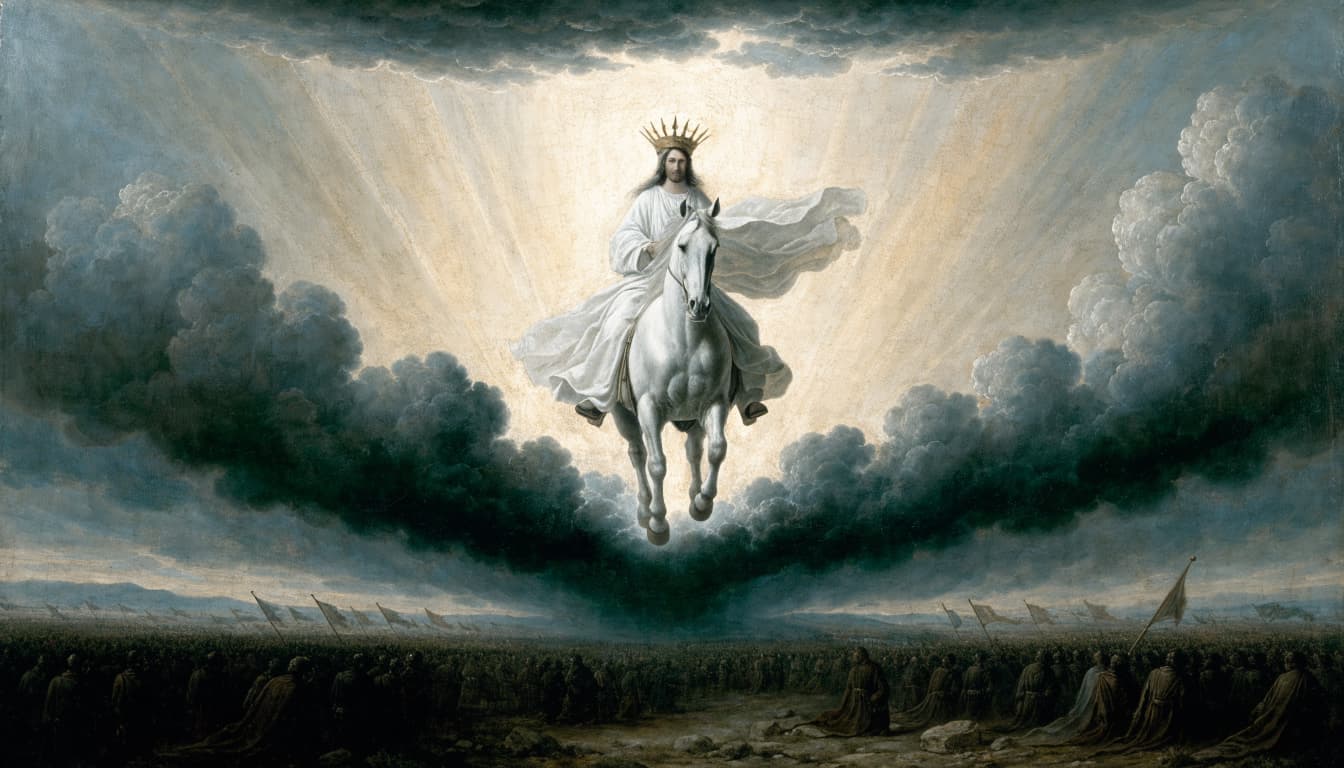
To understand the title "King of kings and Lord of lords," we need to see where John places it. In the wider vision of Revelation 19, heaven rejoices, the Rider appears, and the forces opposing God face judgment. The title on His robe and thigh tells us who has the final authority: Jesus, whose victory fulfills God's purpose and cannot be overturned.
Why Jesus’ reign cannot be overturned
John sees heaven opened and a white horse with a Rider called "Faithful and True." He judges and makes war in righteousness. His eyes are like a flame of fire, and many crowns are on His head. These are apocalyptic images, vivid signs of His authority and judgment, not a timetable for identifying present-day leaders or predicting specific political events.
The contrast is clear. The powers that oppose God may gather and appear formidable, but their strength is temporary. The Rider's authority does not depend on their approval or on the rise and fall of earthly rulers. Revelation presents His victory as certain because He is faithful to God's purpose and rules with justice.
The Rider also bears the name "the Word of God." John is not showing us an anonymous conqueror or a human ruler claiming divine power. The names identify Jesus and tell us what His victory means: He is true, His judgment is righteous, and no opposing force can make God's promise fail. For more on how prophecy points to Jesus, see Christ's victory in Revelation 19.
We don't need to attach the vision to a current political figure to take its message seriously. Revelation directs our attention to Jesus' authority and the certainty of His victory. Rulers change; the Rider's reign does not.
What the image of the Lamb and King teaches
Revelation holds two images together: Jesus is the Lamb, and He is the conquering King. The Lamb is central to the book's vision of redemption and worship. The King rides forth to judge evil and defeat the forces gathered against God. These images belong together. The One who conquers is the same Jesus who gave Himself for His people.
That matters because the scene is not a model for earthly rulers to copy, or a call for Christians to seize political power. The Rider's victory belongs to God's plan. His authority is unlike the ambition and violence of human kingdoms, and His judgment is His to carry out. We follow Him in faithfulness, not by claiming His role for ourselves.
John's vision gives hope without asking us to guess dates or name today's enemies. Jesus is "Faithful and True," the "Word of God," and "King of kings and Lord of lords." Those names point to His identity and rightful rule. Whatever power opposes God, it cannot outlast the King whose victory Revelation declares.
Why Does Jesus’ Kingship Matter for Faith Today?
Revelation's vision of Jesus as King of kings reaches beyond a future scene of victory. His reign shapes how we face fear, respond to injustice, and live as His people now. We trust that earthly powers do not have the final word, and we follow Jesus without trying to seize His authority for ourselves.
The King offers hope when earthly powers fail
When leaders act unjustly or the future feels uncertain, it can seem as if the strongest voices control everything. Revelation gives us another view. Jesus is "Faithful and True," and His reign cannot be overturned by rulers who oppose God. That confidence doesn't mean believers will avoid suffering. Jesus' followers may face hardship, but hardship cannot cancel His promises or make injustice the final word.
This hope steadies us without asking us to pretend that pain is small. We can grieve what is wrong, work for what is good, and pray for those who suffer, while trusting that Christ will judge with righteousness. His kingship also keeps our hope from depending on a particular leader or political outcome. Human governments change; Jesus remains King.
The King calls His people to faithful witness
If Jesus is King, our allegiance belongs to Him above every earthly loyalty. That allegiance should show up in ordinary choices: humility instead of self-importance, holiness instead of compromise, and love of neighbor even when disagreement runs deep. Jesus' Kingdom does not give us permission to coerce others or claim political power in His name.
Jesus told His disciples that the Holy Spirit would empower them to be His witnesses. We see that promise in Acts 1:8. From our Spirit-filled Pentecostal perspective, the Spirit's power equips us to testify to Jesus and serve faithfully. It isn't a badge of status or a license to control people. The risen King sends His people, and the Spirit gives courage to speak and strength to live out the message.

Faithful witness can look like speaking about Jesus, caring for a neighbor, refusing to return hatred for hatred, or standing with someone who faces injustice. We don't have to make ourselves powerful to prove that Christ reigns. Our calling is to live in a way that points to Him. For more on this calling, see how the risen King sends Spirit-empowered witnesses.
How can we read prophecies about Jesus with care?
When a passage points to Jesus, we should ask two questions: What did it mean in its first setting, and how does the New Testament connect it to Him? Holding both questions together helps us read prophecy with confidence without making every passage say the same thing.
Keep the original setting and the Christian reading in view
Take Micah 5. The prophet spoke to a people facing judgment and uncertainty, and he named Bethlehem as the place from which a ruler for Israel would come. In its first setting, the promise offered hope for God's people and pictured a ruler who would shepherd them in the LORD's strength. We can read more about Micah's historical setting.
Matthew later quotes Micah when Jerusalem's religious leaders answer Herod's question about where the Messiah would be born. The Gospel connects the ruler from Bethlehem with Jesus (Micah 5:2-5; Matthew 2:5-6). That Christian reading does not require us to pretend Micah's original audience heard Jesus' name in the oracle. Instead, we see how the New Testament reads Israel's hope in light of Jesus.
This approach helps us avoid two mistakes: ignoring the passage's first meaning, or treating its later connection to Jesus as if it erases that meaning. We can read prophecy in its original context and still recognize the New Testament's witness to Christ.
Let Scripture interpret Scripture
A practical method can keep our reading grounded. First, notice the original audience and setting. Who received the message, and what was happening around them? Next, look closely at the passage's own words and images. Is it a royal promise, a poem, a prophetic oracle, or an apocalyptic vision? These forms work differently. A royal promise speaks in the language of kingship; poetry may use vivid imagery; an apocalyptic vision communicates through symbolic scenes.
Then ask how the New Testament uses or echoes the passage. Does a Gospel quote it directly? Does an apostle connect its image or promise with Jesus? Those connections matter, but we should be clear about what the text says and what we are concluding from it. A direct quotation carries different weight from a broader thematic echo.
We can also read the surrounding verses instead of building an interpretation on one striking phrase. Revelation 19:10 says that "the testimony of Jesus is the spirit of prophecy," but its context also warns John not to worship the angel. That verse directs attention to Jesus without giving us permission to detach prophetic language from its passage.
When a claim depends on a phrase pulled out of context, a current headline, or a prediction that names a date, we should pause and check it against Scripture. Prophetic passages belong together as a Biblical witness to Jesus, but they do not all work in the same way. We honor that witness by reading carefully, comparing Scripture with Scripture, and refusing to force every image into one formula.
Conclusion
Scripture's prophetic witness points to Jesus as God's promised King. Revelation calls Him the King of kings because His authority surpasses every earthly ruler, and His victory is final. His reign gives us hope when human powers fail, while calling us to live faithfully and bear witness to Him.
We can trust Jesus, the King whose reign cannot be overturned, and let our lives point others to Him.
A Title Above Every Throne
The Meaning of Revelation 19:16
Revelation 19:16 names Jesus “King of kings and Lord of lords.” In John’s vision, the title appears as Christ rides forth in victory. It declares that no ruler or kingdom stands above Him: His authority is supreme, and His reign cannot be overturned.
Within Bible prophecy, this scene points to the fulfillment of God’s promise that the Messiah will reign. The title identifies Jesus as more than a future conqueror; He is the rightful King who brings evil to judgment and establishes the triumph of God’s purposes. For believers, His victory is a reason for steadfast hope, even when earthly powers seem secure.

Revelation 19:16 in Context
Jesus, King of Kings: The Reign Promised in Prophecy
Revelation 19 opens with heaven praising God for His righteous judgments and celebrating the marriage supper of the Lamb. Then the vision turns to a rider on a white horse, called Faithful and True and the Word of God. He comes to judge with justice, accompanied by the armies of heaven. On His robe and thigh is written the title that gathers the scene’s meaning into a single declaration: “King of kings and Lord of lords.”
This is more than a title of honor. It reveals Jesus as the sovereign ruler before whom every earthly power must answer. The scene carries forward the prophetic hope of a kingdom that will endure beyond all others, as pictured in Daniel 7:13–14. Revelation 19:16 calls readers to see the return of Christ not as an isolated event, but as the fulfillment of Scripture’s unfolding promise that the Messiah will reign.

“And he hath on his vesture and on his thigh a name written, KING OF KINGS, AND LORD OF LORDS.” — Revelation 19:16 (KJV)
Revelation 19:16 declares that Christ’s authority stands above every earthly throne.
Frequently Asked Questions About Revelation 19:16
What does “King of kings” mean in Revelation 19:16?
It means Jesus holds authority above every other ruler. In Revelation 19, the title identifies the returning Christ as the one whose reign surpasses all earthly kingdoms.
Who is the rider on the white horse in Revelation 19?
The rider is Jesus Christ. The passage calls Him Faithful and True and the Word of God, and verse 16 names Him King of kings and Lord of lords.
Why is the title written on His robe and thigh?
Revelation presents the inscription as a visible declaration of the rider’s identity and authority. The passage does not explain why those two locations are chosen, so its clearest point is the title itself.
Does “King of kings” appear elsewhere in the Bible?
Yes. Revelation 17:14 also calls the Lamb “Lord of lords, and King of kings.” In the wider biblical story, passages such as Daniel 7:13–14 describe the lasting dominion given to the one like a son of man.
How does Revelation 19:16 relate to Jesus’ return?
The title appears during John’s vision of Christ coming from heaven. It emphasizes that His return brings righteous judgment and openly reveals His supreme rule.
Is Jesus’ kingship only a future reality?
No. The New Testament presents Jesus as exalted now, while Revelation 19 portrays the decisive public display of His authority at His return.
What is the difference between “King of kings” and “Lord of lords”?
Both titles proclaim Christ’s supremacy. “King of kings” stresses His authority over rulers and kingdoms; “Lord of lords” underscores that no competing power outranks Him.
How does this verse connect with Old Testament prophecy?
It echoes the prophetic expectation of a Messiah whose kingdom endures. Daniel 7:13–14, for example, describes a figure given dominion that will not pass away, helping readers understand the scope of Christ’s reign in Revelation.
Why does the title matter for studying Bible prophecy?
It keeps the focus of prophecy on Jesus rather than on speculation about earthly powers. Whatever questions remain about the sequence of future events, Revelation 19:16 clearly identifies who holds ultimate authority.
Keep Discovering the King of Kings
Revelation 19:16 reveals Jesus as King of Kings. Keep exploring Bible prophecy to see how Scripture points to Him—from promises already fulfilled to the hope of His return.